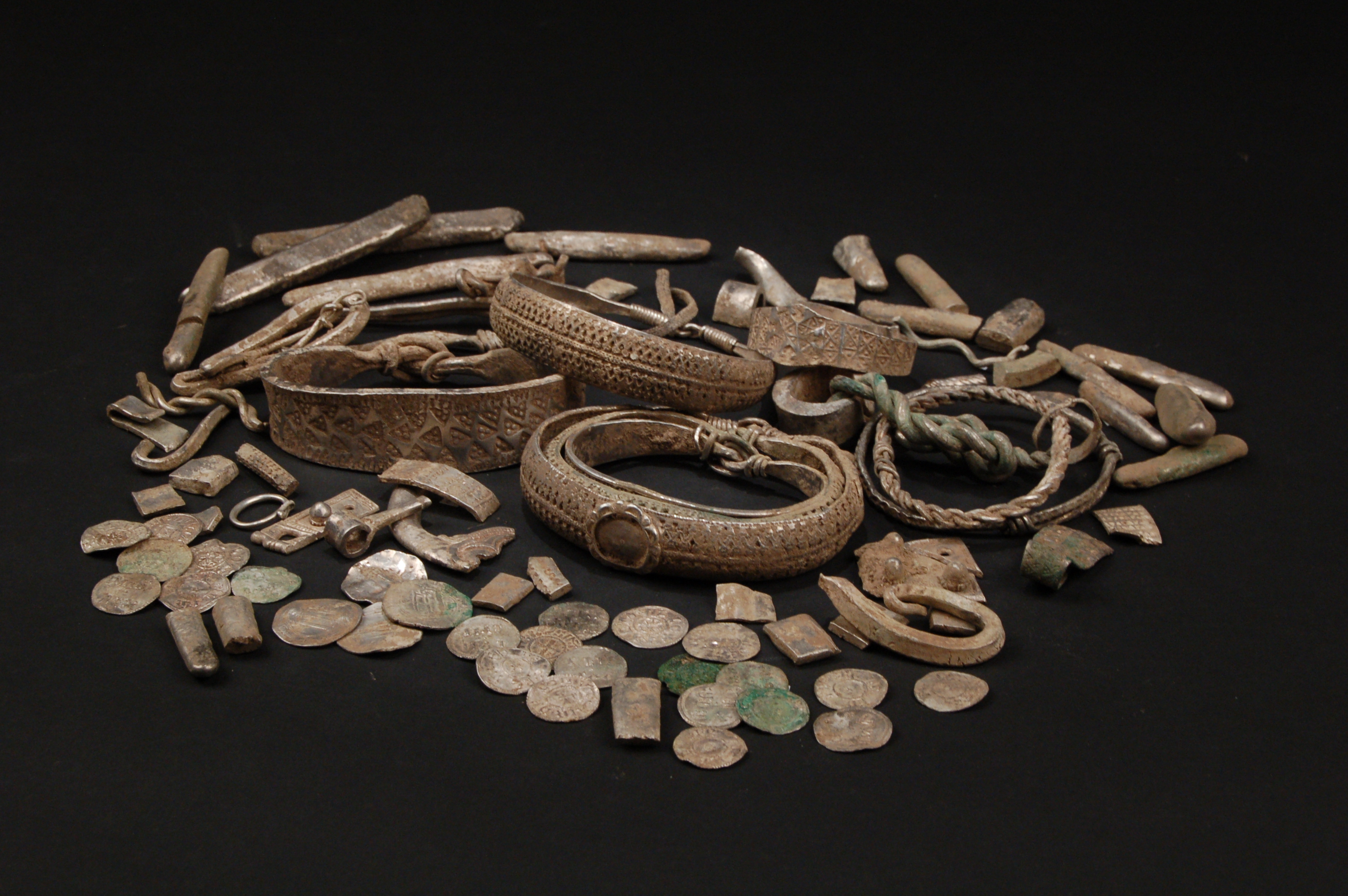
Sometime around the year 905 AD, an unknown Viking hid a collection of silver valuables. Having dug a small hole in the ground, firstly five arm rings were put in, and then placed on top of them was a lead pouch containing coins, hacksilver, rings and brooches. The hoard was covered over, but the owner never returned and it lay undiscovered for over a thousand years.
It’s worth putting the date of this burial into a national context. In 901 the Norse Vikings were thrown out of Dublin. They sailed straight across the Irish sea to settle in the areas of the Wirral, Chester and Lancashire. Two years earlier the Saxon king Alfred the Great had died. He was succeeded by his son, Edward the Elder who continued to rule the Saxon territories in the south of England. Edward’s sister, Aethelflaed was queen of Saxon Mercia, which extended up as far as the river Mersey. Lancashire was part of the Danelaw with the Danish Vikings at York being the dominant force in the area. For the next twenty years a series of battles would be fought between the Vikings and the Saxon armies of Edward and Aethelflaed, and many of the men of Lancashire would be caught up in them. For more on this read the Penwortham Castle blog post. This includes details on the Saxon ‘burhs’ created to defend against the Vikings, built by Edward and Aethelflaed.
Intriguingly, a similar but much larger hoard was buried at Cuerdale near Preston, on the banks of the river Ribble, at around the same time. Some of the artifacts of the Cuerdale Hoard are very similar to the Silverdale one. Why were both of these valuable hoards never reclaimed? Where the owners of these hoards killed in battle against the Saxons, leaving the silver undiscovered for a millennium ?
In 2011 Darren Webster was out in field near Silverdale with his metal detector. On discovering the hoard he contacted the Portable Antiquities Scheme at the Museum of Lancashire. The hoard was classed as ‘treasure’ and the landowner and finder shared equally in the money paid for it. The Museum of Lancashire raised the required amount, and it became the permanent home of the Silverdale Hoard.
The hoard consists of 201 items in total . These break down into the following main groups: hacksilver (pieces of cut silver and ingots, used as currency by weighing them), 27 silver pennies, arm rings (ten of which are complete), brooches and finger rings. Amazingly, the lead sheet that was folded to make the pouch has survived in part too.
Of the 27 pennies, many date from King Alfred’s reign. Some are minted by the Saxons and others are Viking copies. There is even a silver plated coin – a deliberate forgery made from a cheaper metal. Other coins are from the Frankish kingdoms of France, and some from Islamic regions, including one from Baghdad. One piece of jewelry is made from Islamic coins twisted together, which is similar to a piece discovered in the Cuerdale Hoard.
Some of the arm rings are also similar to those found in the Cuerdale hoard. The museum experts report that the arm rings show styles developed in Ireland, but represent a mixing of forms and techniques from across the Viking world. The three arm rings that are nested, (placed inside each other) are particularly impressive.
With the permanent closure of the Museum of Lancashire due to the savage budget cuts to local councils during 2016, the hoard was no longer on display in Lancashire. It was shown at York’s Jorvik Viking Centre during 2022 and 2023, and the armlets appeared at Clitheroe Castle Museum in 2025. Let us hope that all of it is put on permanent display in Lancashire again soon. Perhaps the Harris Museum and Library in Preston would be a suitable home for this treasure.
Site visited by A. and S. Bowden 2014 and 2016. This page updated 2025
References
Viking Mersey: Scandinavian Wirral, West Lancashire and Chester, Stephen Harding (2002), Countyvise Limited
Lancashire Museums website page on Silverdale Hoard: http://collections.lancsmuseums.gov.uk/narratives/narrative.php?irn=591 (accessed 13/5/14)
en.wikipedia.org/wiki/Silverdale_Hoard#cite_note-19
 Lancashire Past
Comments are closed.