At the Wild Boar Park near Chipping stands a reconstruction of an Iron Age Roundhouse. These types of structures were the standard form of living accommodation not only during the Iron Age, but were still in use in Lancashire during the Roman Occupation – the so-called Romano-British period.
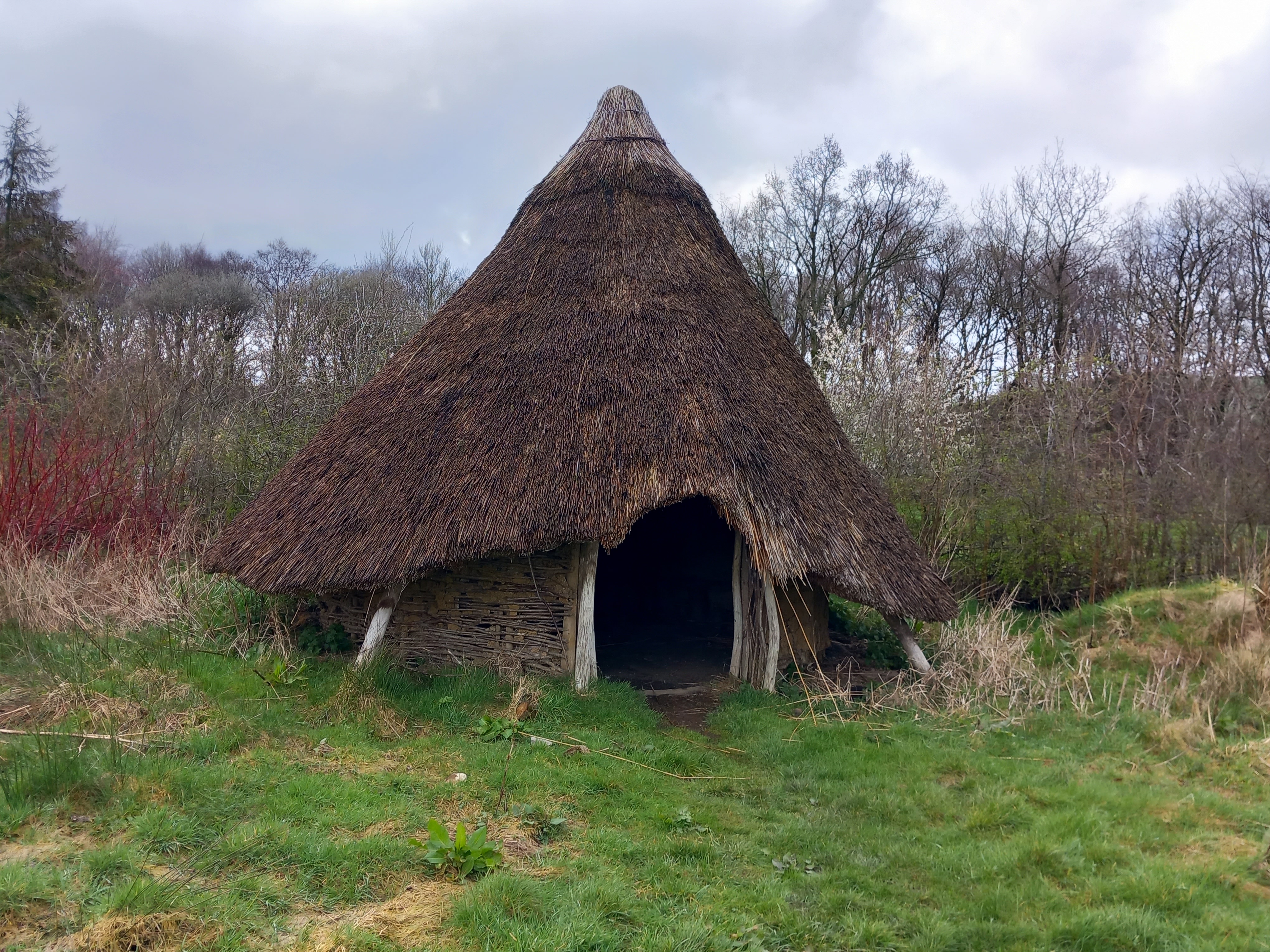
While some had stone as part of their wall construction, in the north-west of England they would more likely be made from entirely perishable material. The question then arises as to how we could know what the houses looked like. This has come about from two sources, namely the excavation of Iron Age settlement sites and from reconstruction archaeology.
Excavation of the site of a round house would reveal post holes that held the structure up. Although by the present day the posts have long since rotted away, they leave an imprint in the soil. The soil where the post stood is a different colour to that surrounding it, making them easy to spot for seasoned archaeologists. In this way the number of posts and the diameter of the roundhouse, which varied greatly, can be estimated. In the centre of many excavations a clay hearth will be routinely discovered. This would provide much needed light and heat within the dark interior.
The structure of the roof poses a harder problem to know for sure what it looked like. Again here, archaeological evidence gives a major clue. Around the circumference of a round house is a circular shallow gulley. This is the drip gulley, into which fell the rain water that came off the roof. By comparing the distance between the drip gulley and the circular sides of the house, the actual pitch of a roof can be worked out.
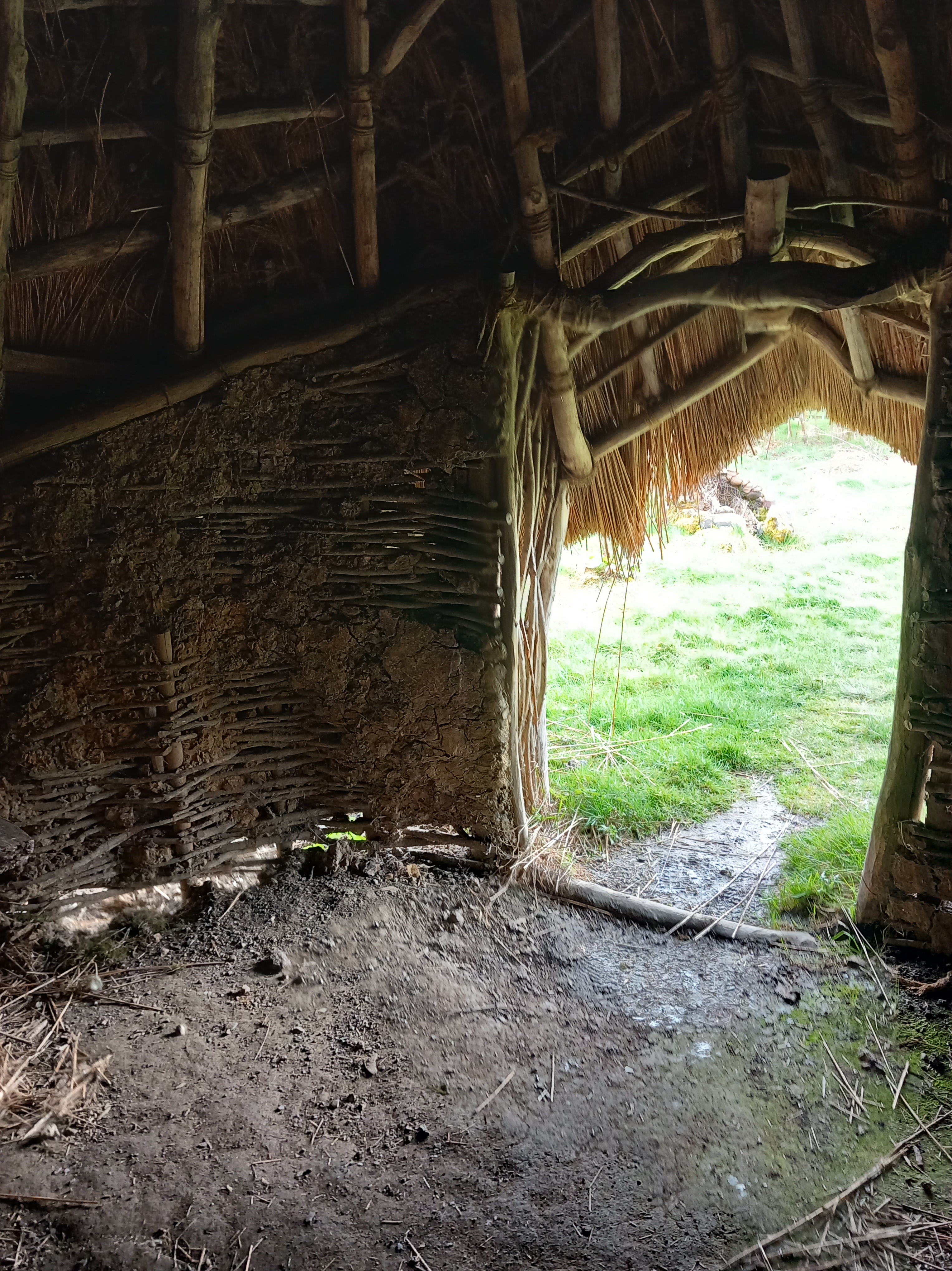
Reconstruction archaeology gives further ideas of how the houses would have looked. Once the upright timbers are in place, pliable lengths of wood are woven to construct a circular wall around them. These are typically made of hazel, a native plant that can be coppiced to produce thin, flexible poles. The woven hazel lengths are then covered in daub, a sticky substance made from clay and water. The daub mixture is strengthened either with straw, horsehair or manure. The daub is put both on the inside and the outside of the house, creating a rigid cylinder of a wall.
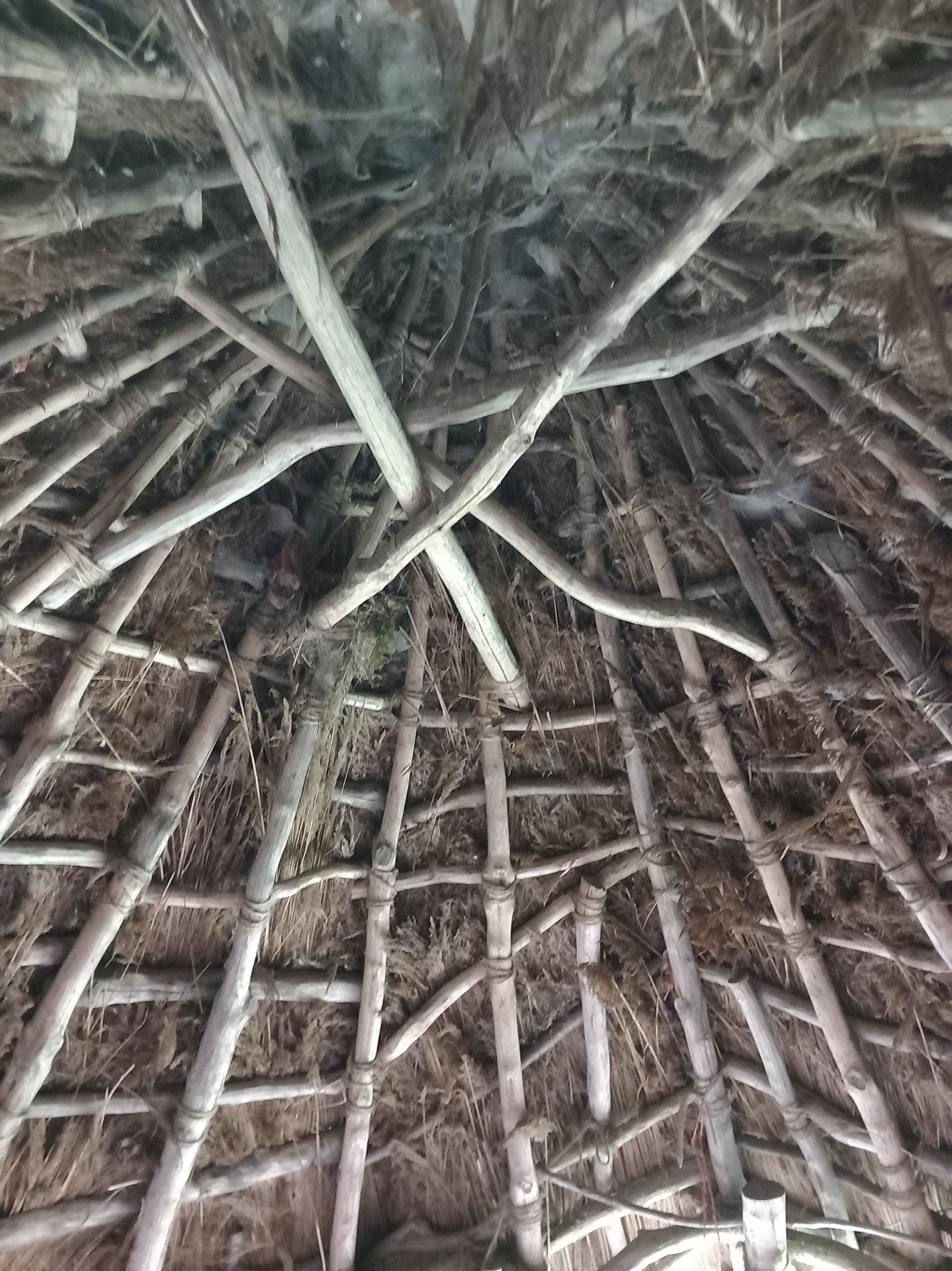
The roof support is created by having a skeleton of rafters, forming a cone, that are lashed to the upright posts. These can be further strengthened by shorter horizontal pieces of wood, known as purlins. The structure would then be thatched using locally available long grasses, such as reeds. It is likely that the apex of the thatched roof would have a small detachable cone on it. This weathered quickly and so would need to be easily replaced.
Experimental archaeology at Castell Henllys in south-west Wales showed that a round house built on that site easily lasted 35 years. Its thatched roof was replaced twice, but only a small amount of new reed was required for repairs, as much of the old reed could be re-used. The external daub had to be repaired in patches where it eroded. The round house could have stood for longer, but it was demolished so that archaeologists could excavate the site to see if it looked similar to actual digs of Iron Age settlements.
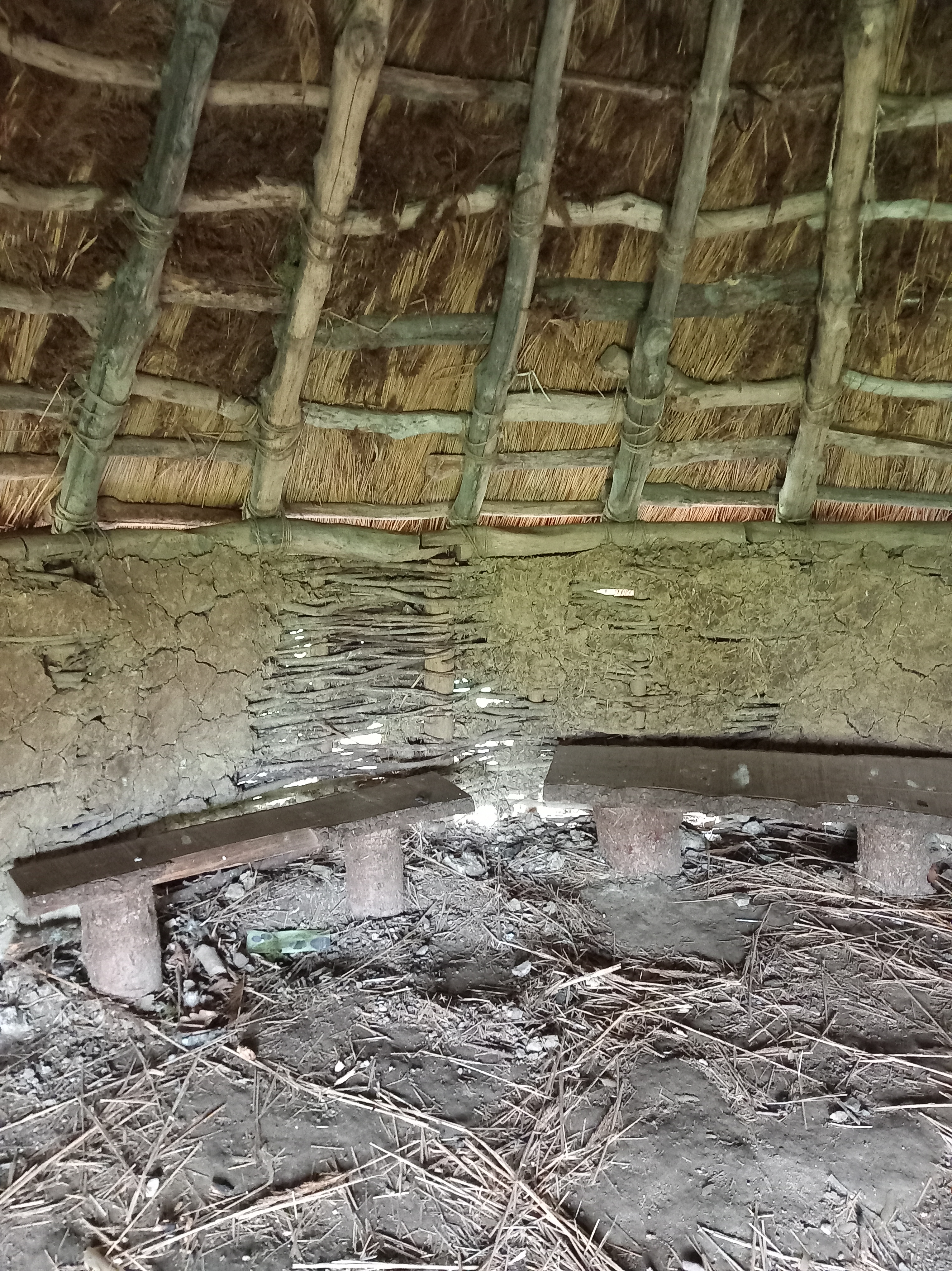
Excavations have given an idea of what would have been typical activity inside the house. There would have probably been a weaving loom to make clothes, a quern for grinding grain for bread, a central hearth for cooking, benches to sit on and simple wooden beds. Some round houses would have had a specialist purpose such as blacksmithing, where the hearth was used for the smelting of iron. Others may have been used for smoking fish and meat.
It’s not clear if the interior of the walls would have been decorated with motifs and patterns, but there are no reasons to suppose that they would not be. Lime-washing the walls makes the interior much brighter as the lime wash can reflect the light from the fire around the room.
The reconstruction at the Wild Boar Park reflects how a house would have appeared around 200 AD. The interpretation board notes that most people then would have been farmers, growing wheat and barley and keeping cattle, sheep and pigs. A form of domesticated pig would have been a familiar sight during the Iron Age. Recent DNA evidence shows that these would be allowed to roam freely, and would interbreed with the native wild boars.
A huge draw for the animal centre is, of course, their wild boars. The piglets have distinctive stripes that camouflage them in their vulnerable first few months. This enables them to be hidden within the undergrowth, or even if they just stand still, blending in to their surroundings. Only two weeks after being born, they will accompany their mother as she forages. The piglets will feed for up to three and a half months off their mother, but begin copying her foraging activities only two to three weeks after birth.
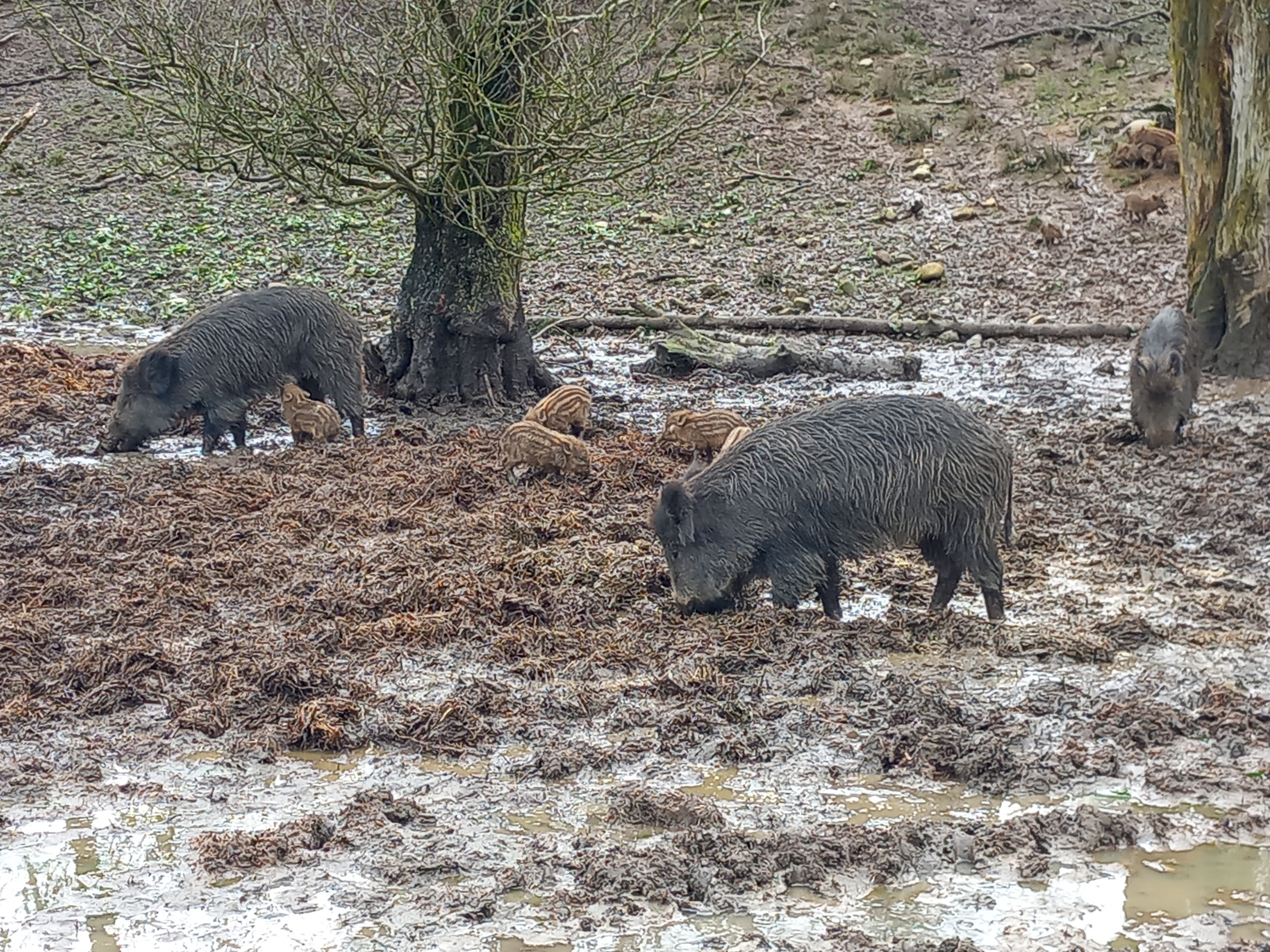
A versatile animal, the wild boar’s preferred habitat is deciduous forest, with oak and beech seeds being particularly favourite foods. They will dig up roots and bulbs, strip bark and eat leaves, as well as feeding on worms, eggs, lizards, snakes and frogs.
Site visited by A. and S. Bowden 2023
Access
See the Wild Boar Park website for opening times here. There is an admission charge.
The Iron Age House is set a little way away from the main attractions. It is clearly marked on the map available on site, or ask at the visitor centre for directions.
References
Experimental archaeology and roundhouse excavated signatures: The investigation of two reconstructed Iron Age buildings at Castell Henllys, Wales, Harold Mytum and James Meek (2020), Archaeological and Anthropological Sciences 12:78. Available online as a free pdf.
On site interpretation at the Iron Age House, Wild Boar Park
wildboarpark.co.uk/iron-age-roundhouse/
en.wikipedia.org/wiki/Wild_boar
nhm.ac.uk/discover/news/2019/august/understanding-the-origins-of-european-domestic-pigs
 Lancashire Past