Spanning the River Hodder near Hurst Green are two bridges. The oldest is known variously as Cromwell’s Bridge, The Devil’s Bridge, or simply Old Lower Hodder Bridge. Oliver Cromwell brought his Parliamentary Army and held a war council at the bridge, enroute to the Battle of Preston. Running parallel to it is the New Lower Hodder Bridge, a large road bridge that carries the B6243 road over the river. This dates from the early 1800s.

The location has long been an important crossing point. It appears to be a natural ford, but the desire to have a secure bridge dates back to Medieval times. In 1329, Adam Walton, the Rector of Mitton, testified that the bridge over the river at that time was frequently broken, damaged by floods. This earlier bridge would probably be a wooden one, supported on stone piers.
The Origin of Old Lower Hodder Bridge
The old bridge was built in 1562. The instigator of the project was Sir Richard Shireburne of nearby Stoneyhurst Hall. Together with local landowners Edmund Shireburne, John Holden and James Shuttleworth he drew up a contract for its construction on the 30th December 1561. Stonemason Richard Crossley accepted the commission. The agreement stated that the bridge would be similar to Edisford Bridge at Clitheroe, now itself a much widened and reconstructed structure and also an important crossing point.
The bridge would be built at the cost of £70, paid for in seven spaced instalments, occurring on important calendar dates such as the Feast of Purification of Our Lady (2nd February), the Feast of St John the Baptist (24th June) and Martinmas (11th November). The stone was to come from a nearby sandstone quarry at Malmerdene. Richard Crossley, as stonemason, would be responsible for extracting it but Sir Richard would arrange for it to be brought from the quarry by cart to the construction site. The funders also had to provide lime and sand to make mortar and timber supports for the arches. The agreement stated that the bridge would be completed by Michaelmas 1562. Interestingly, there was a penalty clause of £100 if it was not completed on time.
The finished bridge was constructed to have a large central arch, and two slightly smaller arches either side of this. Its road surface was cobbled and fairly narrow, but wide enough to allow packhorses over. Its low parapets meant that the sides did not interfere with the packs of the heavily laden animals. Three triangular cut waters on each of the piers would help to prevent river debris from piling up against them.
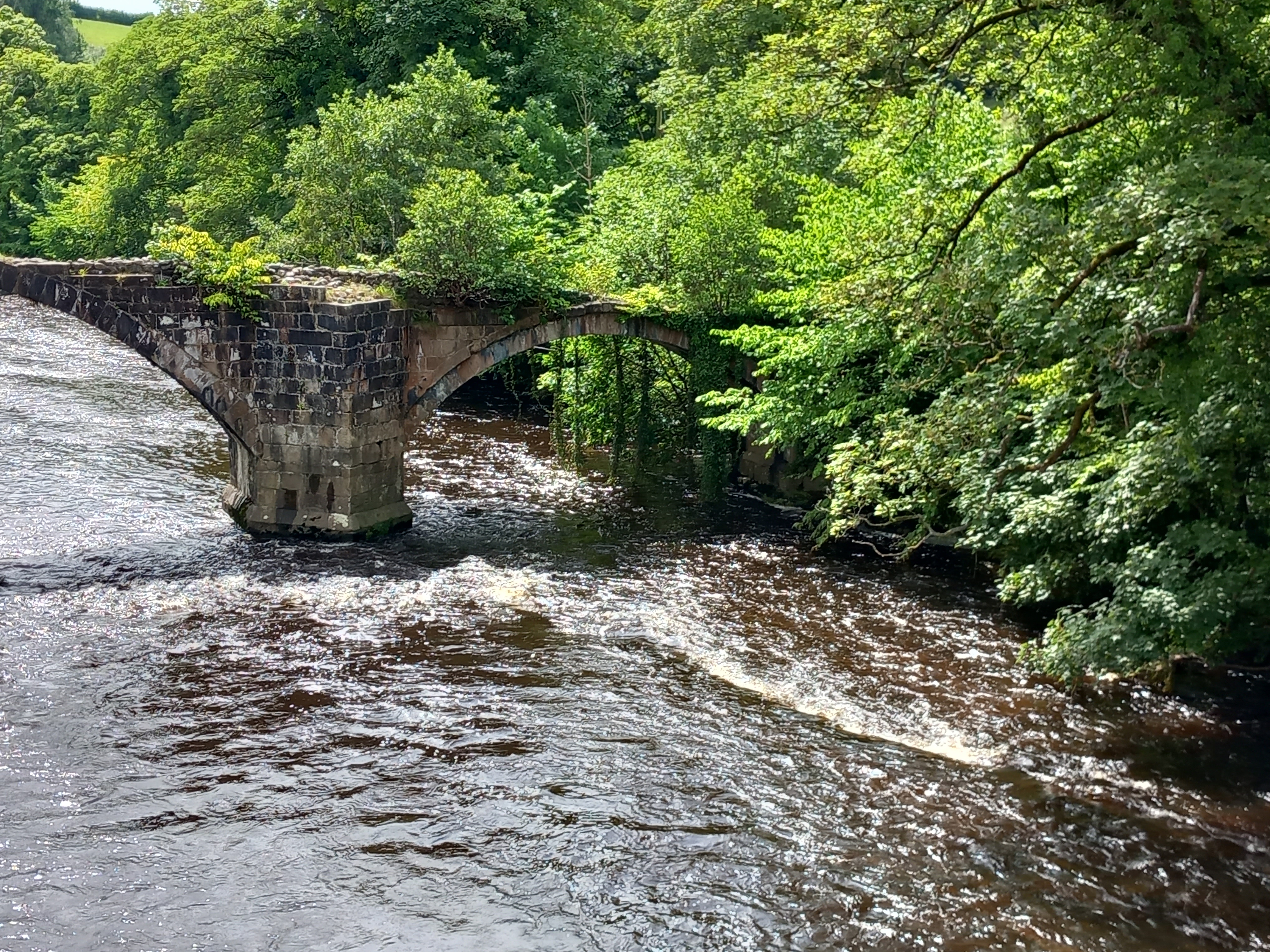
Cromwell’s Bridge
When King Charles I escaped from captivity during the Civil War, he was able to persuade large numbers of Scots to rally to his Royalist cause. This had the effect of starting up the armed conflict once again between the Parliamentarians and Royalists. Oliver Cromwell had been fighting in South Wales, and after re-equipping his men with socks and boots which had been worn out by long forced marches, he brought them into Yorkshire looking to engage his enemy.
Having intelligence that the Royalist forces were in Lancashire, he marched his 8000-strong army from Skipton to Gisburn. The next day, 16th August 1648, he gathered his New Model Army and local militias at Old Lower Hodder Bridge and there, in his own words, “held a council of war”. A discussion took place as where best to intercept the Royalists. Preston seemed the most likely target and Cromwell wrote in a letter to the Speaker of the House of Commons that they would “there engage the Enemy, who we did believe would stand his ground”. Explaining his reasoning, he added “It was thought that to engage the Enemy to fight was our business; and the reason aforesaid giving us hopes that our marching on the North side of Ribble would effect it, it was resolved we should march over the Bridge; which accordingly we did; and that night quartered the whole Army in the field by Stonyhurst Hall being Mr. Sherburn’s house, a place nine miles distant from Preston. Very early the next morning we marched towards Preston…”
Cromwell’s Parliamentary forces engaged the Royalists at Preston and nearby Walton-le-Dale, defeating them soundly, This action was the decisive battle that ended the Civil War. Subsequently, King Charles I would be executed and Cromwell would become the ‘Lord Protector’ of the country.
The Devil’s Bridge
Another name for Old Lower Hodder Bridge is The Devil’s Bridge. This may stem from a tale written in the note book of Reverend Thomas Jolly. Writing around 1690 he states “Not long since one Richard Atkinson, a profound drunken bailiff, who was one that reproached and cursed the faithful servants of Christ…riding over Hodder Bridge was lifted off his horse, turned thrice about and thrown into the river by an invisible hand, when he was taken dead, it was supposed that he was dead before he came into the water; as he lay dead his wife confessed that the evening before he told her that the devil brought him home and said he would fetch him shortly“.
New Lower Hodder Bridge
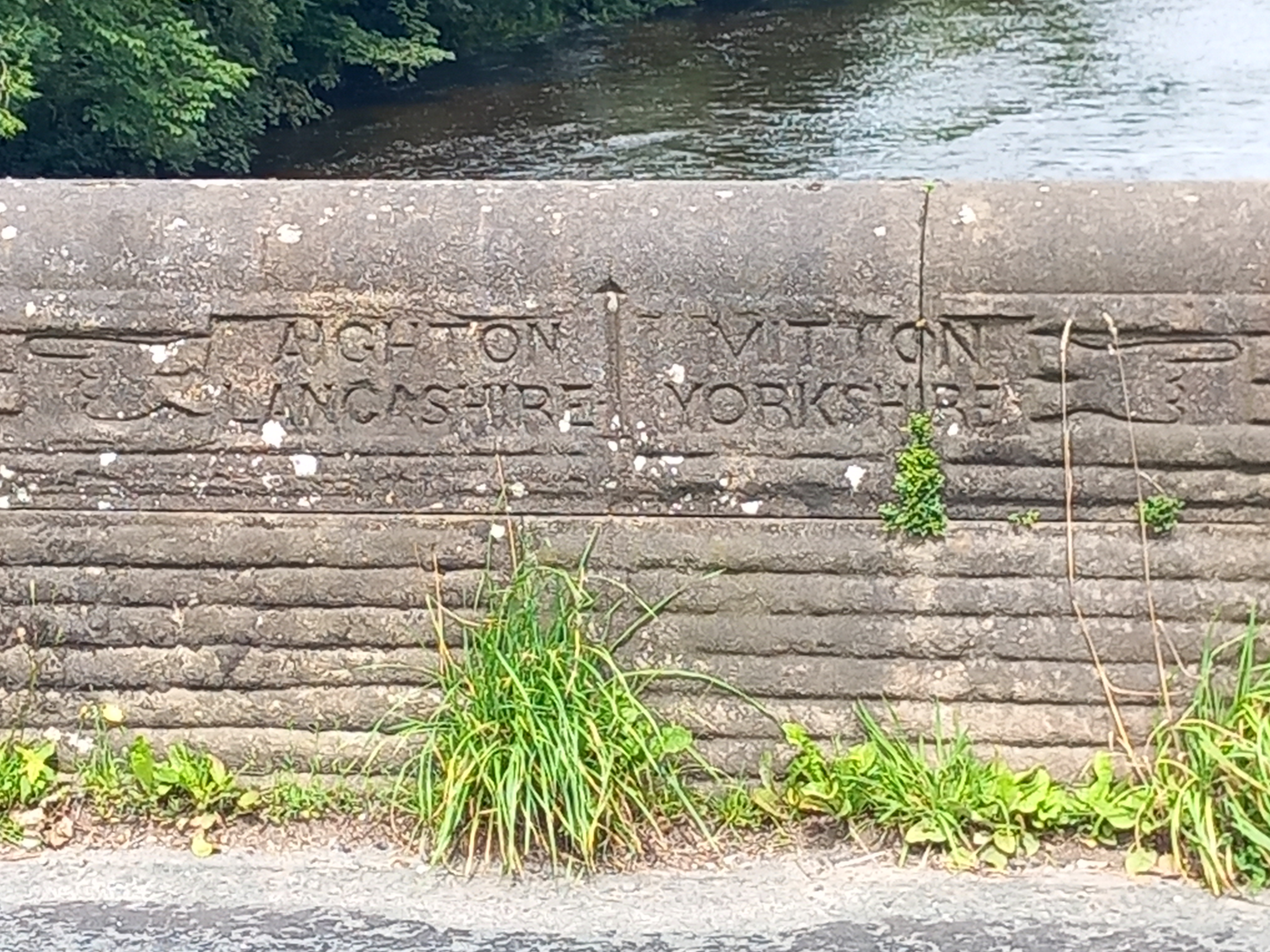
Some time around 1820, the New Lower Hodder Bridge was constructed, a few metres upstream from the old one. The new bridge was much wider than its predecessor and is now a main route that carries the Longridge to Clitheroe road over the river. Some sources claim that John Macadam was working on a portion of the road between Hurst Green and the Hodder, and it may well have been him that realigned the road to travel over the new bridge. Macadam had recently perfected the layering of crushed stone to make hard-wearing stone surfaces, a boon in comparison to the rutted and potholed roads that were the norm throughout the country. Today, this late Georgian bridge remains in good condition. Of particular interest are the finger posts carved into it, pointing the way to Aighton in Lancashire in one direction and Mitton in Yorkshire in the other.
Old Lower Hodder Bridge is unfortunately not so well looked after. Although it is Grade II* listed, the English Heritage 2022 Heritage at Risk register states that its condition is ‘Very Bad’. It is being damaged by sapling and tree growth, mortar is failing on the surface of the bridge and missing stones are allowing vegetation to become established on it. A displaced stone on a cut water is allowing water to enter the structure when the river is high. These are all fixable problems, but it will require adequate finance for the work to be carried out. For such a well known local landmark, steeped in history, this is surely a heritage priority for Lancashire.
Site visited by A. and S. Bowden 2023
Access
The New Lower Hodder Bridge is the best place to view the Old Lower Hodder Bridge. There is an unofficial parking area on Lower Mitton side of the new bridge (the side that leads to Clitheroe). Otherwise park in Hurst Green and follow the pavement along the B6243 to reach the bridges.
Be aware that there is there is no pavement on the new bridge, and vehicles do drive over it at some speed.
There is currently no direct access to the old bridge, but the views of it from the new one are excellent.

Nearby
Dandy Dog and the Pendle Witches
References
Jaggermen’s Bridges on Packhorse Trails, Christine McEwen (2008) Sledghammer Engineering Press Ltd. This excellent publication can be bought from the publishers here. This book was invaluable in writing this piece, giving an extensive account of how the bridge was funded and constructed. It contains a wealth of information about packhorse bridges throughout the north of England.
Oliver Cromwell’s letter can be found at olivercromwell.org/letters_and_speeches.htm. The two below were used for this piece:
For the Honourable Committee of Lancashire sitting at Manchester. Preston 17th August, 1648.
To the Honourable William Lenthall, Esquire, Speaker of the House of Commons. Warrington 20th August, 1648.
en.wikipedia.org/wiki/Battle_of_Preston_(1648)
‘Blackburn hundred: Mitton’, in A History of the County of Lancaster: Volume 7, ed. William Farrer and J Brownbill (London, 1912), pp. 1-20. British History Online
historicengland.org.uk/advice/heritage-at-risk/search-register/list-entry/48059
Chetham Society, New Series, Vol 33: The Note Book of Rev. Thomas Jolly 1671 to 1693. Available online at archive.org
 Lancashire Past
Comments are closed.