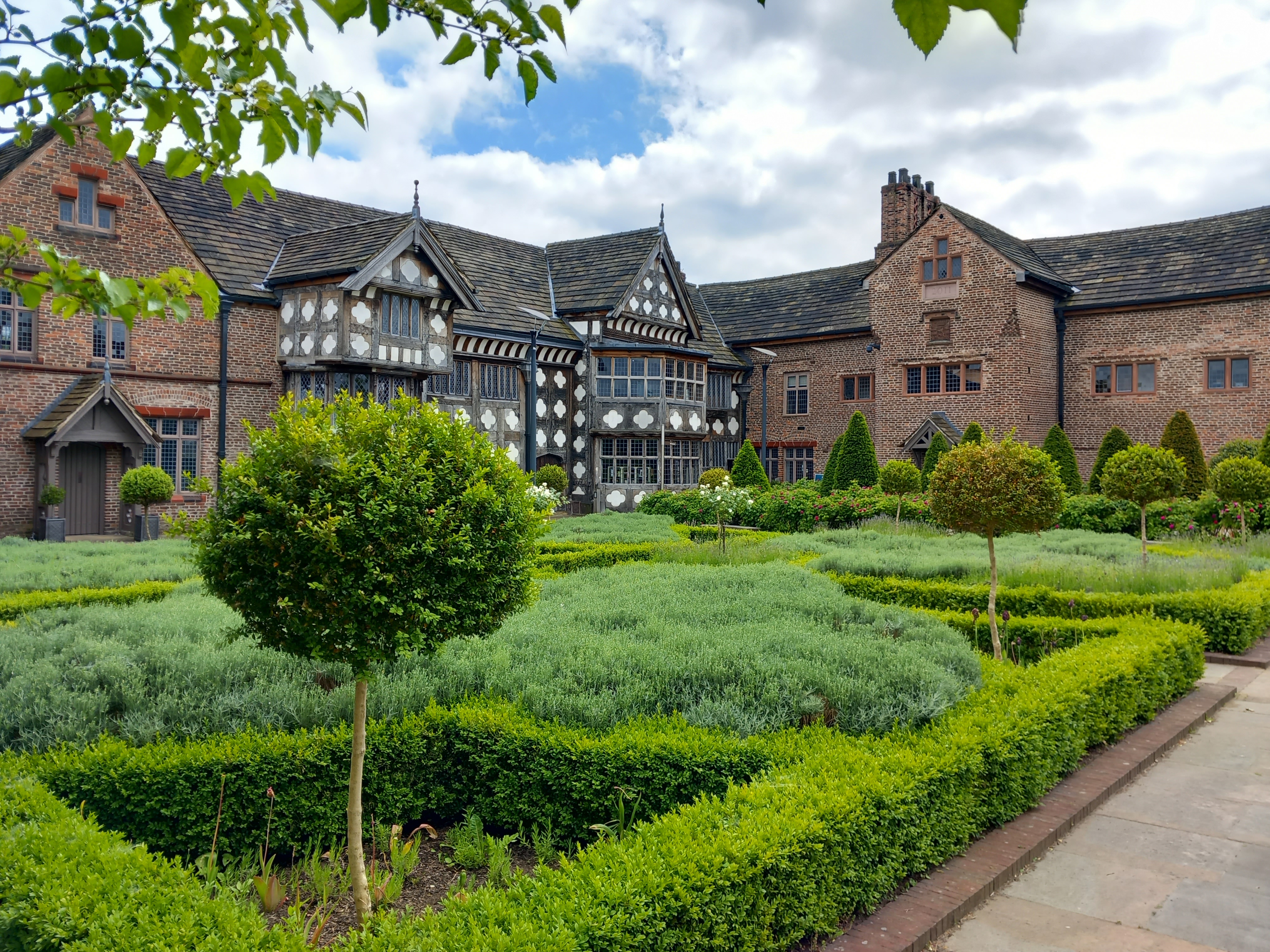
The earliest parts of Ordsall Hall were constructed by Sir John Radclyffe and date from the mid-1300s. By 1380, records show it consisted of a main hall, five bed chambers, a kitchen and chapel. The larger estate included three farms, a brewhouse, dovecote, granary and windmill.
The Radclyffe family’s wealth increased greatly during the 1500s and 1600s, and was derived from their sheep and cattle farming. Archaeological remains from the moat reveal that they were using expensive decorated Venetian glass goblets to drink from, along with high quality pottery. From the mid-1600s, a watermill for grinding corn, a saw mill and a brick kiln had been added to the estate.
Twins Sir Alexander (III) and Lady Margaret Radclyffe were frequently at the court of Queen Elizabeth I. Lady Margaret became a lady-in-waiting to the queen, and was seen as a favourite. Sir Alexander had been knighted after fighting alongside the Earl of Essex to capture Cadiz in 1596, in the Anglo-Spanish War. Three years later, while on campaign with the earl in Ireland, he died. With Lady Margaret inconsolable at the news of his death, Queen Elizabeth brought her to Richmond Palace. There she was attended by the queen’s staff, but despite their best efforts she went into a rapid decline, dying that same year. She was buried at the Church of St Margaret in London. This was an occasion of some note, as she was given a funeral deemed fitting for the daughter of a nobleman. The 24 women attending the ceremony were all bestowed with new gowns to wear. Ben Johnson, the famous playwright, was commissioned to write an ode to her. It included the lines “Rare as wonder was her wit, And like nectar ever flowing…Earth, thou hast not such another”.
Sir John (VI) Radclyffe inherited the hall from Sir Alexander, his deceased brother. Sir John was knighted for his fighting service in Ireland, where he had accompanied his brother. He later saw action in France and the Low Countries, serving as a captain in the Dutch army. Sir John and his wife Alice Byron had four children and he was MP for Lancashire on three separate occasions. After the last of these, he returned to military campaigning. In 1627, Sir John was killed on expedition to La Rochelle during the Anglo-French Wars. Large portraits of the brothers have survived and now hang in the gallery of the hall, showing them modelling the height of Tudor fashion.
The Civil War
At the outbreak of the Civil War, the Radclyffes (like so many other local Catholic families) sided with King Charles I. James Stanley, a prominent Royalist commander of the leading Lancashire landowning family, stayed at the hall in 1642. He was a guest of Sir Alexander (IV) Radclyffe. A deputation from Manchester came to petition him, as his position of son of the Earl of Derby meant he was a man of considerable influence. The town of Manchester had declared for Parliament and, with tensions high, there was an attack by locals on the hall. This was probably provoked by the stationing of a garrison of Royalist soldiers in the hall’s attic.
In September of the same year, James Stanley and Sir Alexander (IV) Radclyffe took part in the Siege of Manchester, fighting against the Parliamentary forces that were holding the town. At the news of his father’s death, James Stanley abandoned the siege and and left to secure his title of Earl of Derby. Sir Alexander went on to take part in the subsequent Battle of Edgehill. There he was wounded and taken prisoner. He was held in the Tower of London for a time, but whether by pardon, escape, or payment of a fine, he was able to return to the Manchester area by 1653. The following year he died and was buried at the Radclyffe Choir at Manchester Collegiate Church.
The End of the Radclyffe Connection
The years immediately following the Civil War were difficult for the family. In 1658, Sir John (VII) Radclyffe mortgaged the hall, its surrounding estate, and the water and corn mills to Edward Chetham. Four years later, the hall was sold on to Colonel John Birch and the Radclyffe association with it was severed for good.
The Stocks family bought the hall in 1704, and owned it for the next fifty years. One of their tenants was a Mr Frith, described as a man of ‘remarkable genius’ who discovered Nankeen Buff, a secret dye only known hitherto by the Chinese. He constructed a dye-house to further his research on how to produce the pale yellow colour.
The Egertons and Their Tenants
In 1758, Ordsall Hall passed to Sam Egerton of Tatton. The Egerton family would keep it for the next two hundred years, but none of them ever lived there. The building was divided up into separate residences and rented to tenants.
Around 1815, recently married Ellis and Mary Markendale moved to the hall. They would go on to have six daughters and three sons while resident there. At first they mainly lived in the middle part of the building, but by 1850 they were renting the whole of it. The Markendales owned butchers shops, skin brokers and slaughter houses in Manchester, and used the farmland around the hall for cattle grazing. By the time Ellis died, in 1853, he was a multi-millionaire, and his wealth was divided between his wife and children. Mary continued to own the hall, but also spent time living with her son John at Dunham Massey. John and his brothers Richard and Ellis Jnr continued to run the business empire, and to prosper. Interestingly, John Markendale was prosecuted for using faulty scales to weigh the meat that one of his shops was selling. Ellis and Mary’s portraits, recently re-discovered in an outhouse on a Cumbrian farm, now hang in the hall.
A Guy Fawkes Connection?
In 1841, novelist William Harrison Ainsworth wrote a book titled Guy Fawkes. In the book he spun a yarn about Guy Fawkes visiting the hall, trying to enlist support for the Gunpowder Plot. Here he meets Robert Catesby, who was in love with 18-year-old Viviana Radclyffe. Despite Viviana’s best efforts, Robert is drawn into the plot. When officers raid the hall looking for a Catholic priest, Humphrey Chetham, a wealthy textile merchant saves the day. He leads Robert, Viviana, Guy Fawkes and the priest through a secret passage, and then on to Old Trafford and finally out to Chat Moss. A gripping story, but there is no evidence for any of this ever taking place. Today, Guy Fawkes Street next to the hall perpetuates the myth that he once visited. (For more on the real Humphrey Chetham’s fascinating life, see our posts on his tenure at Turton Tower and how his will set up Chetham’s School and Library. Robert Catesby was a real life figure too, and was the leader of the Gunpowder Plot. It was he who personally recruited Guy Fawkes, and not vice versa).
Industrialisation
In the mid to late 1800s, the landscape around the hall began to change radically. A dye works and a paper mill were constructed nearby. This was very much the shape of things to come, as the rural surroundings began to be transformed into an industrial landscape.
The artist Frederic Shields was living at Ordsall Hall in the 1870s, and recorded the changes. He was a friend of the Pre-Raphaelite painters Dante Gabriel Rossetti and Ford Maddox Brown. In correspondence with their patron John Ruskin, he described how the immediate area around the hall was being built up with mills and the workers’ houses. Despite this, and the fact that the hall was now in a poor state of repair, he described it as “the happiest refuge I have ever nested in”. He feared the hall would be demolished once an oil cloth factory being built behind it was completed. He wrote “Where the sheep fed last year, five streets of cheap cottages, one brick thick in the walls (for the factory operatives belonging to two great cotton mills near) are in the course of formation”. Shields went on to create religious paintings and stained glass of great acclaim, but while living in Salford he specialised in drawing and painting portraits of the local children. St Ann’s Church in central Manchester contains some of his stained glass work, based on the theme of ‘A Shepherd’.
Following the departure of Shields in 1875, the hall was let to neighbouring Haworth’s Mill and used as a working men’s club for the next twenty-one years. The men from the mill could enjoy a gymnasium in the Great Hall, billiards, a skittle alley, a room to read the newspaper, and a bowling green. Hot meals were served daily. The Salford Chronicle stated “…In short, the fortunate members of Messrs. Haworth’s works have all the privileges of an aristocratic mansion without expense.” This may be taken with a large pinch of salt, as photographs from the time show the outside of the building to be in poor condition.
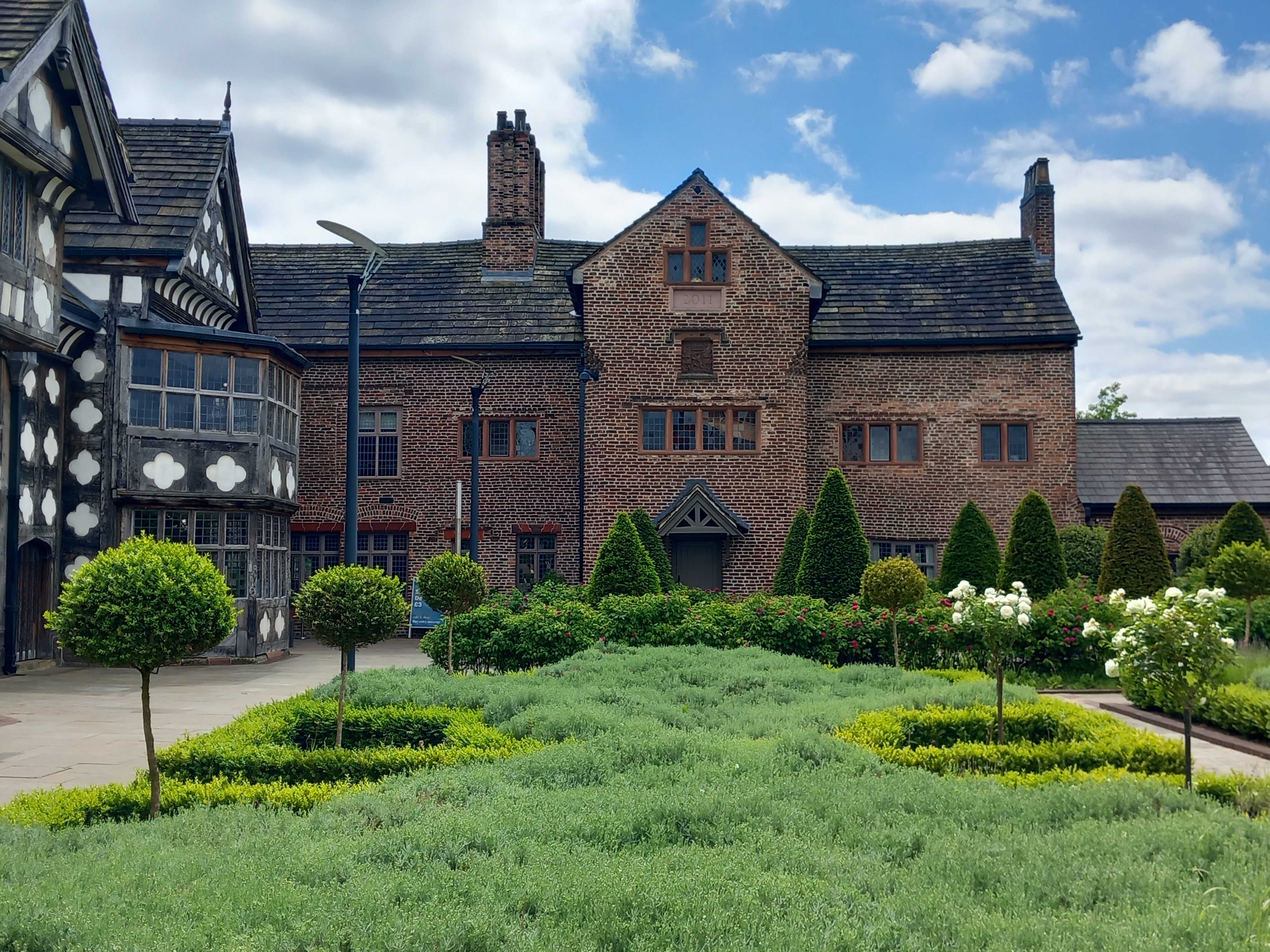
When the lease expired in 1896, Earl Egerton took the decision to convert the hall into a clergy training school. It was seen as an ideal location, in which the trainee priests would gain experience from working with the impoverished locals. The next year, St Cyprian’s Church was built in the grounds. At the same time, the earl paid for Alfred Darbyshire, a Manchester architect, to restore the hall. Darbyshire rebuilt the south front in brick, giving it the look it has today.
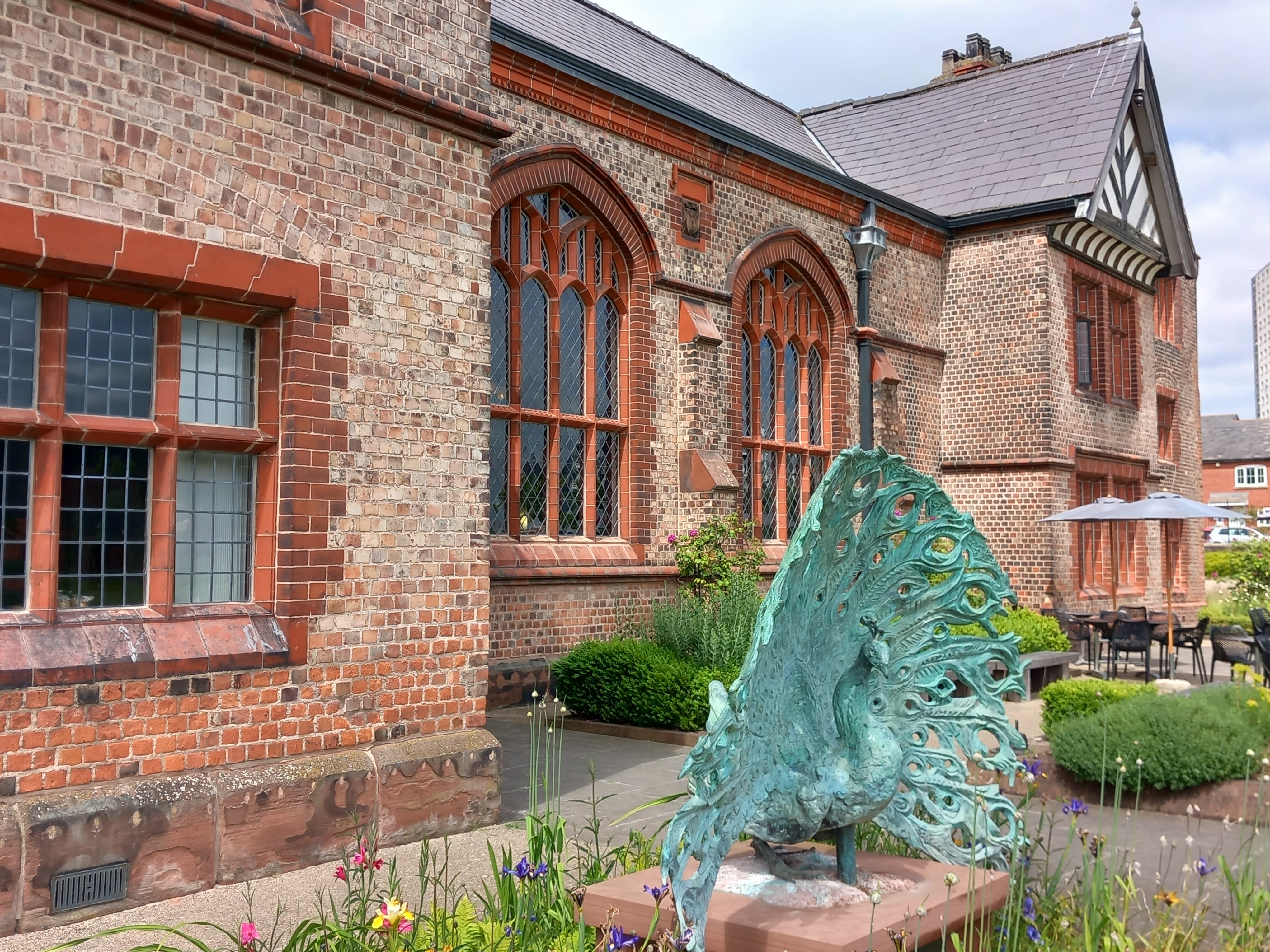
In 1908, the clergy training school left, but the rectors continued to be tenants at St Cyprian’s church. During the 1930s, the hall was used as a community house and a job centre. This had its own football squad, called the Ordsall Out of Work Team. A snapshot from the same decade shows how St Cyprian’s held a fundraising drive by organising a church fair. The day was opened by the Rose Queen. There were “refreshments and reasonable prices”, stalls for drapery, hoopla, sweets and a bran tub. Entertainment included singing by St Cyprian’s Church Choir, a selection of music played on a gramophone, and a promise that Mr Thornley Dodge “will Entertain”.
During the Second World War, Ordsall Hall was commandeered for various wartime purposes. A detection centre was set up to look out for enemy bombers heading for the docks. Another section of the building became a wireless station, and two large huts were used by Air Training Cadets. Parts of the hall were badly shaken by nearby bombing, and the wireless station was damaged by fire.
In 1959, the rectors left St Cyprians. Baron Egerton sold the hall to the council, but this did not secure its future. Opposing camps wanted to either save it, or demolish it, with one councillor describing it as “a heap of rubbish”. The vote was split, with 30 wishing to save it and 18 wanting to have it knocked down. This outcome meant that it was fortuitously spared.
In the 1960s, St Cyprian’s church was demolished. Ordsall Hall was subsequently restored and in 1972 it was opened to the public for the first time, as a period house and museum. In 2009, it was closed for two years, during which a £6 million restoration project of the buildings and gardens took place.
Visiting Today
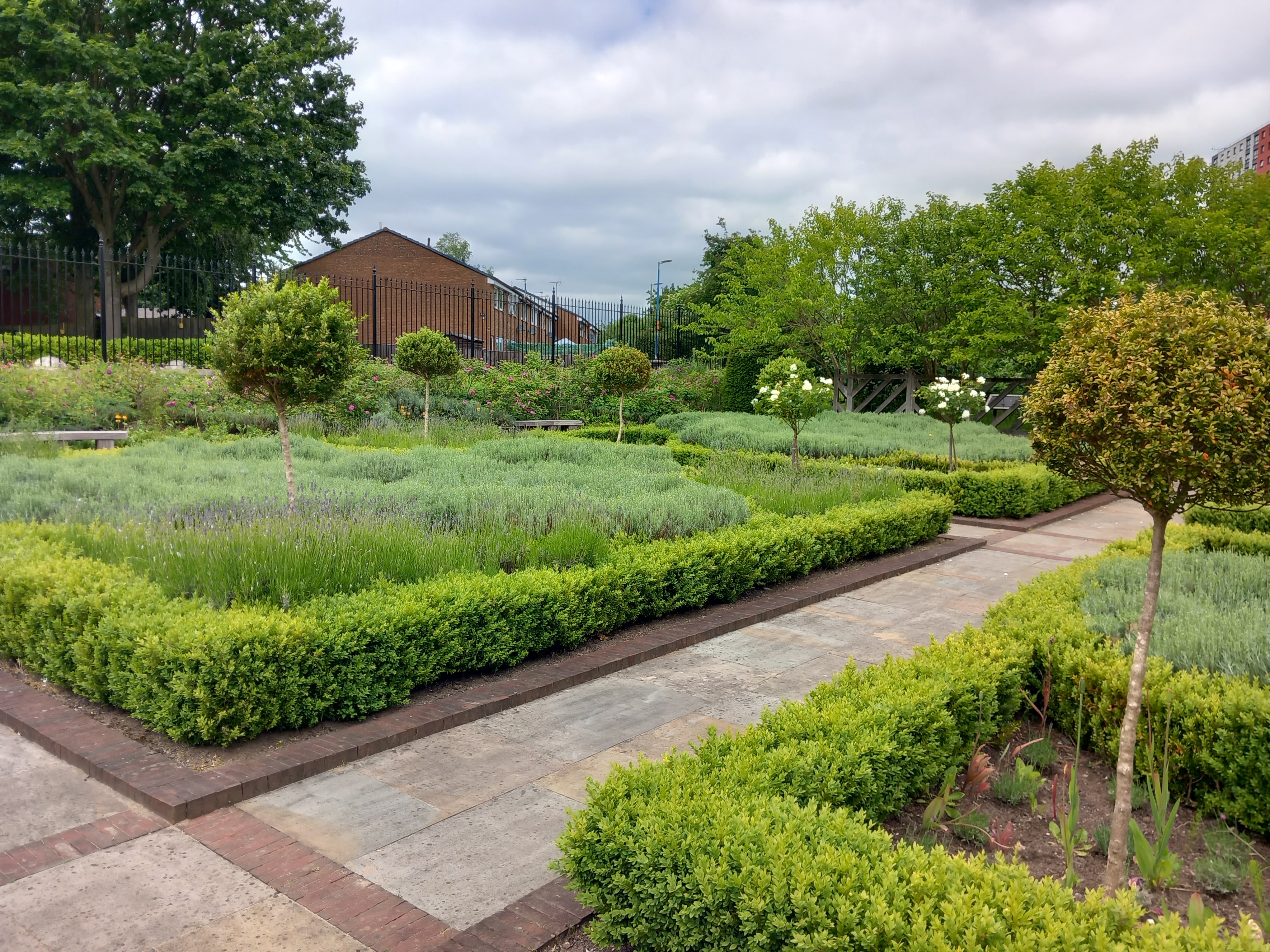
Currently, there is a huge amount for visitors to see inside Ordsall Hall. Below are just some of the highlights.
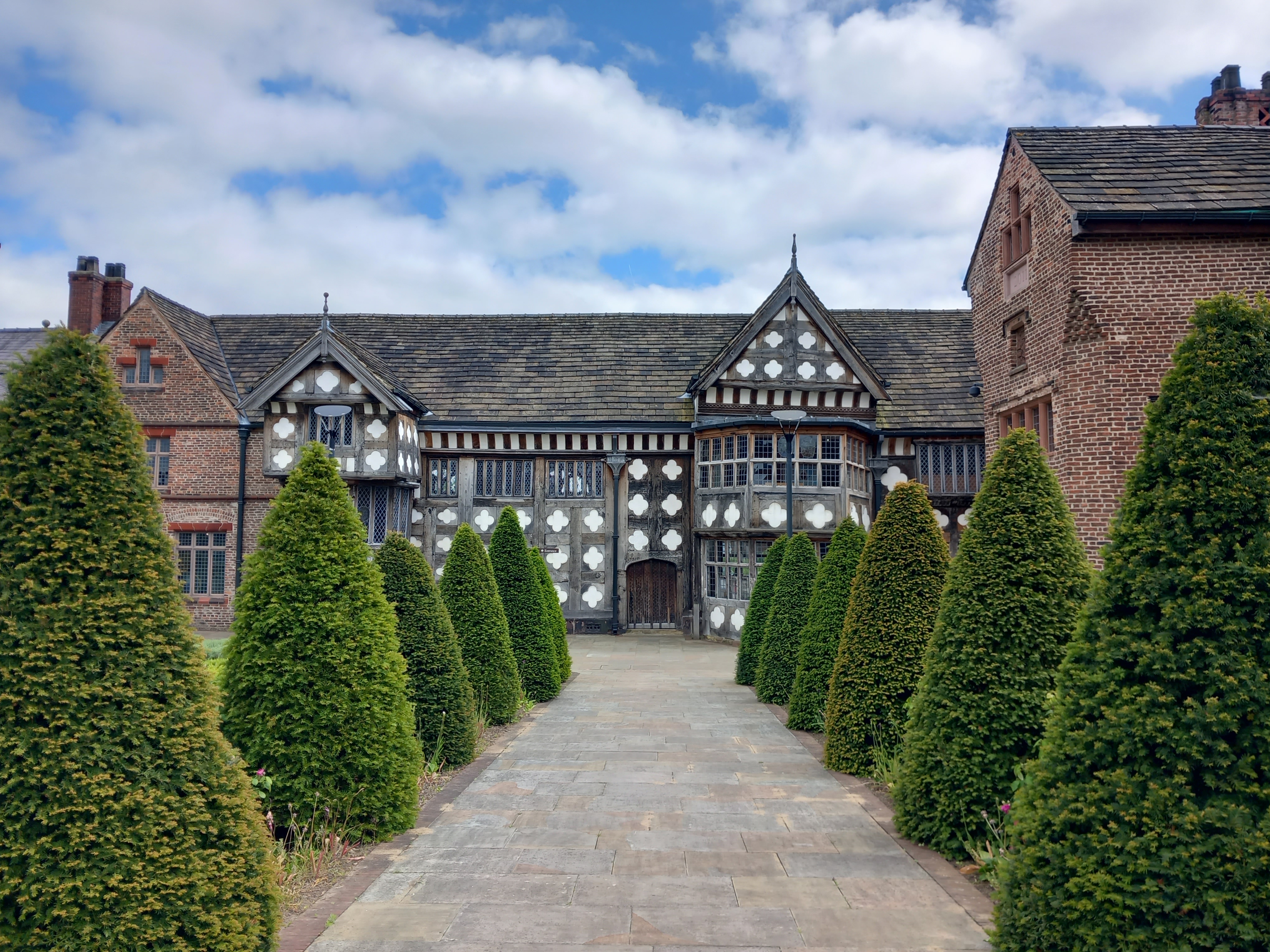
Analysis of the timbers in the Great Hall shows that it dates from around 1512. Its four-leaf (quatrefoil) design sparked a fashion in Lancashire that was followed by Rufford Old Hall, Samlesbury Hall and Speke Hall. The Oriel Window dates from the late 1500s, and still has its original carving of a grapevine (often explained as a secret expression of Catholic faith). The long table dates from the 1600s, and features the Red Rose of Lancaster and the White Rose of York.
The Star Chamber is a well-preserved domestic apartment built around 1360 by the first Sir John Radclyffe. It is named for its gilt lead stars that adorn the roof. Intriguingly, one of the stars can be removed, so someone could look in from the Great Chamber above. The Star Chamber features the impressive Radclyffe Bed constructed in the late 1500s. This features carvings of the Radclyffe coat of arms, Radclyffe bulls, dragons and human figures.
The Great Chamber dates from the same time, and has painted beams that display stylised pomegranates, one partially open, the other fully. These are thought to represent unity and fertility. The oak leaves painted either side of them denote virtue and strength.
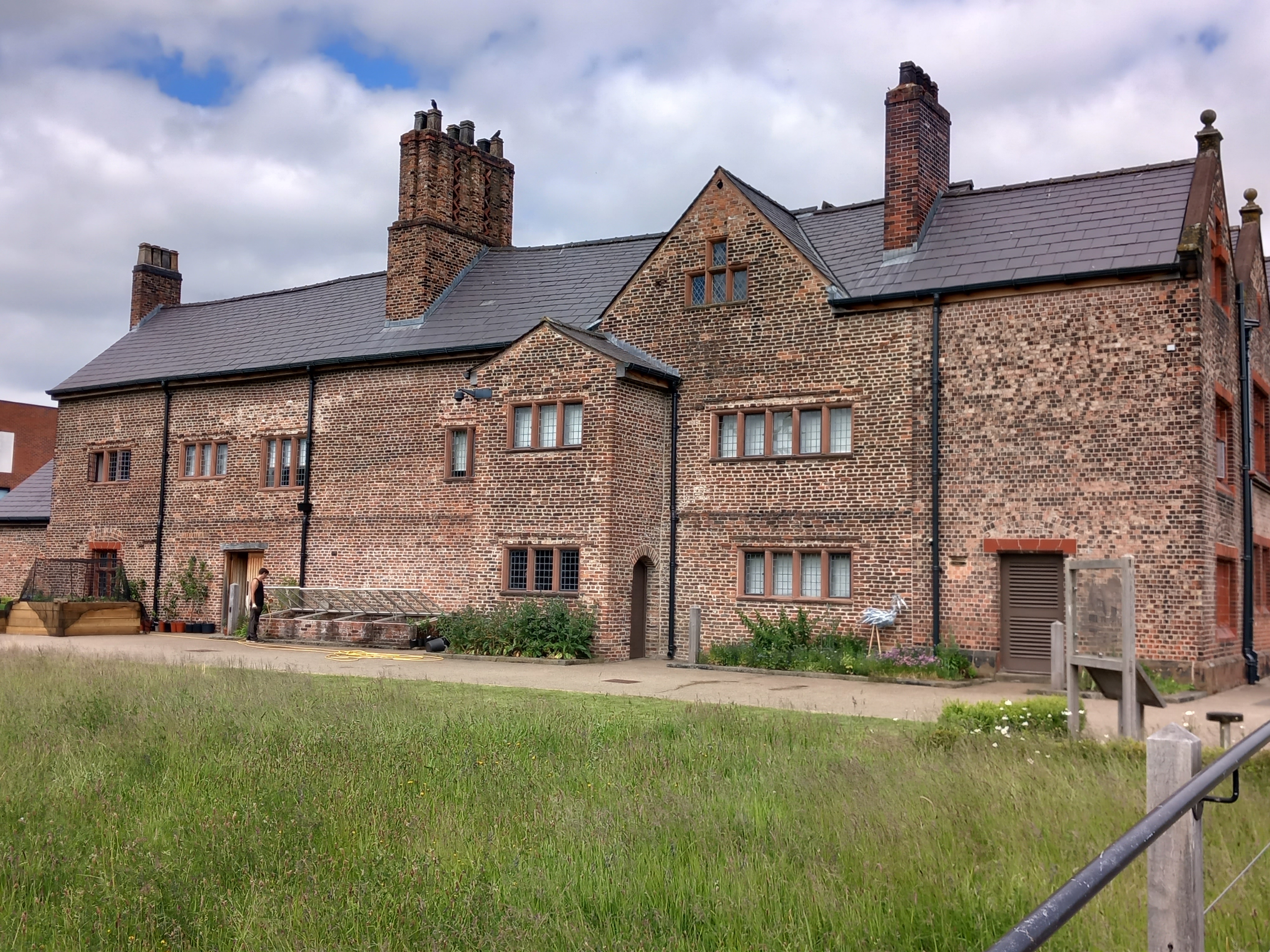
The brick-built kitchen dates from 1630s, and has an adjoining smoke corridor used for hanging meat. In order to feed the Haworth Mill workers, two wall ovens with cast iron doors were inserted in the 1860s. At the time, the kitchen could provide hot meals for over 400 people.
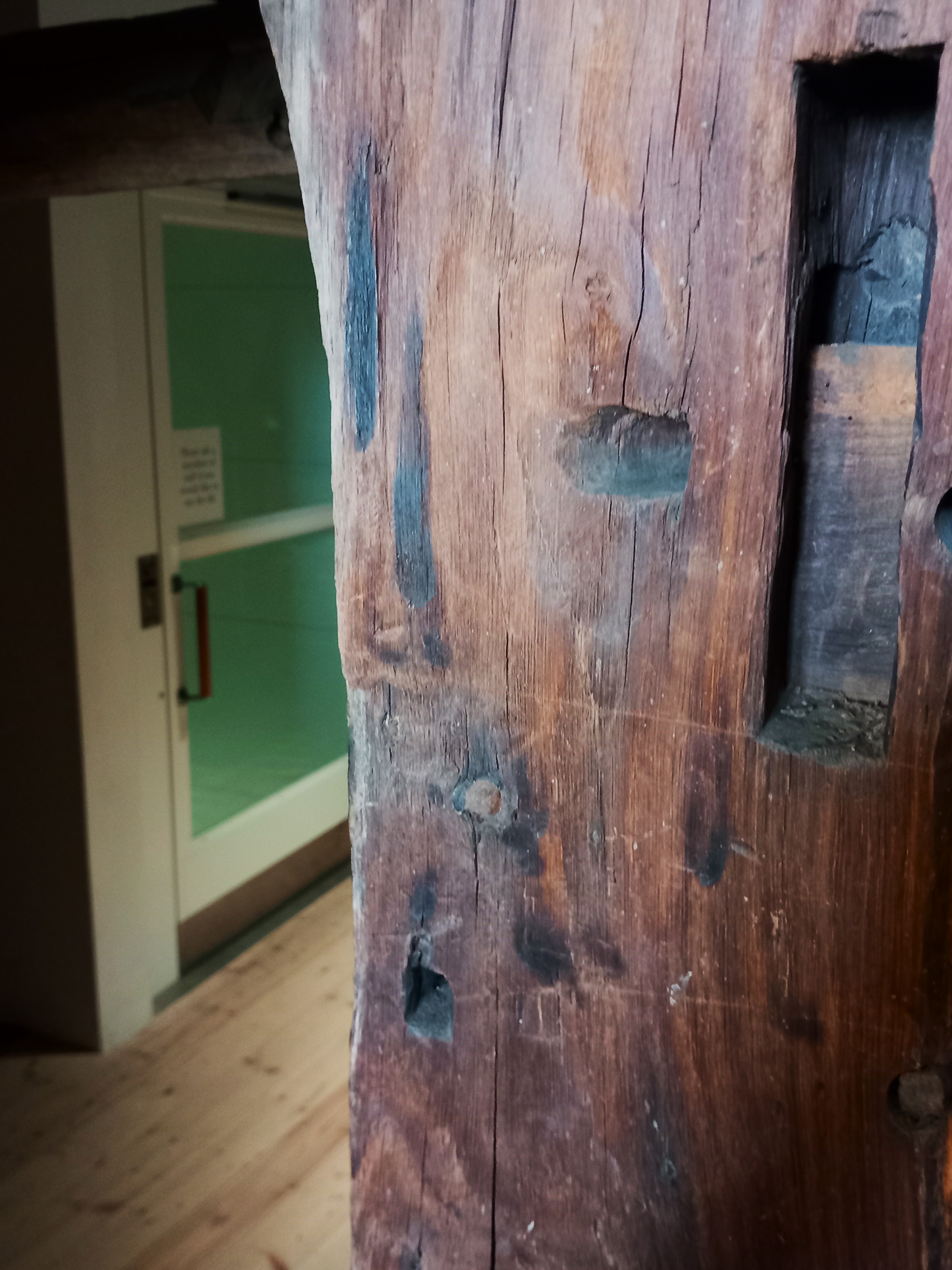
The Roof space reveals much of the original wattle and daub construction. This would have been where the servants lived, and there are a number of ‘witches’ marks’ by one of the entrances. These are ritual protection symbols, also known as apotropaic marks, which were thought to ward off evil. They were made by holding a candle flame against wood. It is a deliberate act, and takes quite some time before the wood is scorched, producing a tadpole or long teardrop shape. They were often put at doorways or on window frames, places where it was believed that evil spirits could enter in.
A boy’s red Moroccan leather shoe dating from the 1700s was found in a chimney, placed there as a protection against evil from the outside. These kind of supernatural beliefs may no longer be with us, but in the 20th and 21st Century, a belief in the existence of ghosts has a strong hold on many. This popular form of folklore is discussed in the section below.
Ordsall Hall Folklore
Most, if not all, of the old halls of Lancashire have reports of ghosts. Whether the reader is a sceptic or believer, the telling of such stories is an important cultural phenomenon, and worth recording. The following are just some of the reports from over the past 70 years:
In 1950, the Reverend Matthew Nelson and his wife Joyce moved into the hall and remained there for five years. The Star Chamber was their living room, and their bedroom was the Great Chamber above. Reverend Nelson spoke to the Manchester Evening News and told them he repeatedly heard tapping in the cellar, and the sound of footsteps in a corridor at night. He would say to Joyce “If there are spirits at the Hall, they have more right to be here than we do”. To the newspaper he was more sanguine, stating “We are not going to do anything about it because it may turn out to have quite a normal explanation”. Joyce believed the house to be haunted and on numerous occasions would hear a door open, and presuming it was her husband returning, would call out “I’m here Matthew”, but there would be no one there.
Jennifer and Ann Radcliffe lived in a purpose-built flat at the hall with their dad Fred, who was the caretaker between 1953 and 1962. They were both young when they moved in, Jennifer being five and Ann just six months old. As they grew up, Jennifer realised her father was frightened of going into Ordsall Hall on his own. She claims she saw spirit children there, and her sister spoke of seeing a lady, who she called ‘Celery’, which they later decided was a mispronunciation of Cecily.
Vincent Alcock was caretaker of the building during from 1979 to 1985. He would take his grandchildren into the hall at night, using only a torch to check on things, not wishing to put the lights on in case people phoned the police thinking it was burglars. On a number of occasions, he found a large old door that led to the hall was unlocked, even though he knew it to have been locked previously. Leaflets pinned to a notice board were found scattered on the floor, and the log pile in the hall would frequently collapse.
It is not difficult to explain these happenings away as the intervention of humans, not ghosts. For example, Jimmy Wright, a local resident, recalls that in the 1950s, at night, he and his friends would climb over the walls surrounding the hall. Once within the grounds, they would gain access to the hall using a side door. They would explore with torches, and if they heard a noise from the residents, they would quickly scarper back out again. It would be very easy to interpret the sounds they made, or things they moved, to be work of ghosts.
However, the strange stories persist up to today. A number of the museum’s staff have smelt lavender and roses in the Star Chamber. Some have heard heavy footsteps and loud bangs. They also have felt that they were in the presence of others, even when they were alone. The hall used to run a ‘GhostCam’, where viewers from around the world could log on and watch at night. The most popular ghost is perhaps an inevitable ‘White Lady’, said to be the heartbroken Lady Margaret who died so soon after her brother. As one museum worker stated “You’re not a building of stature unless you’ve got a White Lady”.
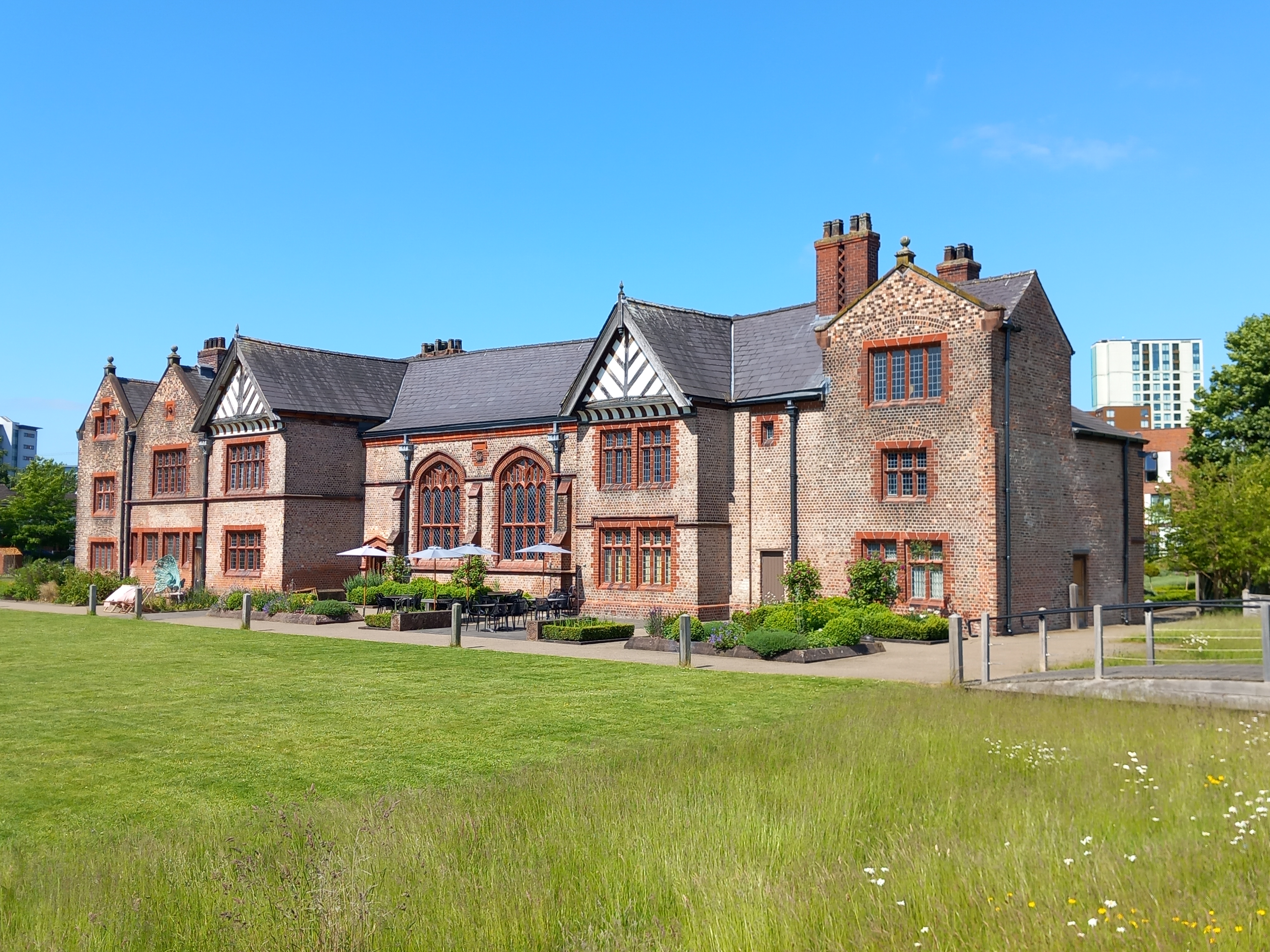
Today, Ordsall Hall is a Grade I listed building, with a wealth of Tudor and Stuart architecture and furniture. Its grounds have undergone extensive restoration too, and visitors can see where the moat was which encircled it, delight in the beautiful gardens, and marvel at the different styles each aspect of the hall shows. The building and grounds are a tremendous asset for both the people of Salford and the whole of the region. Salford City Council are to be commended on all their hard work in restoring and maintaining Ordsall Hall, for anyone to visit, for free.
Site visited by A. and S. Bowden 2023
Access
There is free entrance to the building and grounds. Paid car parking is available in the grounds of the hall.
Opening times:
Monday, Tuesday, Wednesday, Thursday 10.00 am- 4.00 pm
Friday, Saturday closed
Sunday 11.30 am- 4.30 pm
The website is here
Nearby
Worsley Green and Fountain Monument
Brindleheath and Old Jewish Cemeteries
References
Ordsall Hall (current, but undated) Salford City Council. Available from Ordsall Hall.
On site interpretation panels at Ordsall Hall
A Curious Old House, Liz Lock and Mishka Henner (2011) Salford City Council. Available from Ordsall Hall. This book is a good source of the contemporary and past ‘ghost stories’ attached to the hall.
The Radclyffe Bed, (current, but undated) Salford Community Leisure Limited. Available from Ordsall Hall
Ordsall Hall Large Print Guide (undated). Available as free pdf document online.
en.wikipedia.org/wiki/Robert_Catesby
en.wikipedia.org/wiki/Frederic_Shields
historicengland.org.uk/whats-new/features/discovering-witches-marks/what-are-witches-marks/
 Lancashire Past
Comments are closed.