At the turn of the last century, when the decision was made that Leigh needed a new town hall, perhaps only one man was in the frame for the commission – James Caldwell Prestwich. Born in Atherton and educated at Leigh Grammar School, he moved down to London to study to be an architect.
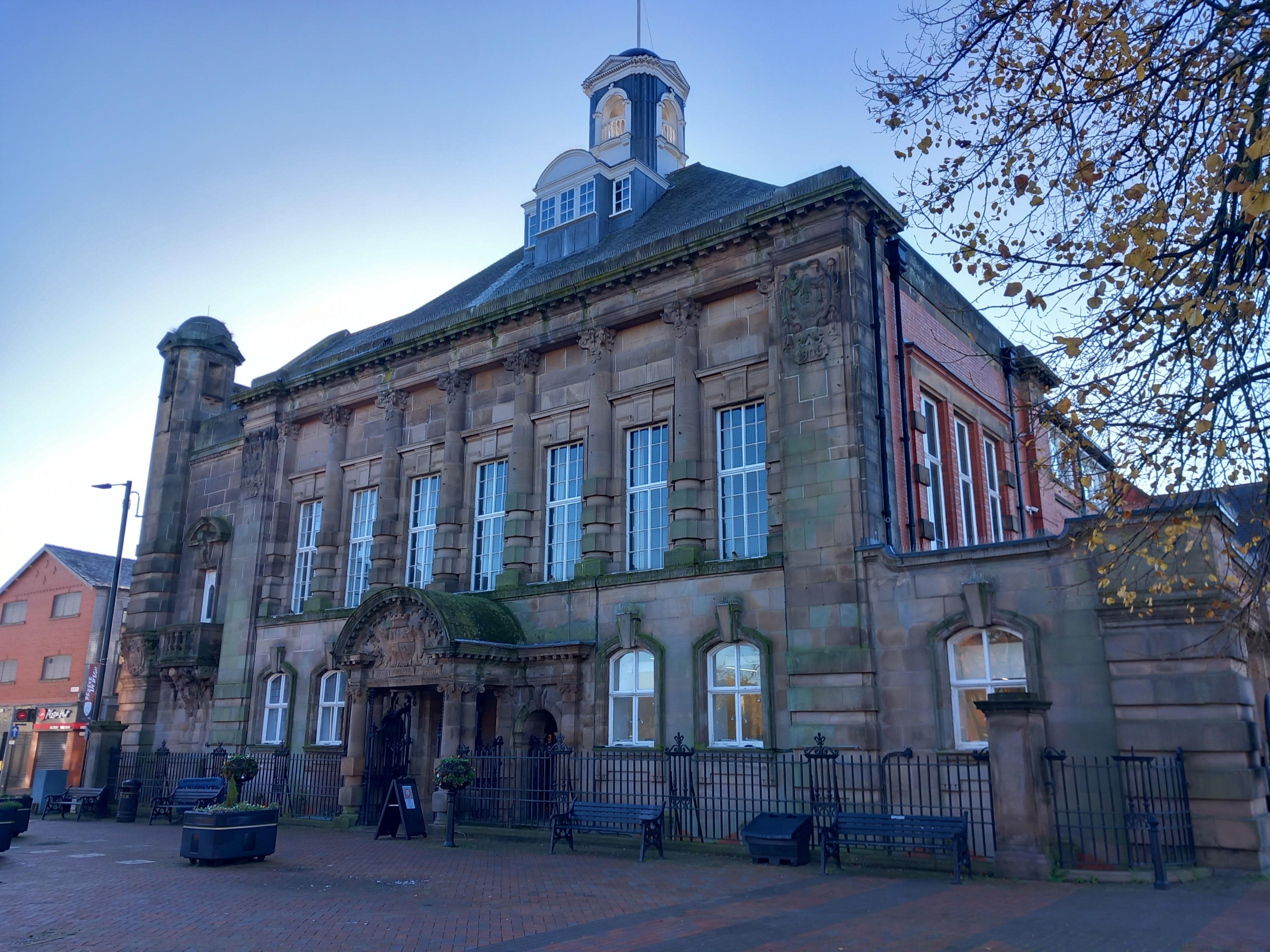
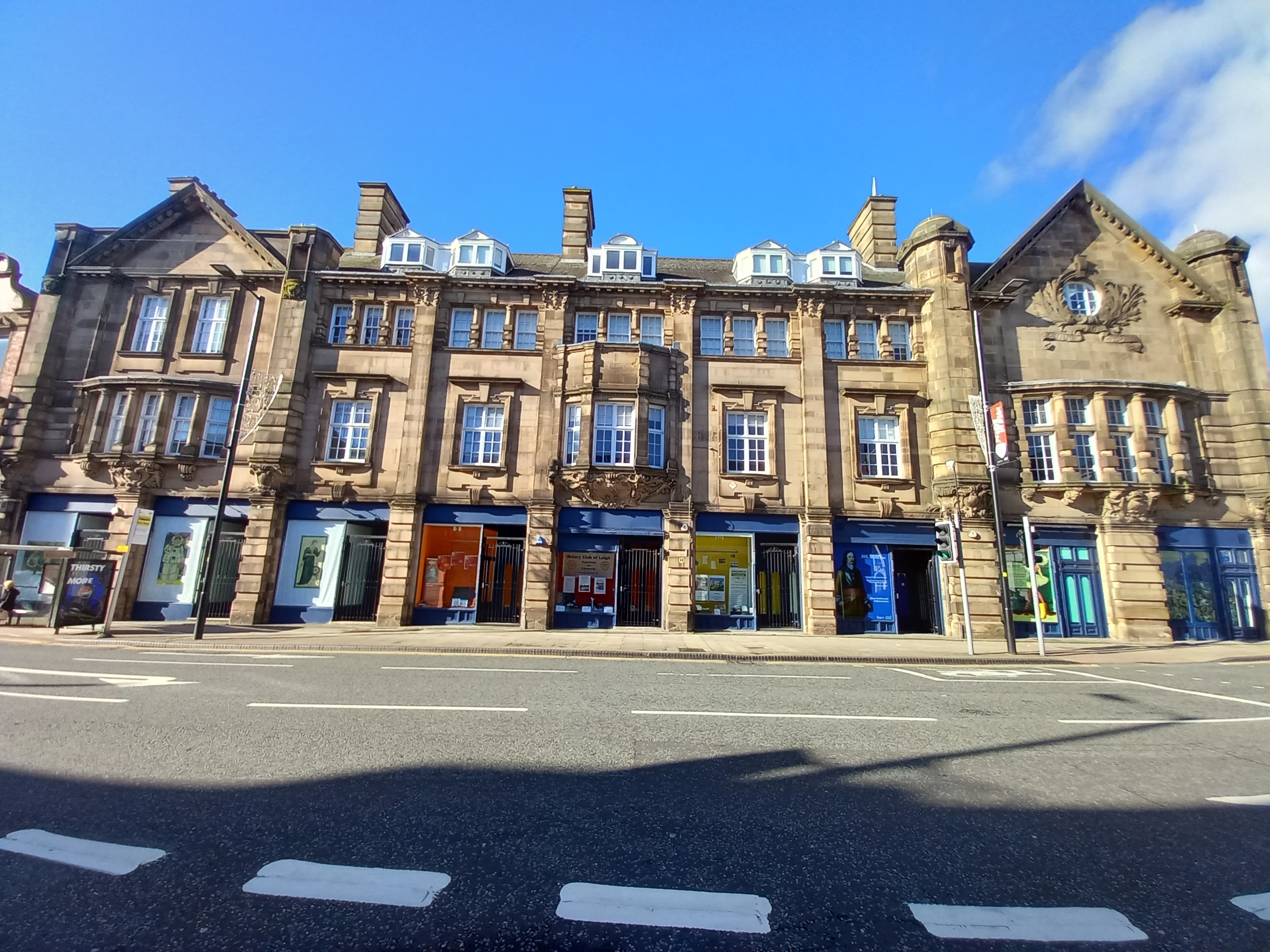
He did not forget his roots, and soon returned to set up an architectural practice in Leigh, becoming a fellow of the Manchester Society of Architects. In Leigh, he was to oversee the design of the town’s infirmary, technical college, library, Palace Cinema, Theatre Royal, The White Horse and Rope and Anchor pubs. Many of his constructions still stand, such as the stunning Leigh Friendly Co-operative Society Buildings on Railway Road, with their distinctive upper storeys of red Ruabon brick and terracotta. As leading architectural historian, Nikolaus Pevsner, later said of his firm “Any building of any merit (in Leigh) which is not a church or mill is almost certainly by the local firm of J.C. Prestwich and Sons, capable – sometimes very capable – in a number of styles”.
The foundation stone was laid by the mayor Alderman Henry Cowburn on 24th October 1904. The Chairman of the Town Hall Committee, Councillor W. Harrison, declared that the day’s ceremony was the most auspicious and important event in the history of Leigh. He stated that the want of a “more commodious and suitable Municipal Offices” had long been felt by the town.
The new town hall was built in the Edwardian Baroque style, out of Darley Dale ashlar stone. It consists of three stories, with a basement and attic. The steeply pitched roof is made from Westmorland green slate, topped by a turret and dome. The main entrance is via an elaborate porch, placed in the centre of the façade on the Civic Square. This leads into a grand entrance hall with scagliola (imitation marble) columns. A second façade is on Market Street, and on this front nine shop windows were integrated into the ground floor.
Henry Gustave Hiller designed the stained glass for the building. Hiller studied at the Manchester School of Art and based his firm in Liverpool. He was well known for his stained glass in churches throughout Lancashire and North Wales. In the main stairway, Hiller’s glass features the heraldic arms of the historical land-owning families of Leigh, namely Shuttleworth, Atherton, Bradshaw, Tyldesley, Mort and Urmston.
In the main Council Chamber, a large window by Hiller commemorates the town’s industries of weaving, spinning, commerce, education, engineering and mining. JC Prestwich’s firm also devised the furnishings for the Council Chamber and Mayor’s Parlour, which are still in place today. A raised dais was put at one end of the council chamber for the mayor, deputy mayor and town clerk. The aldermen and councillors sat in a semi-circle facing the Dias, at school-like desks, complete with inkwells. Opposite the dais, a public gallery was constructed, with room for around 50 people.
The town hall was completed in 1907. Pevsner described it as “An exceptionally good building, expressive yet not showy”. James Caldwell Prestwich’s son Harold joined the architectural practice that same year, and his second son Ernest became a partner in the firm five years later.

In 1938, King George VI and Queen Elizabeth visited Leigh. They were met at the train station by Lord Derby, and brought along a route strewn with flags and streamers to a large crowd at the town hall. There they spoke to veterans from the Boer War and First World War, including Alfred Wilkinson who had received the Victoria Cross in the latter. This was awarded for his brave act of delivering a vital message despite being under 600 yards of machine gun fire. He volunteered for the task, after four other men had died before him in the attempt.
JC Prestwich retired in 1930, but his sons continued the architectural business, and this was still going strong in the 1970s, employing fifty staff. At the start of that decade, the firm was commissioned to build the Turnpike Centre, to sit adjacent to the town hall in the Civic Square. For more on this remarkable ‘brutalist style’ building, which stands in stark contrast to the town hall, see our page here.
Recent Renovations and Increasing Access for the Public
In 2019, refurbishment of the town hall began. This was funded by a £1.3 million grant from the National Lottery Heritage Fund, which was match-funded by Wigan Council. Walter Carefoot & Sons was the contractor that undertook the renovation work. Two years later, the restoration was complete. An extensive archive in the basement was opened, which now houses records for all of the Metropolitan Borough of Wigan. This stores 800 years of documented history from churches, schools, hospitals, estates and people. A new public archive search room was also opened on the ground floor. Visitors can now use this room to research local history, or their own family trees, using online resources such as Ancestory.com, for free. They can also request items from the borough’s extensive archive, or peruse the numerous copies of Past Forward, the excellent local history magazine for the Wigan Metropolitan Borough area. (A selection of Past Forward can be seen online here).
Behind the scenes is a new conservation studio for repairing and digitising the archives. This has resulted in increased access for the public to the digital archives online. Topics of interest include the Lancashire and Cheshire Miners Relief Society, First and Second World War records, a photograph collection, a postcard collection and a manuscript collection. To access these online, see here.
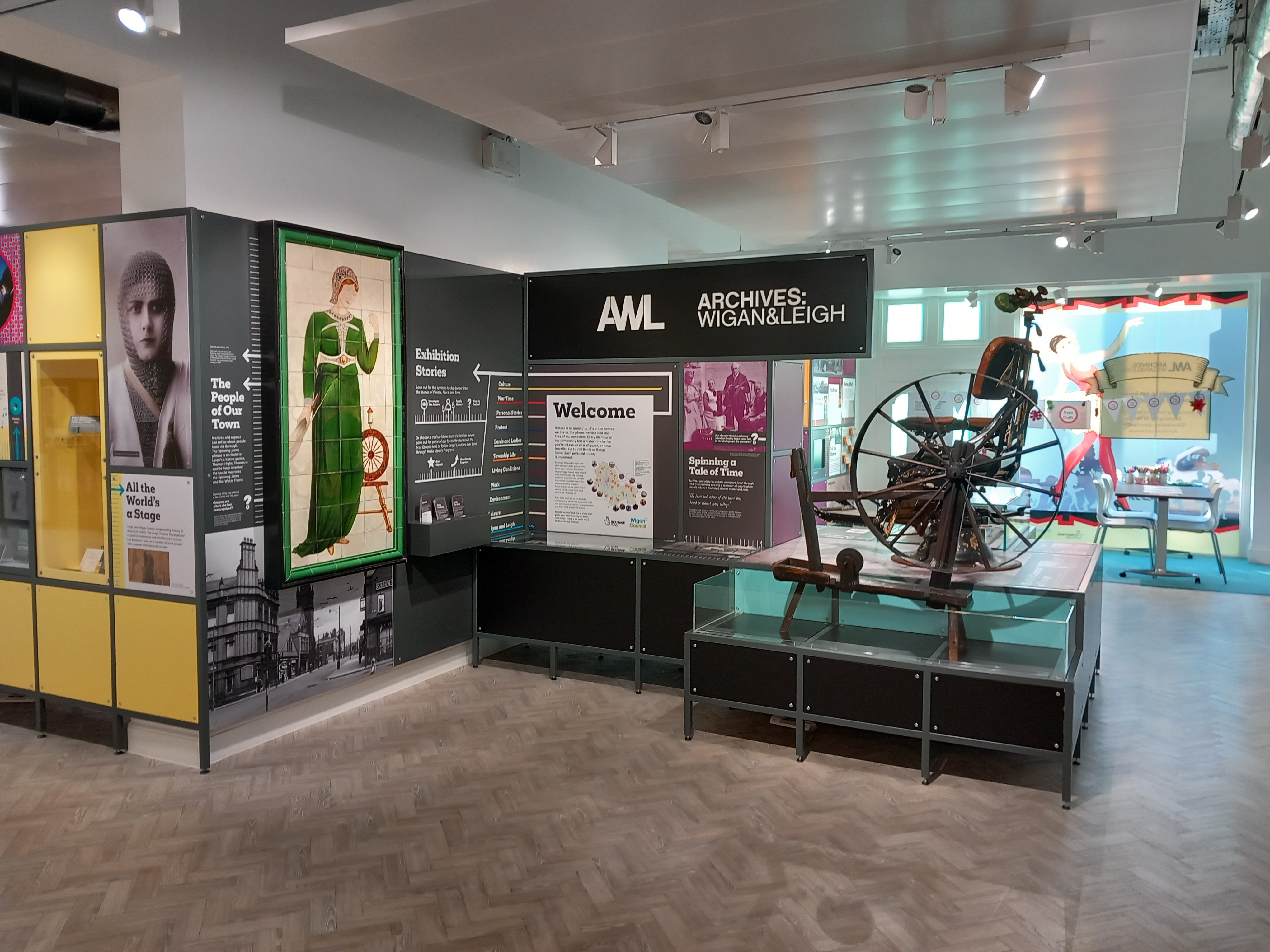
The Wigan and Leigh Exhibition Room has also been opened on the ground floor, with free entry. This features many local luminaries, and historical objects or photographs associated with them. There are so many interesting things in this room, it is hard to single out any for particular mention, but below is a short selection:
-) Royalist Orders, an important relic from the Civil War, signed by the Earl of Derby in 1642. These state that Leigh was to be held by 20 men and two horses. Of related interest is a pistol found near the site of the Battle of Wigan Lane. This was fought in 1651, when the future King Charles II tried to raise an army to regain his executed father’s lost throne.
-) Two photographs of Mary Pownall’s work. Pownall was a trailblazing artist, at a time when few women were accepted into the profession. Born in Leigh in 1862, she regularly exhibited at the Royal Academy. In 1928, Pownall was commissioned to design a First World War Peace Memorial at Watford, a very rare thing for a woman at that time. The exhibition room includes a picture of her sculpture The Harpy Celaeno, a dramatic ‘self portrait’.
-) A collection of badges commemorating the punk music of Leigh-born Pete Shelley and his band The Buzzcocks. These are on display with a pair of limited edition Buzzkicks boots by Kickers. There is also a large mural of Pete Shelley in the car park next to the town hall.
When visiting Leigh Town Hall don’t forget to drop into the Turnpike Gallery inside the Turnpike Centre, just across from the town hall. Admission is free and exhibitions are changed on a regular basis.
Access
The Town Hall Car Park is next to the town hall. There is a parking charge
The Wigan and Leigh Exhibition Room is open Tuesday to Friday 10am- 4pm, Saturday 10am-2pm. Free entry, no need to book
The Archives: Wigan and Leigh is open Tuesday to Friday 10am-4pm, Saturday 10am-2pm. It is recommended to book if you wish to use the search facilities. See here
Guided tours of Leigh Town Hall occur on the last Wednesday of each month. They are free and last around an hour. Highlights include the Council Chamber, Mayor’s Parlour and the huge basement archive. The tour guide will also explain the history of the building. For more details see the website here, or book directly on eventbrite here
Nearby
The Lost Church of St Stephen’s
Wigan’s Roman Bath House Hypocaust
References
Construction of Leigh Town Hall
Guided Tour of Leigh Town Hall, October 2023
On site interpretation panels at Leigh Town hall
Past Forward Issue No. 57 April- July 2011
Past Forward Issue No. 90 April 2022-July 2022
Leigh Town Trail comprising two guided walks in Leigh town centre. Undated, available as a pdf document online
wikipedia.org/wiki/Leigh_Town_Hall
historicengland.org.uk/listing/the-list/list-entry/1163007?section=official-list-entry
en.wikipedia.org/wiki/James_Caldwell_Prestwich
architecture.arthistoryresearch.net/firms/prestwich-sons
en.wikipedia.org/wiki/H._Gustave_Hiller
en.wikipedia.org/wiki/Alfred_Robert_Wilkinson
manchestervictorianarchitects.org.uk/buildings/leigh-friendly-cooperative-society-central-premises
Renovation and Increasing Public Access
leighjournal.co.uk/news/19395792.newly-renovated-leigh-town-hall-archives-open-public/
wigantoday.net/news/politics/boroughs-new-archive-in-transformed-town-hall-open-to-public-3290746
carefootplc.com/leigh-town-hall-race-to-the-finish/
wigan.gov.uk/Resident/Museums-archives/Wigan-Archives/viewing-the-collections.aspx
archives.wigan.gov.uk
 Lancashire Past
Comments are closed.