Soon after the formation of Rochdale Municipal Borough in 1856, it was decided that a grand town hall should be constructed to reflect this new-found status. The building would be multipurpose, having not only a Council Chamber and borough offices but also police and fire stations and a magistrate’s court.
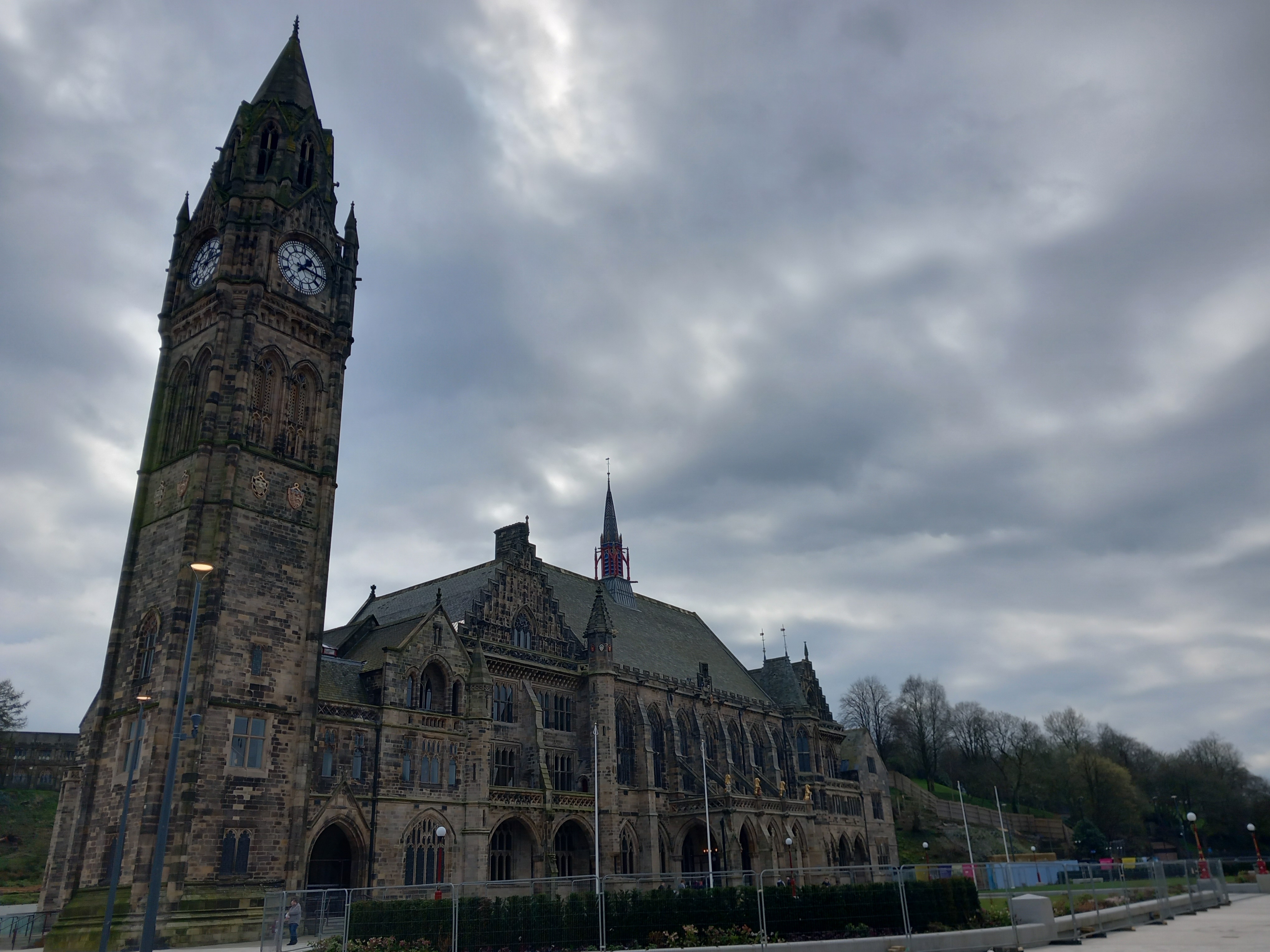
The site settled on seemed at first unpromising. It was occupied by a large abandoned house, known as The Wood, and Roch Foundry. Philosopher and art advocate John Ruskin described the place as a “havoc of ruin… The furnaces of the city foaming forth perpetual plagues of sulphurous darkness”.
Rochdale councillors visited local town halls to gain ideas as to what facilities were needed. It was decided that the police station would have a Superintendent’s Office and suite of rooms, a Night Sergeant’s Room and bedroom, a room for the Watch Committee, a Parade Room and nine prison cells. The fire station would have the capacity to house three fire engines. The courts would include a Magistrate’s Private Room, Clerk’s Office and Police Court Room. There was also provision for a Nuisance and Lodging House Inspector’s Office, Hall Keeper’s Room, Treasurer’s Office and an Office for the Collection of Debts.
Following a competition in 1864, Leeds-based architect William Crossland was selected to complete the design of the town hall. He was a relative unknown; his only previous major work was the Founders Building at Royal Holloway College in London.
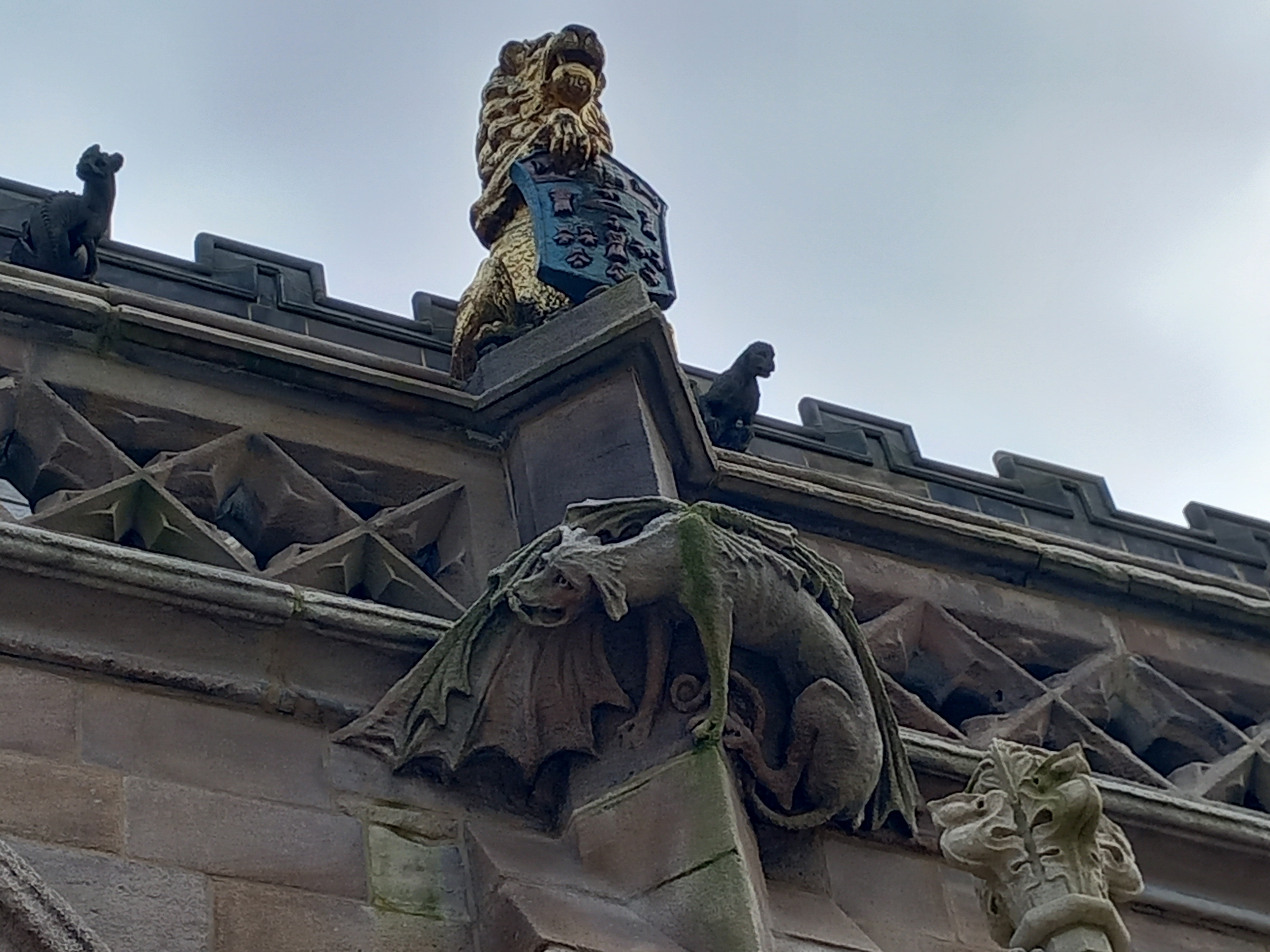
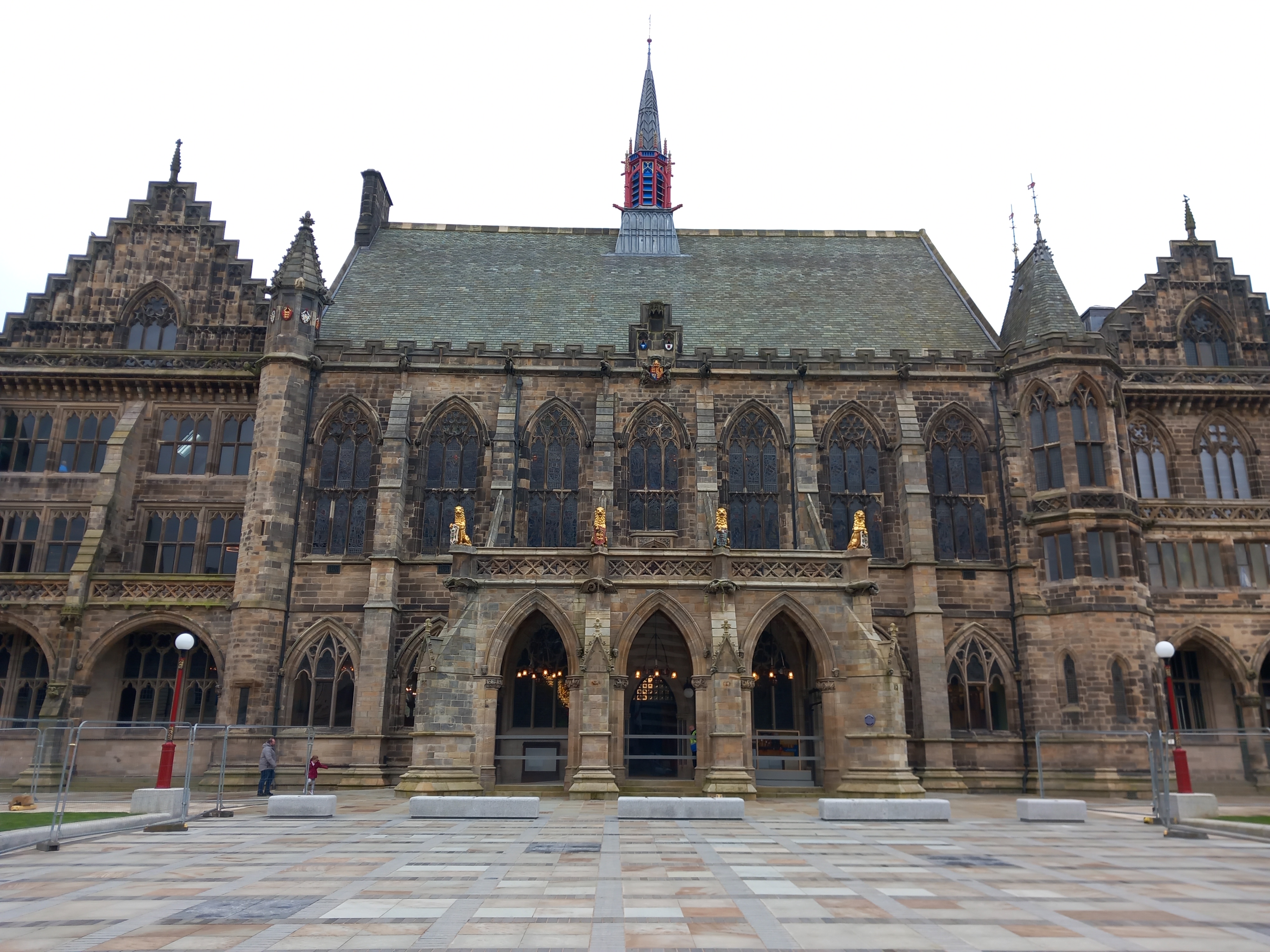
The architectural style Crossland used is known as Gothic Revival, at its peak in the late 1800s, and looked back to the designs of the Medieval past. This style can also be seen at Manchester Town Hall and Manchester Assize Courts. For the interior, Crossland also used elements from the Arts and Crafts movement which uses natural imagery of plants and animals.
Crossland split the town hall into three areas – civic, municipal and public parts. The civic wing contained the rooms used by the mayor and councillors. The municipal wing had the court, police station and fire station. The public part held Rochdale’s first free public library.
Warburton Brothers of Harpurhey in Manchester were employed as the main building contractors. Crossland brought in Heaton, Butler and Bayne, the leading stained-glass company of the era, to produce the stunning stained-glass windows throughout. Major alterations and additions meant the cost of the building continued to rise. By the time it was ready to be opened, the cost exceeded the original budget seven-fold.
The Opening
Concern over the cost was acknowledged by Mayor George Ashworth at the opening ceremony when he stated “We cannot have beauty without paying for it”. The Rochdale Observer described the building as “A magnificent municipal palace”.
A two mile long march processed to the town hall on the opening day, consisting of seven bands, four fire brigades, Friendly Societies and Sunday Schools. Six hundred special guests were welcomed in and speeches were given in the Great Hall. The public got to see the interior themselves the following month, and in the first three days over 4000 people came in to look around and buy souvenirs.
A Fire
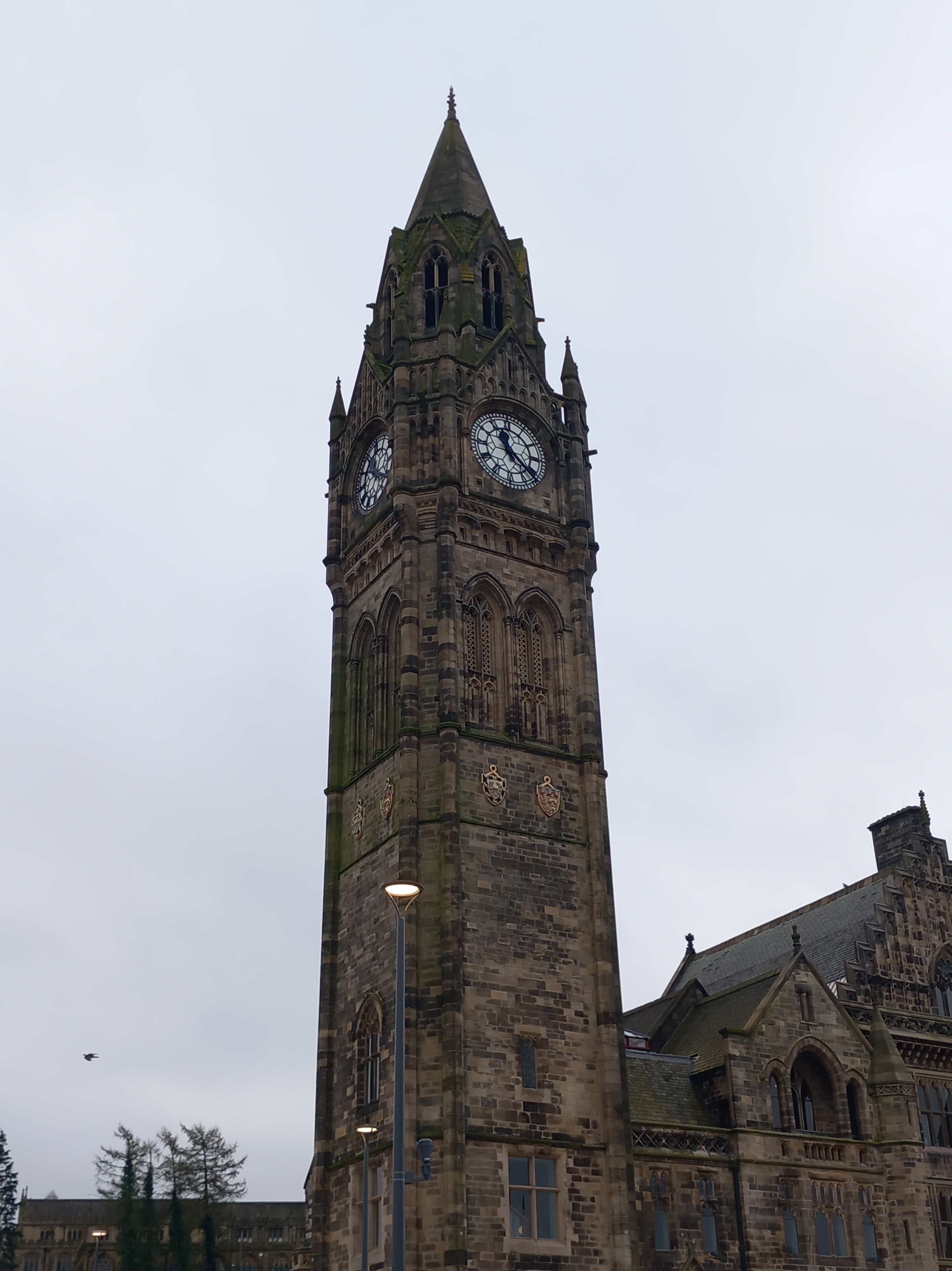
Just 11 years after the opening, dry rot was found in the clock tower and wooden spire. Remedial measures meant that the spire was to be demolished, but while this work was being carried out, the spire caught fire. Chief Joseph Wilkinson of the Rochdale brigade took charge. He immediately sent telegrams out to neighbouring brigades requesting support. Meanwhile, his own team struggled to get their steam powered engine going. The delay was so long that firemen from Oldham, Milnrow, and Bright’s Mill turned up before it was operational. When it did get working, an argument broke out as to who should be in charge, and the Rochdale brigade turned their hoses on the men from Bright’s Mill.
A crowd gathered to watch the proceedings and witnessed the statue of St George that topped the spire come crashing down to the ground. Mayor Taylor took two men with him into the library to try to rescue books. Thomas Foy and another man ran into the Town Clerk’s Office to try to pull out the records. Remarkably, no one was killed, but two policemen were badly burnt by falling lead.
The Aftermath
The damage was widespread. The spire and clock tower had been destroyed, and the tower bells melted. Many of the rooms suffered from smoke and water damage, and most of the books in the library had been destroyed. The cause of the blaze was never ascertained. Some suspected arson, others blamed the construction workers who had been dismantling the spire. Fortunately, the insurance agents paid out.
Walter Crossland was not available to design a new tower, so the contract was given to Alfred Waterhouse. He had worked on Manchester Town Hall and London’s Natural History Museum. Sensibly, his new spire was made of stone. The following year, a new free public library was opened in the building that is now Touchstones Gallery and Museum.
The Second World War
In the Second World War, a Civil Defence Control Centre was set up in the basement of the town hall. There was concern that bomb damage would destroy the windows of the Great Hall, so after all their positions were labelled, the glass was removed and stored at Rochdale’s public swimming baths. No bombs ever fell near the town hall, which perhaps has given rise to the local folklore that Hitler wanted it to be preserved. Two alternative reasons are given for this. The first is that he wanted the building removed stone by stone and set up in a new German city of Germania, which would contain other impressive buildings from the conquered countries of Europe. The second reason given is that he would use it as a command post following a successful invasion of Britain. There is no evidence for either of these stories, and in fact similar ones are told about Manchester Town Hall, the City Hall in Norwich, Senate House in London and presumably many more grand buildings around the country.
Restoration
By the new Millennium, it was clear that Rochdale Town Hall was in urgent need of multiple repairs. Both the roof and windows had been leaking for a long time. The building’s drainage system was breaking apart, and the electrical wiring had not been replaced in many years. The outside was covered in grime, and the interiors had a thick coat of dust, dirt and nicotine. In 2013, Rochdale Council came up with a bold plan to completely renovate the building. The first phase would be funded by the council, and the second more extensive phase would also use a grant from the National Lottery Heritage Fund.
In 2016, Donald Insall Associates were appointed to lead the redevelopment. They had previously worked on the restoration of the John Rylands Library in Manchester, and on the Houses of Parliament. Over a thousand people worked at the town hall to achieve the renovation. As well as building contractors and conservation specialists, a large army of volunteers was raised.
In the first phase, scaffold was erected, asbestos removed, the old electrical system taken out and a new drainage system installed. Old ineffectual interior partition walls were pulled down. The second phase began in 2021. The roof was fixed and insulated, the exterior stonework cleaned and repointed. Windows were replaced and new three lifts installed. The interior panels and painted walls were cleaned by specialists and the stained-glass, much of which was cracked or had lost its paint, was restored by York Glaziers Trust.
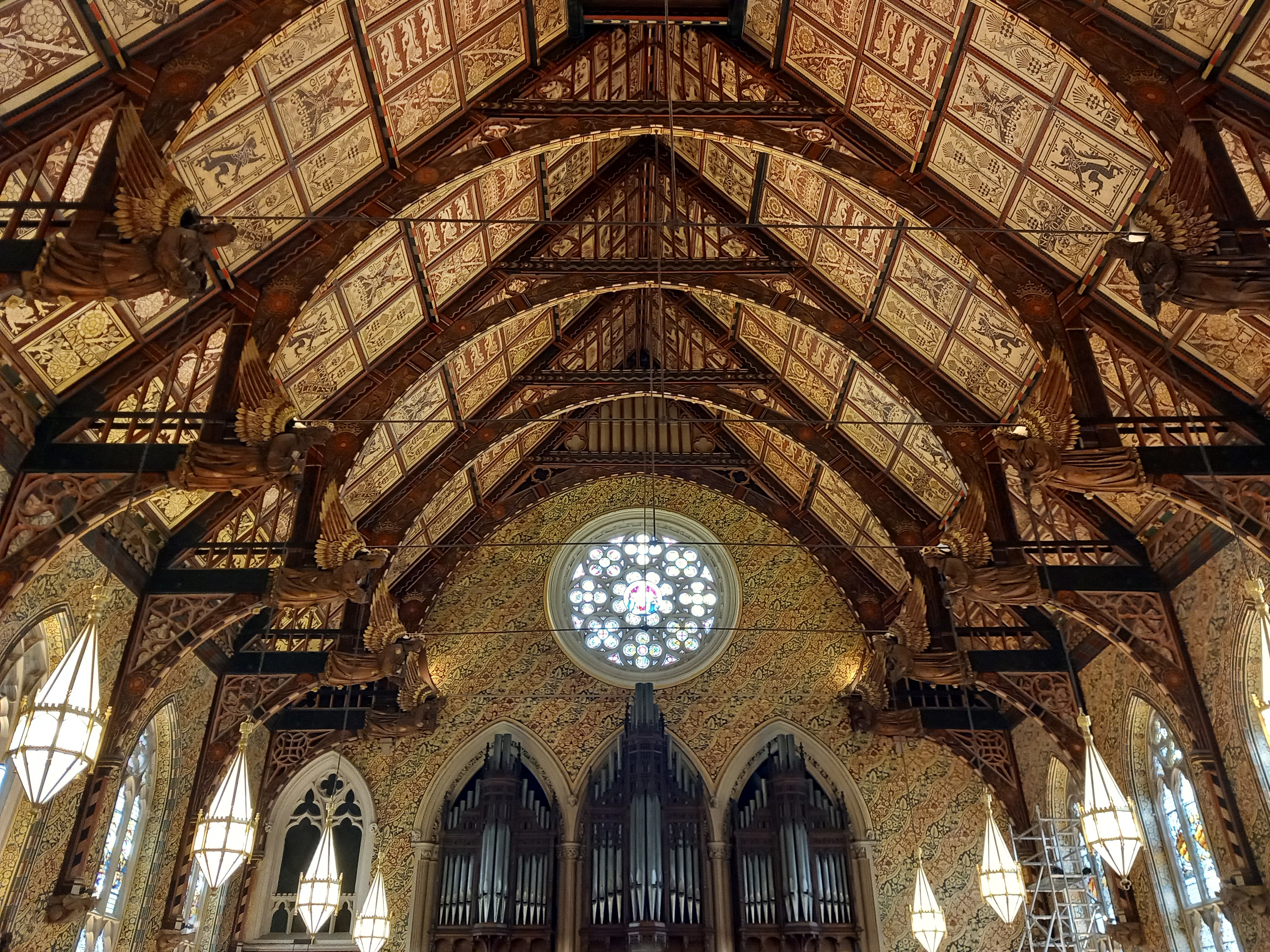
The ceiling and walls of the Great Hall were cleaned of dirt, much of this work done by trained volunteers. Some of them also worked on the sixteen larger than life angels. These had been coated with thick layers of dark varnish in the 1970s and could barely be seen from ground level. The inappropriate coatings were removed by painstaking work, restoring them to their original glory. Specialist conservators used latex cleaning poultices to take off dirt from the interior stonework. Volunteers also worked on conducting research and cataloguing the town hall collections.
A new town hall square was created by Gillespies architectural landscapers. They got rid of the car parking immediately around the outside of the building and converted it to a large pedestrianised area. Historic paving stones with etched inscriptions were laid, new lawns put down and benches installed. The area can now host large outdoor events.
The total cost of all this work was £20 million. This is a considerable sum, and part of the brief to justify it was that the town hall would become fully open to the public. It is now open seven days a week, and it is absolutely free to see the spectacular rooms within.
Visiting Today
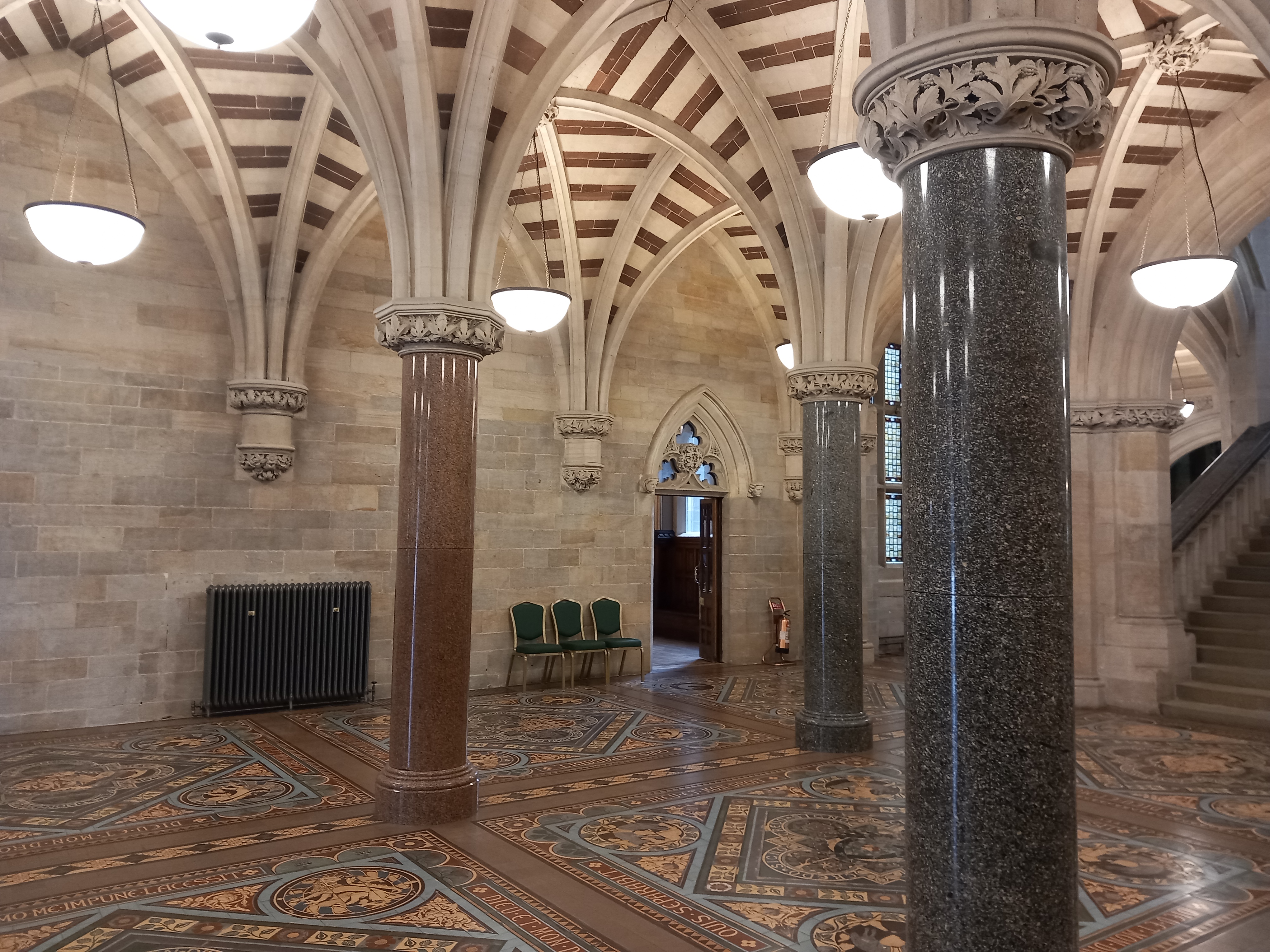
There are a large range of rooms to be seen, each with its own traditional purpose. On entering the building the visitor moves into a space known as The Exchange. This was created for cotton and wool traders to meet, but they never used this space, preferring to strike their deals in the local public houses. The Exchange became the main entrance way into the town hall, where visitors could gather before turning right into the Lecture Hall (now the Welcome Room), or left into the mayor and council chambers. The Grand Staircase leads up to the Great Hall which has hosted many official functions over the years.
The interior of The Exchange is a mix of the Gothic and Arts and Crafts styles. The Gothic vaulted ceiling is made from red and white stone from Mansfield in Nottingham, alternating to give it its striking, striped appearance. The columns that support the ceiling are of red Aberdeen granite and grey Peterhead granite. The many stone carvings are of an Arts and Crafts theme, and feature oak and chestnut leaves, primrose and geranium flowers, along with owls, squirrels and foxes.
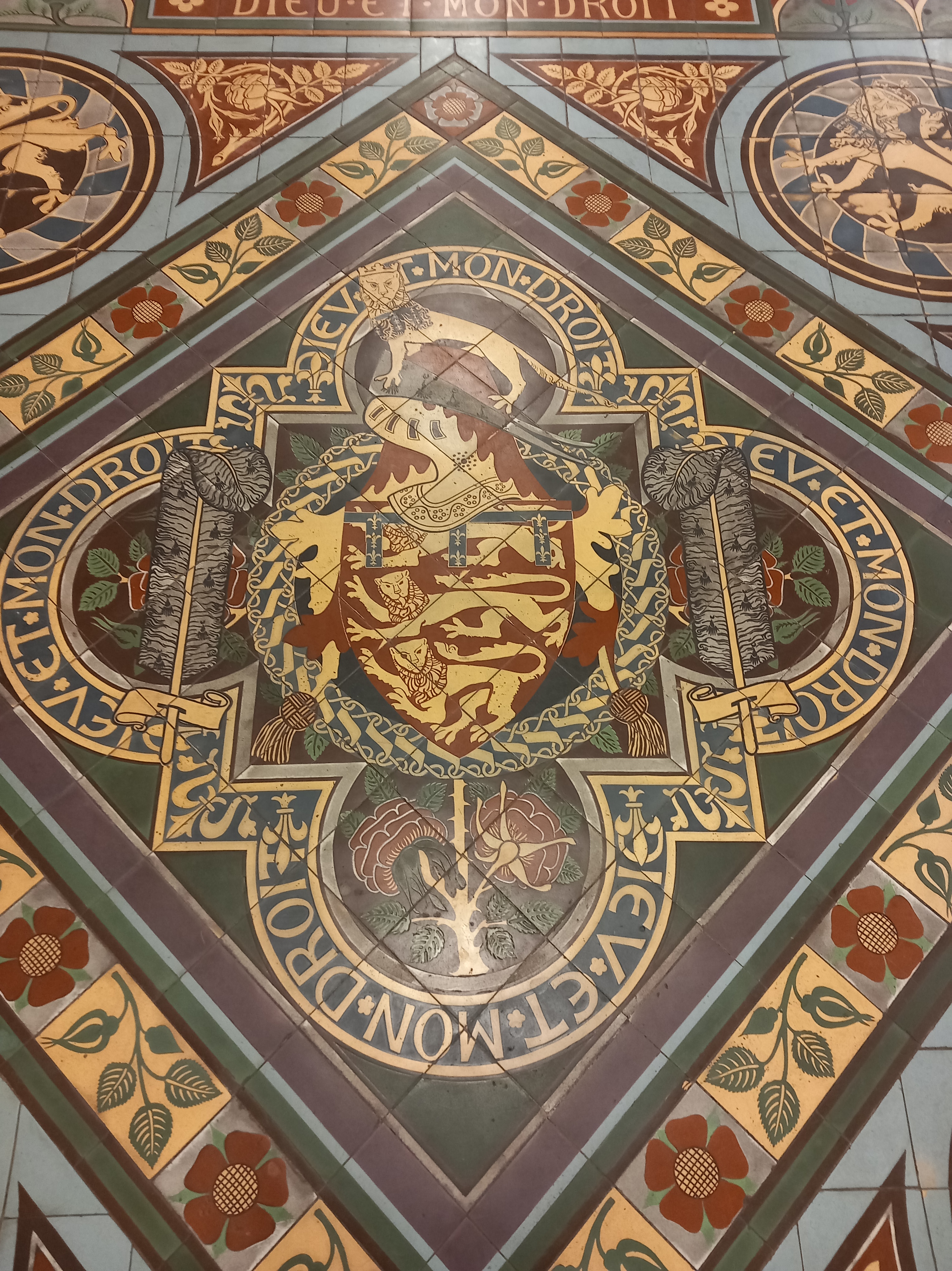
The floor tiles form twenty-one decorated squares with borough, county and royal coats of arms and crests. They were designed by Clement Heaton and produced at the famous tile works of Minton, Hollins & Company in Stoke on Trent.
The Old Council Chamber
Before the town hall was built, the council would conduct its business in local halls and pubs. This purpose-built room allowed the councillors to meet here on a regular, more formal footing. The decorative theme of the room is the history of textiles, as Rochdale’s wealth was built on these. Spinning techniques of ancient Greece and Egypt are contrasted with a power loom. Textile and dye-producing plants such as cotton and flax, indigo and madder are depicted. Visitors may also find a hidden toilet behind a swinging panel in one of the corners of the room.
The Mayor’s Suite of Rooms
Three rooms were constructed for mayorial business: an entrance room, a parlour and a reception room. The Mayor’s Parlour was where the mayor would carry out his work and hold meetings. The interior takes its inspiration from Greek mythology, the ceiling features a tree from the Garden of Hesperides. Beautiful depictions of birds and flowers adorn the walls, and the stained glass reflects the changing months and seasons. The mayor’s original desk and chair designed by Rochdale cabinet maker William Snowden are still within the room.
The Mayor’s Reception Room was designed to impress, but would have been seldom seen by the public. It was used as a dining room for official dinners, and boasts a wealth of detail and a mixing of different themes. The blue ceiling shows stars, butterflies and gold swallows. The ceiling beams have paintings from Aesop’s fables. On the frieze at the top of the walls, the tiny bird King Wren can be seen flying above an eagle. The corbels on the ceiling beams are thought to represent Councillors who had differing opinions as to whether a town hall should be built at Rochdale. Councillor Taylor, who wanted to spend the money instead on sanitation, is seen shaking his fist across the room at Mayor George Ashworth, who is holding a model of the town hall.
At the end of the Mayor’s suite of rooms is the Small Exchange. This was an entrance lobby, where visitors on official business could wait to be brought in to the other rooms. The national flowers of Britain and Ireland decorate the space. Twenty-seven local Victorian era trades are shown, along with a nod to clothing from the pre mass-produced textile era. Animals whose fur was used for clothing before the invention of spinning and weaving are also depicted.
The Grand Staircase
The huge stained-glass windows that are viewed on climbing the steps represent Rochdale’s commercial trading links. Crests of northern towns such as Liverpool and Manchester are shown, along with the further afield ports of Bristol, Belfast and Glasgow. Rochdale’s international connections are depicted by America, Canada and Australia (featuring a kangaroo). The names of the Levant Merchants, West India Merchants and East India Company are also remembered.
The Great Hall
Stunning stained-glass also surrounds the Great Hall. The theme is the royal rulers of Britain, featuring Kings and Queens from William the Conqueror onwards. The Lord Protector, Oliver Cromwell, who stands proudly between King Charles I and Charles II, had to be sent to York for careful restoration, as time had taken its toll on this particular piece. Henry Holiday designed the large mural of King John reluctantly signing the Magna Carta with his rebel barons – the first tentative step towards the democracy that we enjoy today. Holiday was inspired by the Pre-Raphaelite movement in his design, and used pictures of Medieval effigies and reconstructed armour to give an authentic sense of what the scene could have looked like.
The Bright Hall
The Bright Hall is named after the Bright family. John Bright, a local millowner, was a radical politician and campaigner for people’s rights. His brother Jacob, one time mayor of Rochdale, was similarly politically persuaded, and worked toward securing women the right to vote. His niece, Helen Bright Clarke, continued this work as a suffragette and public speaker. The Bright Hall has had a number of uses over the years. It was originally the library that was so badly damaged in the 1883 fire. Amazingly, the original stained glass windows survive and these depict Guttenberg, the inventor of the printing press, and Cadmus, the Greek hero who brought the Phoenician alphabet to Greece. It later became the base for an art school, a surveyor’s office and a music school. Since the recent building work it is now used as a community space.
The renovation of the town hall has been lengthy, and has come at a considerable cost. It is part of the ongoing restoration and improvement of Rochdale town centre. Much of the money came from the National Lottery Heritage Fund, and the part that Rochdale Council contributed came from their capital budget, which is separate from their service budget (and by law cannot be spent on local services). The decision to open the building up to the public for free is laudable. More is yet to come, as at the time of writing there are plans to open the magistrate’s court and police cells within the building too. Perhaps other councils in the Lancashire region can take note and give increased access to their historic buildings. Leigh Town Hall already has a free monthly guided tour of their building (see our page here).
Access
Free entry 10am-4pm every day of the week (except Bank Holidays). The Martlet Kitchen pop up is open similar times. See the town hall website here
Nearby
A little further afield
Watergrove Reservoir and Drowned Village
Ellenroad Enginehouse and Museum
Cowm Reservoir and Deserted Valley
References
Rochdale Town Hall Guidebook, Ruth Darling (2024) Rochdale Borough Council and Heritage Fund. Available from Rochdale Town Hall.
rochdaletownhall.co.uk
en.wikipedia.org/wiki/Rochdale_Town_Hall
investinrochdale.co.uk/regeneration/projects/town-hall
manchesterhistory.net/rochdale/CITYCENTRE/townhall.html
theguardian.com/uk-news/gallery/2024/jan/30/the-20m-renovation-of-rochdale-town-hall-in-pictures
donaldinsallassociates.co.uk/projects/rochdale-town-hall/
visitmanchester.com/ideas-and-inspiration/blog/post/the-gothic-masterpiece-of-rochdale-town-hall-and-why-its-redevelopment-matters/
 Lancashire Past
Comments are closed.