The Bronze Age burials at Pendleton contained one of the most significant and intriguing prehistoric finds in Lancashire. In a burial pot containing a child cremation, a vanishingly rare rolled gold bead, together with other unusual and rare offerings, was discovered. The site in the small picturesque village was found by chance, during routine building work.
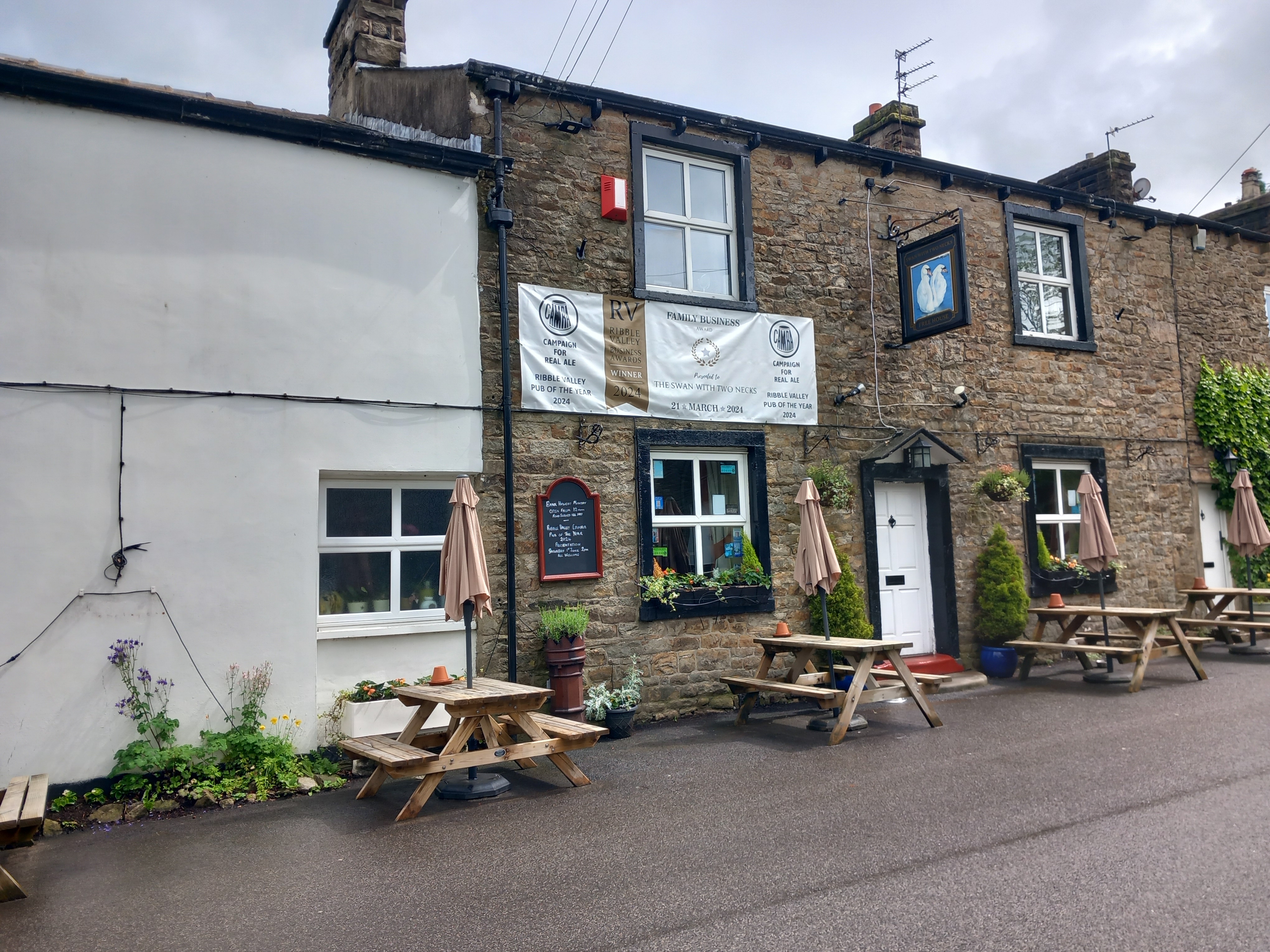
In 1968, a mechanical digger was excavating foundation trenches for a new building behind a cottage on the main street. During the process, a large Bronze Age burial pot was uncovered and inadvertently sliced in two. The digger was halted and the rest of the pot was dug out by hand.
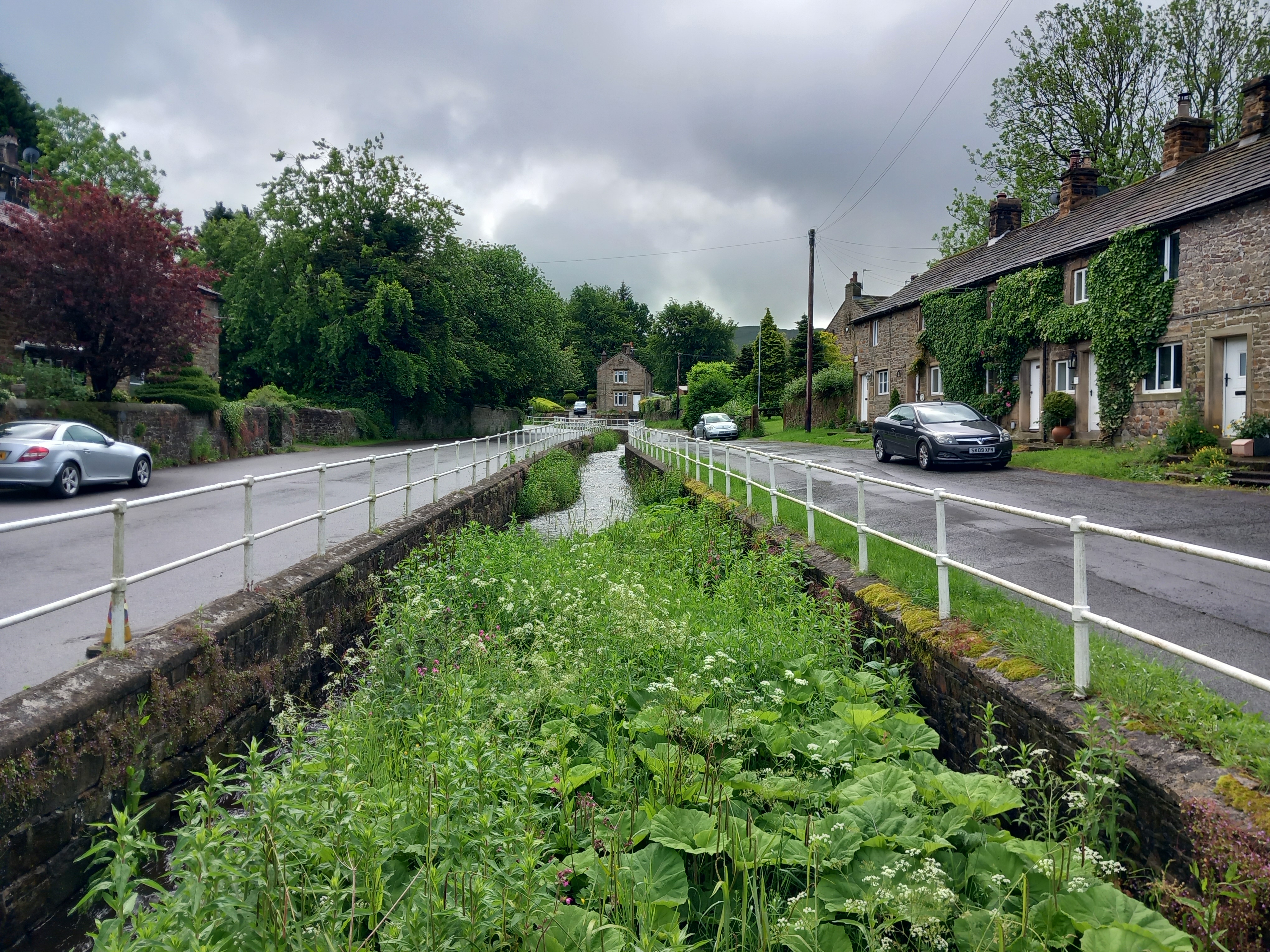
In 1975, archaeologists began to formally excavate the site, known as Carriers Croft. It lies just 20 metres from the canalised brook that runs through the village, opposite the Swan with Two Necks pub. While trenches in the surrounding fields yielded nothing, the site itself still had plenty of secrets to give up.
The archaeologists found a further two funeral pots of the type known as Collared Urns. These are the main type of vessel used in Lancashire Bronze Age burials. They were placed, upside down, into a cobbled floor. The cobbles were laid out, forming a rough mosaic-like floor, which had a worn and ‘polished’ appearance. This overlay a foundation of stone, pebble and clay. The monument appeared to be a Ring Cairn, which consists of a circular embankment with a flattened central part. The evidence for this came from a curve of stones in one of the trenches, and the fact that it lay close to the brook. There are comparable Ring Cairn sites in Yorkshire that commonly have water nearby.
The Urns and Their Contents
The pots are classed as Secondary Series Collared Urns, North Western Style, of the Early Bronze Age. Such pottery often does not survive well, as it was fired at a low temperature, making it not particularly robust in the conditions of long-term burial. This is why so often in Early Bronze Age burials only parts of a pot are recovered.
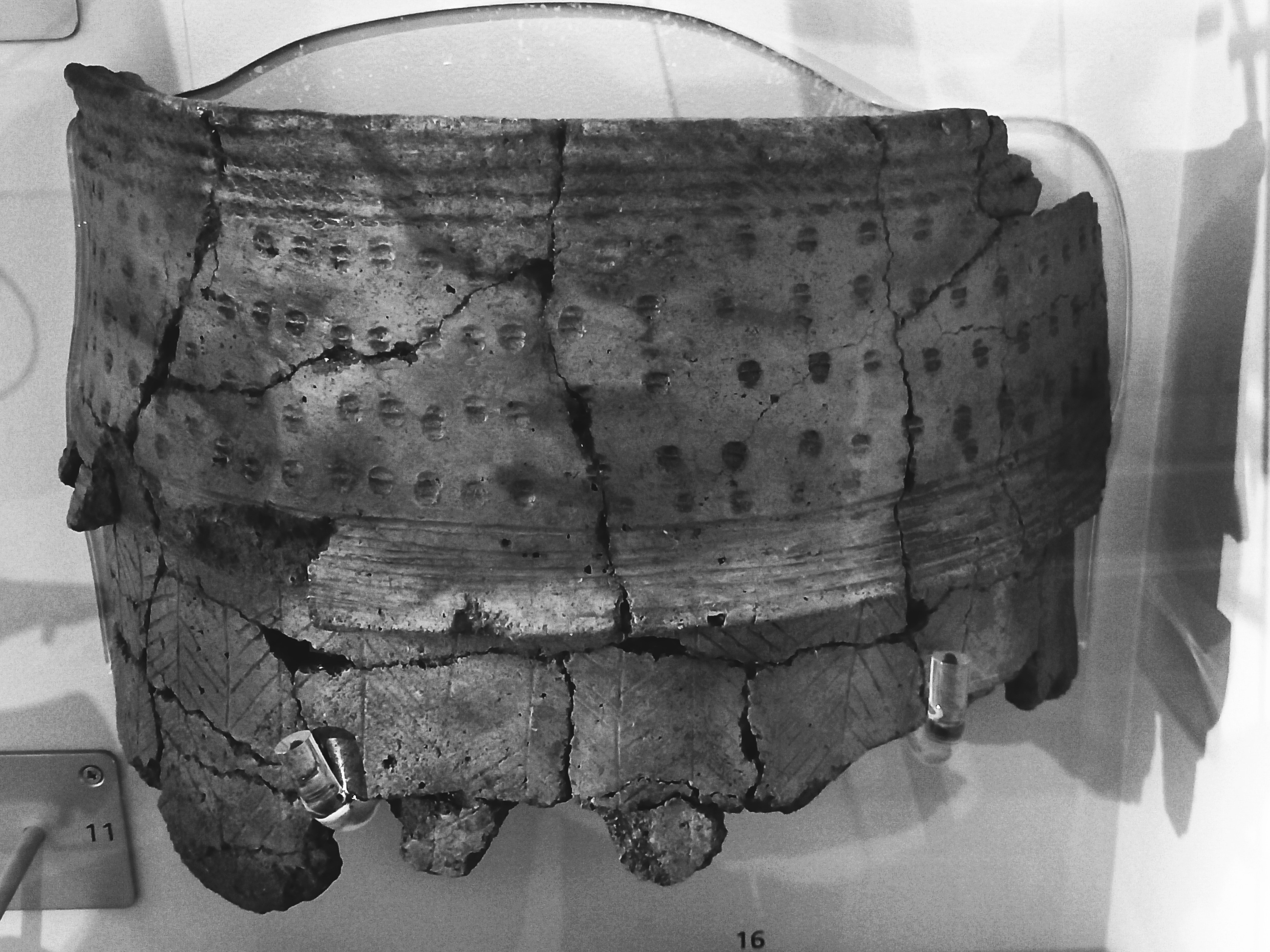
Urn 1 was the original pot found by the builders when digging the foundation for the building. It was decorated with twisted cord impressions, rows of bird bone imprints, and incised lines (all visible in the image below). No artefacts or cremated bone were discovered at the time, but this could have been because it was not removed from the ground by trained archaeologists, who were on hand to take out Urns 2 and 3.
Urn 2 was decorated by two rows of thumbnail imprints, triangles and horizontal lines. As stated previously, the urn was placed in an inverted position, with its neck resting on the bottom of the burial pit. Interestingly, the base of the urn had been broken off, along a construction join, before it had been placed into the ground. Into the pot had been placed fragments of human bone, charcoal, burnt shale and sandstone, all presumably from the funeral pyre. The mass of cremated bone, some 1160g, was put on top of this, filling the urn up. The base was then replaced, acting as a kind of lid. Analysis of the size of the bone fragments revealed that it had come from an adult male.
The really intriguing finds were discovered in Urn 3, which was decorated with two rows of dots, triangles and horizontal lines. This had a very small amount of bone, only some 239g, in tiny fragments. Analysis showed that this was the cremation burial of a child, aged between three and seven years old. The child’s bones were mixed in with charcoal and soil. Beneath the bone were stones that had been reddened by fire, and lumps of a stiff brown clay that was not found anywhere else on the site, but resembled puddled clay from which the pot was created.
This burial also contained a small funerary cup, which had been put into the funeral pyre and fired. While the large Collared Urns are always pre-fired in an oven before burial, it was common for Bronze Age people to put a small unfired ‘accessory vessel’ into the funeral pyre. When this particular one was analysed it was seen that small pieces of charcoal and bone had been used in the clay to make it. For a discussion of funerary cups and their significance, see our page on the Bronze Age burial at Ashleigh in Darwen here.
Lying with the funerary cup were five sherds of Beaker ware. This is a very rare find in Lancashire, as the Beaker people were found mainly in the south and central Britain, only extending as far north as Derbyshire and parts of Yorkshire. Why such fragments should be deliberately placed in a burial raises interesting questions, which will be discussed below.
More discoveries were to come. Amongst the cremated bones of the child was discovered a lozenge shape bone button, which tend only to occur with child burials. These are not normally found in Lancashire and is the only known occurrence of a bone button found with a Collared Urn burial in Britain. Evidence from elsewhere shows that they would belong to a shroud placed on the body before the cremation. Also rare in cremation burials, but present here, were four unburnt quartz crystals. Most intriguing of all was a rolled gold bead ornament.
The Rolled Gold Bead
The ornament been made from a thin sheet of gold, and rolled up to be a tube-like object. It would have probably been threaded on a necklace, and worn for a special occasion such as a funeral. It was small, just 12 mm by 7mm, and one of the sides seems to have been roughly cut giving a jagged edge. Two parallel lines were the only form of decoration on it. Only three similar ones have been found in Britain, and these are with Beaker burials, not Collared Urns, and nowhere near Lancashire.
An analysis of it shows that the metal did not come from England as it has a very high platinum content, which English gold sources do not. The most likely source is Brittany, where gold pieces do contain a high amount of platinum, and a good number of rolled gold beads have been found. However, it was probably not fashioned in Brittany, as French rolled gold ornaments tend not to be complete tubes like this one, but have a small unrolled protruding ‘lip’ at the end. This means it was probably made in southern England, and then brought north. The rough edge indicates it may have once been part of a larger piece of a thin flat gold sheet, and had been cut off.
How the rolled gold bead came to be in Lancashire is a mystery. It was perhaps traded, all the way from its source in Brittany, to its manufacture in Southern England, and then up to the Pennine region. Alternatively, some theorists speculate that a number of Bronze Age individuals embarked on ‘heroic’ long journeys to prove their worth, and would bring back rare, high status artefacts. In all likelihood the rolled gold bead did not belong to the child, but was placed in the ground by one of the mourners, or perhaps even by a ritual specialist who could possess such an item.
The Significance of the Artefacts found in the Child Burial
It is always difficult to try to reconstruct the meaning behind prehistoric grave goods. However, by comparing similar sites, and looking at tribal beliefs of people at similar levels of development throughout the world today, some ideas can be put forwards.
The fact that Urns 2 and 3 were inverted gives the impression that the dead must reside within their pots, or at least not return to the land of the living. Inversion means the soil beneath forms a thick barrier over the open lid, forming a seal. Professor Alice Roberts makes a salient point in Ancestors, her book on the Prehistoric Britain. She states that although tribal people revere their ancestors, at the same time they fear the recent dead, believing they could return to haunt them. In some cases, there is evidence of a belief in an upside down underworld, which mirrors our own. This too could also be the reason why the pots are inverted so the spirits of the dead could emerge into that world. See our page on the Winter Hill Bronze Age burial for a full discussion of this, here.
The sherds of Beaker ware are an unusual find in a Lancashire site, although a few other sites do exist. Fragments have been found in burials around the Morecambe Bay area, at Extwistle Moor near Burnley, Portfield at Whalley and Castleshaw near Saddleworth. Dr David Barrowclough in his 2014 paper on Pendleton speculates that the sherds could originate from a nearer location to Pendleton, that of Lower Brockholes. This is a site by the banks of the River Ribble near Preston which has been excavated in recent years. Here two middens (pits containing thrown away or broken things) were found to contain Beaker ware. He suggests that fragments were taken from here, to be buried at Pendleton with the child, while other parts may have been kept by the family.
Quartz crystals are not normally placed within a burial, but some have been discovered at Mosley Heights near Burnley. It is not easy to say what the significance of these four crystals were, but their pale milky appearance, and the fact that they can generate light and heat when struck together, may have marked them as important.
Barrowclough draws the gold bead, the sherds of Beaker ware and the quartz together, and speculates on their significance. Pot, made of clay, is transformed when fired. Quartz has electrostatic properties when struck together. Gold is unlike other metals, in that it does not tarnish. These items were perhaps seen as amulets, to help the deceased child in the afterlife. The fragments of Beaker pottery could already have been very old by the time of the burial. These would be seen as powerful artefacts coming from outside of the region. Alternatively, they could have been in possession of the tribe for some time, and so have been seen as important heirlooms.
The fact that they were in the child’s grave, and not the adult one, speaks to the status differences accorded to individuals, perhaps in connection to powerful families. Most people in the Bronze Age would not have their cremation remains placed in pots and buried in monuments. They were most likely cremated and had their ashes scattered in the landscape. Only a select few ended up having their bones interred in pots and placed in a burial monument.
Visited by A. and S. Bowden 2024
Access
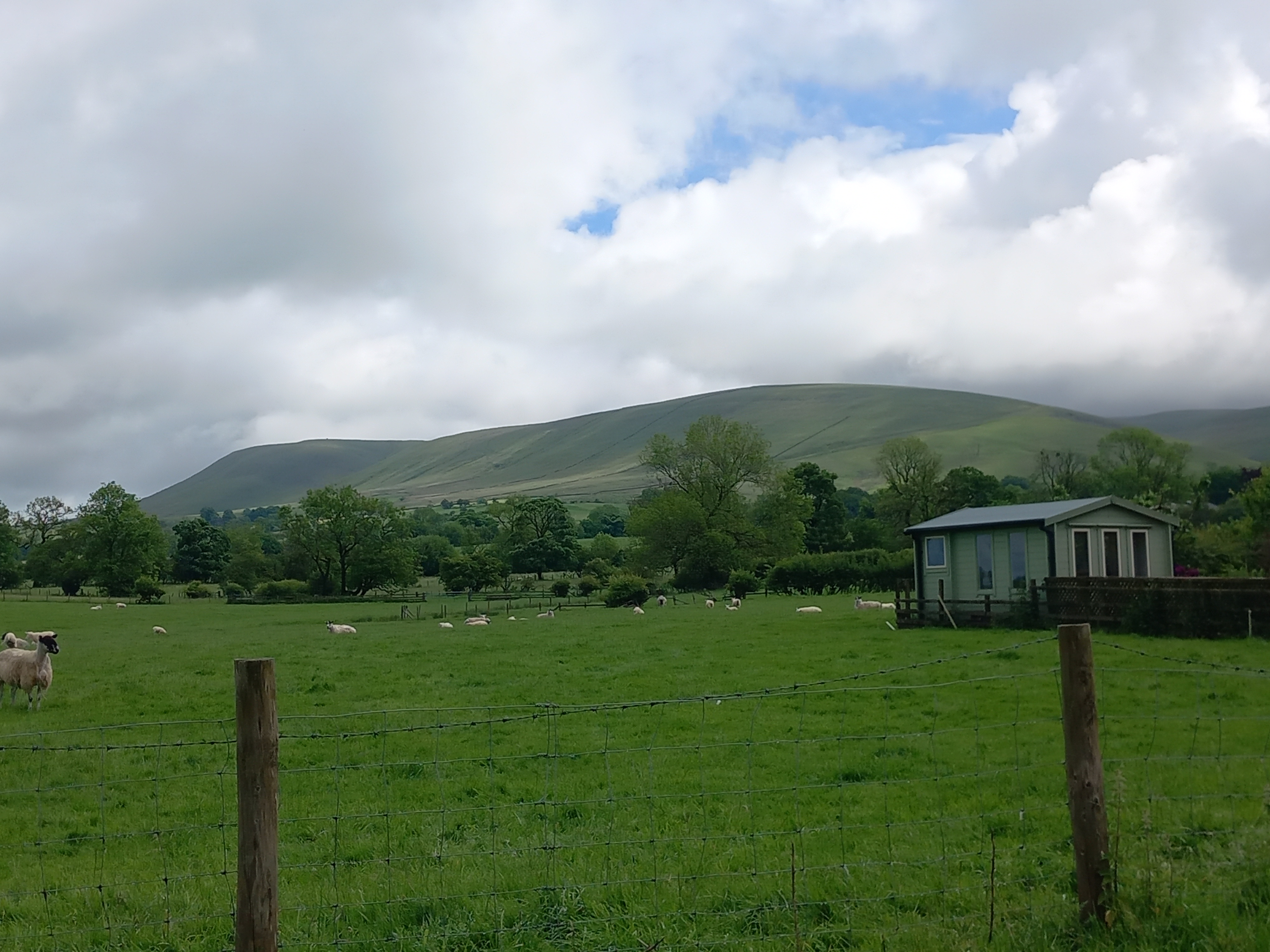
It is worth visiting Pendleton village to get a sense of the area where the burial happened. At the foot of Pendle Hill, there are good views out towards it and other surrounding hills. The canalised brook that runs through the village is likely to be close to where it was in Bronze Age times and, as has been stated, the Ring Cairn was deliberately put in close proximity to it. As the brook leaves the village it is no longer canalised, and perhaps a sense of its original size can be seen.
The actual site where the pots were discovered is on private property in the grounds of Carrier Croft bungalow, behind one of the cottages on the main street in Pendleton – so obviously there is no public access. The cottage is directly opposite the Swan with Two Necks pub. Standing at the brook at this point puts a person within 20 metres of the burials.
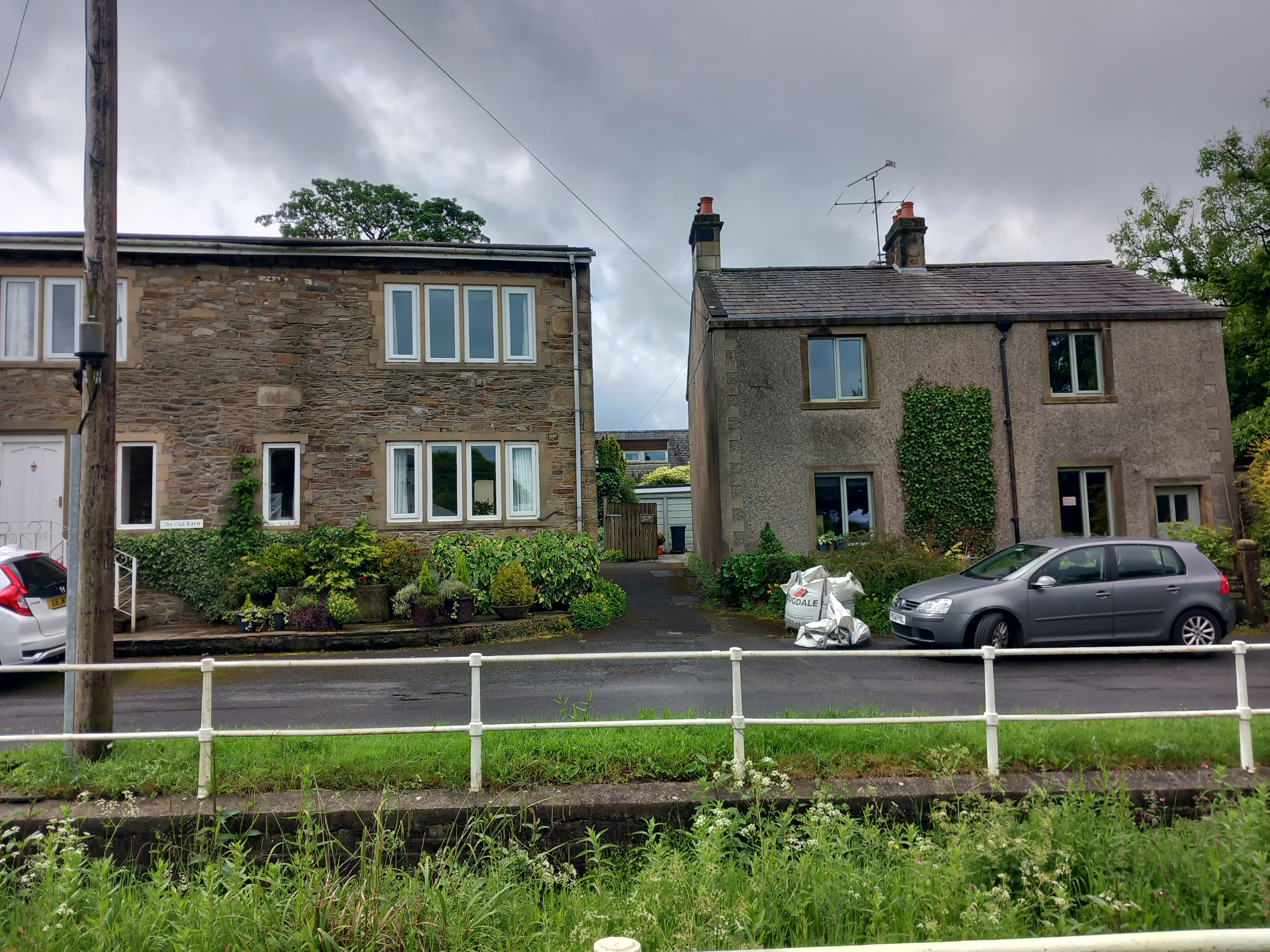
There is a car park shared between Pendleton Village Hall and the Swan with Two Necks.
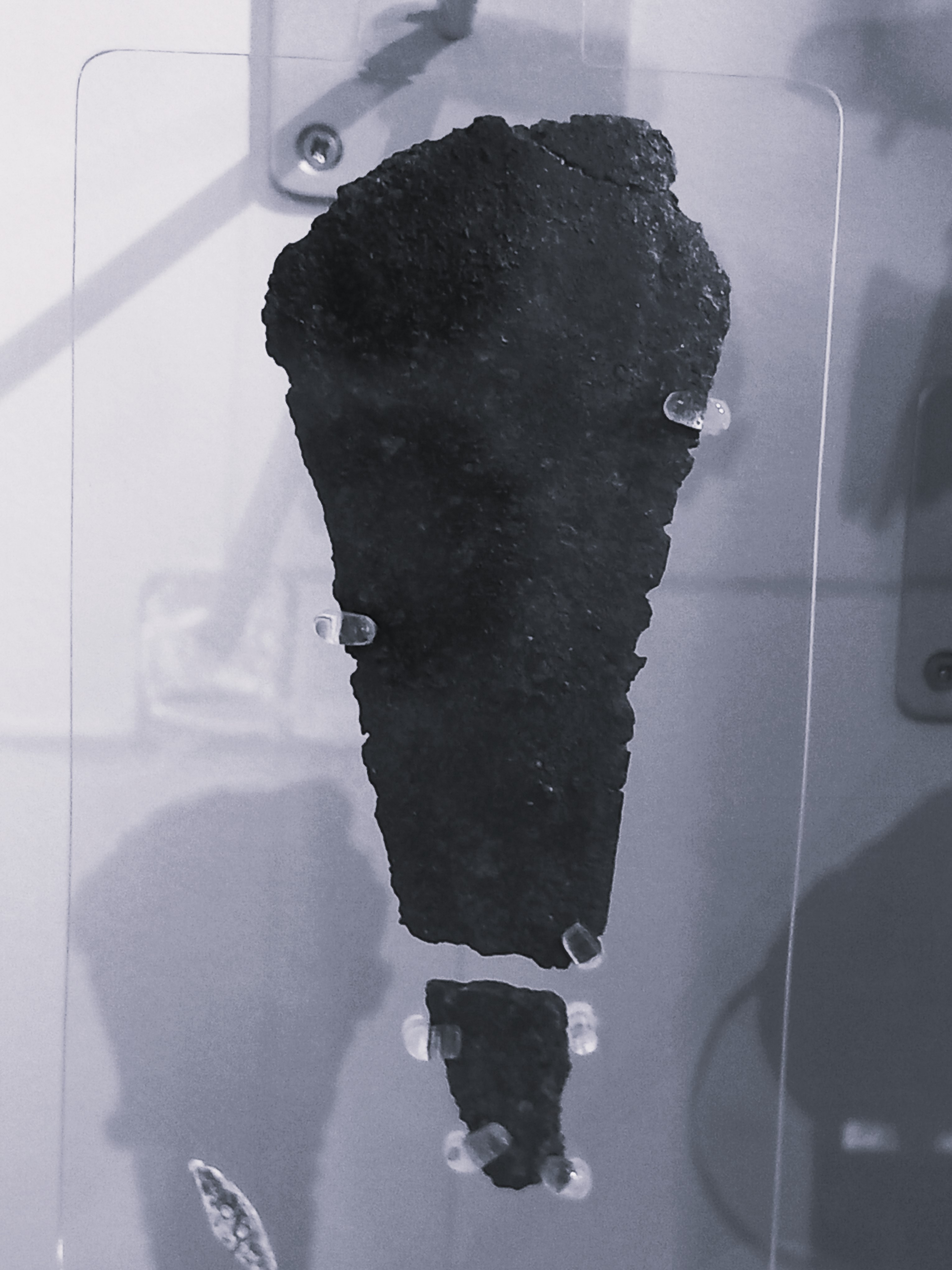
In Clitheroe Castle Museum, there is a prehistoric display that features one of the Pendleton Collared Urns and the bone button, along with a Bronze Age dagger that appears to have been found elsewhere in the village area.
Site visited by A. and S. Bowden 2024
Nearby
Dandy Dog and the Pendle Witches
References
Golden Biographies: The production, curation, fragmentation and deposition of Amorican-type rolled-gold bead-like ornaments found at Pendleton, Lancashire David Barrowclough (2014) Archaeological Journal 171 . This fascinating article goes into greater depth and discussion about the Pendleton Urns and their contents. It can be read for free as a pdf document at Academia.edu (you need to register with the site before you download the document, but that is free to do so).
Prehistoric Lancashire David Barrowclough (2008) The History Press. This book remains the definitive account of Prehistoric archaeology in Lancashire and is still available new or second hand.
Ancestors: A prehistory of Britain in seven burials Alice Roberts (2021) Simon & Schuster
The inverted dead of Britain’s Bronze Age barrows: a perspective from Conceptual Metaphor Theory (2021) Rob Wiseman, Michael J. Allen, Catriona Gibson, Antiquity Volume 95 (381): 720-324. Published by Cambridge University Press and available as a free pdf online.
 Lancashire Past
Comments are closed.