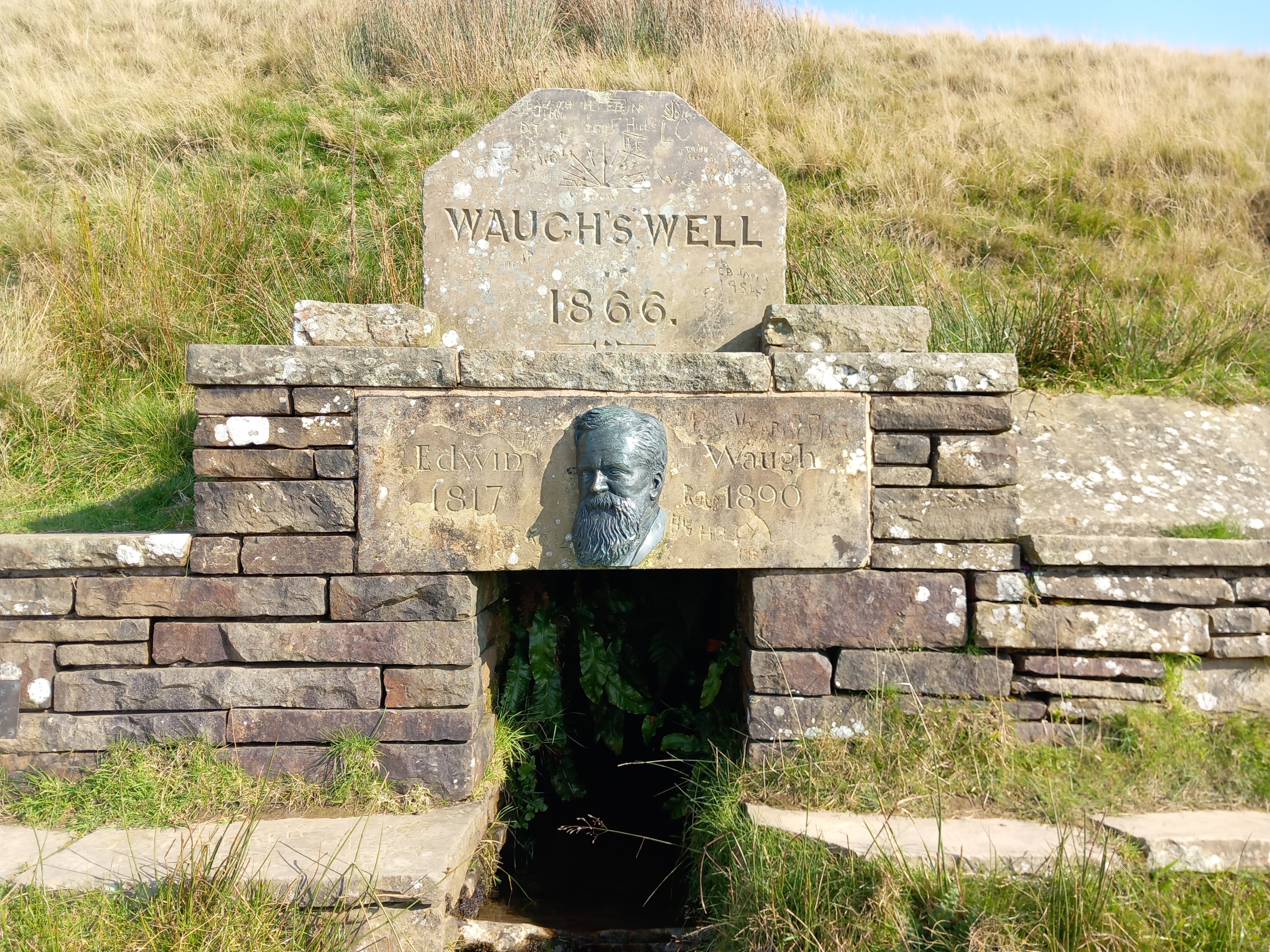
Waugh’s Well is built around a natural spring, high up on Scout Moor. It was a favourite place of Lancashire’s most famous dialect poet, Edwin Waugh. Born in Rochdale in 1817, Waugh rose from humble origins to become a chronicler of the lives, hardships and landscapes of the Lancashire working class. Perhaps surprisingly, the well was dedicated to him within his own lifetime, and remains now a place of frequent pilgrimage some 150 years after its construction.
When Edwin was just nine years old, his father, a clog maker, died. This meant poverty for the family, but his mother was able to keep him in school until the age of 12. He left to work as an errand boy for printer John Walker at Townhead. Two years later, he was apprenticed for seven years to printer Thomas Holden. While working for Holden, he educated himself by reading any books he could lay his hands on.
At age 22, Waugh started working as a journeyman printer, residing in Durham, Wakefield and London. In 1844, he returned to his former master Thomas Holden, but their relationship proved difficult. Holden was a Tory and Waugh a Liberal, and their clashing views probably caused Waugh to leave three years later. He took up a new job in Manchester as Assistant Secretary to the Lancashire Public Schools Association. That same year he married Mary Ann Hill.
Two years later, he had accrued heavy debts, and was struggling with alcoholism. Mary moved back to Rochdale and in 1855 they became permanently separated. That same year he borrowed £120 to self-publish his book Sketches of Lancashire Life and Localities. It was not this though that would make him famous, but a poem published a year later. Come Whoam to thi’ Childer an’ Me, printed in the Manchester Examiner, caught the public’s eye. It is the lament of a wife to a husband, asking him to leave the pub and come home to his family. The poem was subsequently printed on penny postcards and sold thousands of copies. More dialect writing followed, with the collection entitled Poems and Songs cementing his fame.
This success meant that in 1860, aged 43, Waugh was able to put his efforts into writing and performing his works full time. By now a regular contributor to the Manchester Examiner and Manchester Weekly Times, he would write essays about the Lancashire Moors, and trips further afield to the Lake District, Scotland and Ireland. These essays were also sold as pamphlets.
The Origin of Waugh’s Well
In 1865, Waugh was still having problems with alcoholism. His friend Edmund Chattwood of Bury suggested he go to live at Foe Edge Farm, high up on the moors above Edenfield. This remote spot was perhaps a way to recover and remove further temptation. It was occupied by Bill and Ann Taylor who welcomed him in and he initially stayed for a few months.
Close to the farm was a fresh water supply that Waugh described as “a rindle of cold spring water”. The following year, a group of his friends sought permission to erect a stone by the side of it, dedicated to him. With the assent granted by the landowner, a Mr Collings of Clitheroe, the stone was duly installed,. A celebratory dinner was partaken at the farm, after which the well was dedicated. Waugh would return to the farm and the well many times during his life to have somewhere quiet to write. Over time, the appearance of the well would become more elaborate as Waugh’s fame grew.
In 1867, Waugh published his most important book on the conditions of the working class, Home Life of Lancashire Folk during the Cotton Famine. This terrible era saw the collapse of the cotton industry, in part due to a blockade on imported cotton during the American Civil War. Starting in 1861 and lasting five years, Lancashire went from being the most prosperous region of the country to the most impoverished. To promote the work he began a tour of northern towns, giving penny readings. He continued touring for the next couple of years, extending his journeys down into the Midlands. When giving readings from his books of poetry or essays, he paid little attention to his dress, appearing in large boots, thick tweed and accompanied by a heavy walking stick.
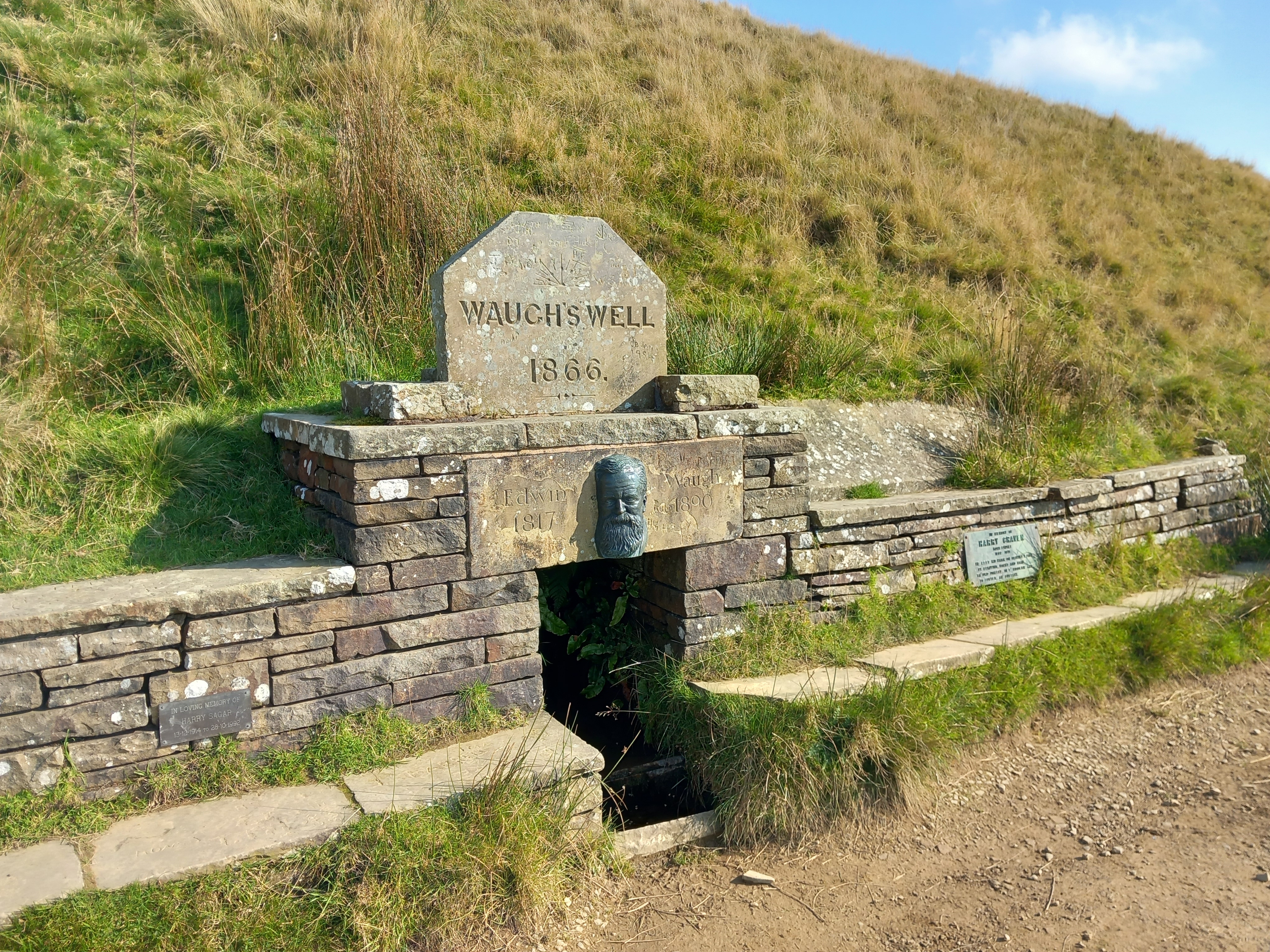
In 1877, aged 60 and with his health failing, Waugh moved to Kersal Moor near Prestwich, to take advantage of the cleaner air. Four years later, he was granted a Civil List pension. That same year, Waugh’s Well was expanded to resemble more closely what can be seen today, including the seating area on the bank. The work was done by a farmer from nearby Silocks Farm, the excellently named Bob O’ Dick O’ Giles.
By 1883, Waugh had moved to New Brighton, presumably once again for health reasons. He died seven years later and his body was brought back to St Paul’s Church at Kersal Moor, where his grave can still be seen today. His contribution to dialect poetry, both in composition and in his standardisation of how dialect words should be spelled had led him to be dubbed ‘The Burns of Lancashire’. In 1900, a memorial was erected to him and three other dialect poets in Broadfield Park in Rochdale. Unfortunately, around the same time, the original commemorative stone on Waugh’s Well was accidentally broken.
Waugh’s Well Becomes a Place of Literary Pilgrimage
On June 23rd 1917, Lancashire Authors Association celebrated the centenary of Edwin Waugh’s birth. They organised two sets of walkers, one group beginning in Waterfoot, the other from Edenfield, to head over the moors to meet up at the well. There, Samuel Compston addressed the several hundred strong crowd standing in windy weather, giving them a history of the well.
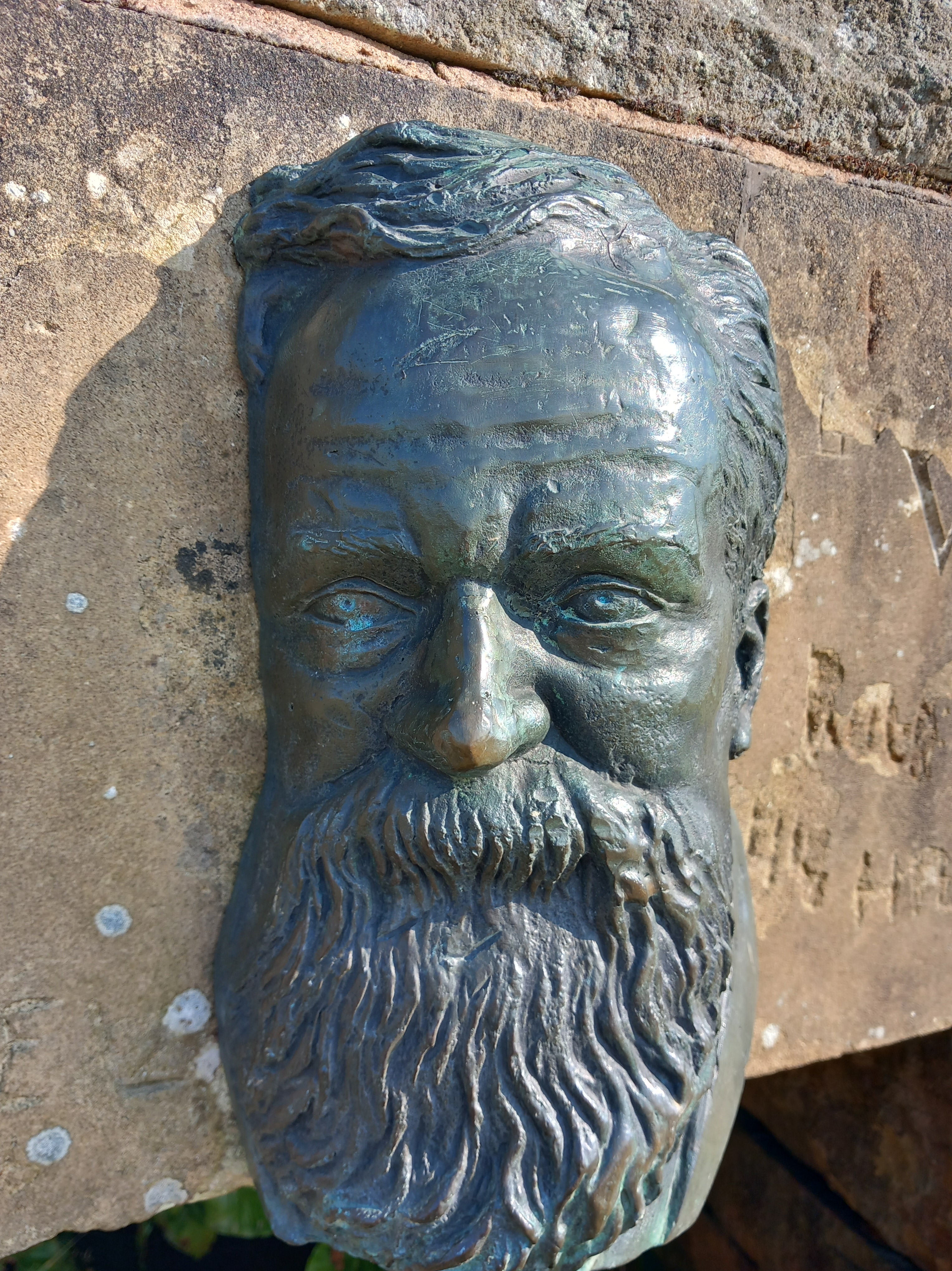
In 1938, the Edwin Waugh Society was created. Although membership lapsed during the war, it was reformed soon afterwards. In 1966, the society, together with the Lancashire Authors Association and Pennine Paths Protection Society planned a major restoration of the well. Mrs N. Lord of Newchurch created the bronze head of Waugh, and the well was remodelled by Mr Baldwin and Mr Sagar of Rawtenstall. On July 16th, a crowd of over 400 gathered for the rededication ceremony. Among them was famed author Jessica Lofthouse, chronicling the occasion in one of her many books that did so much to promote the historical heritage of Lancashire.
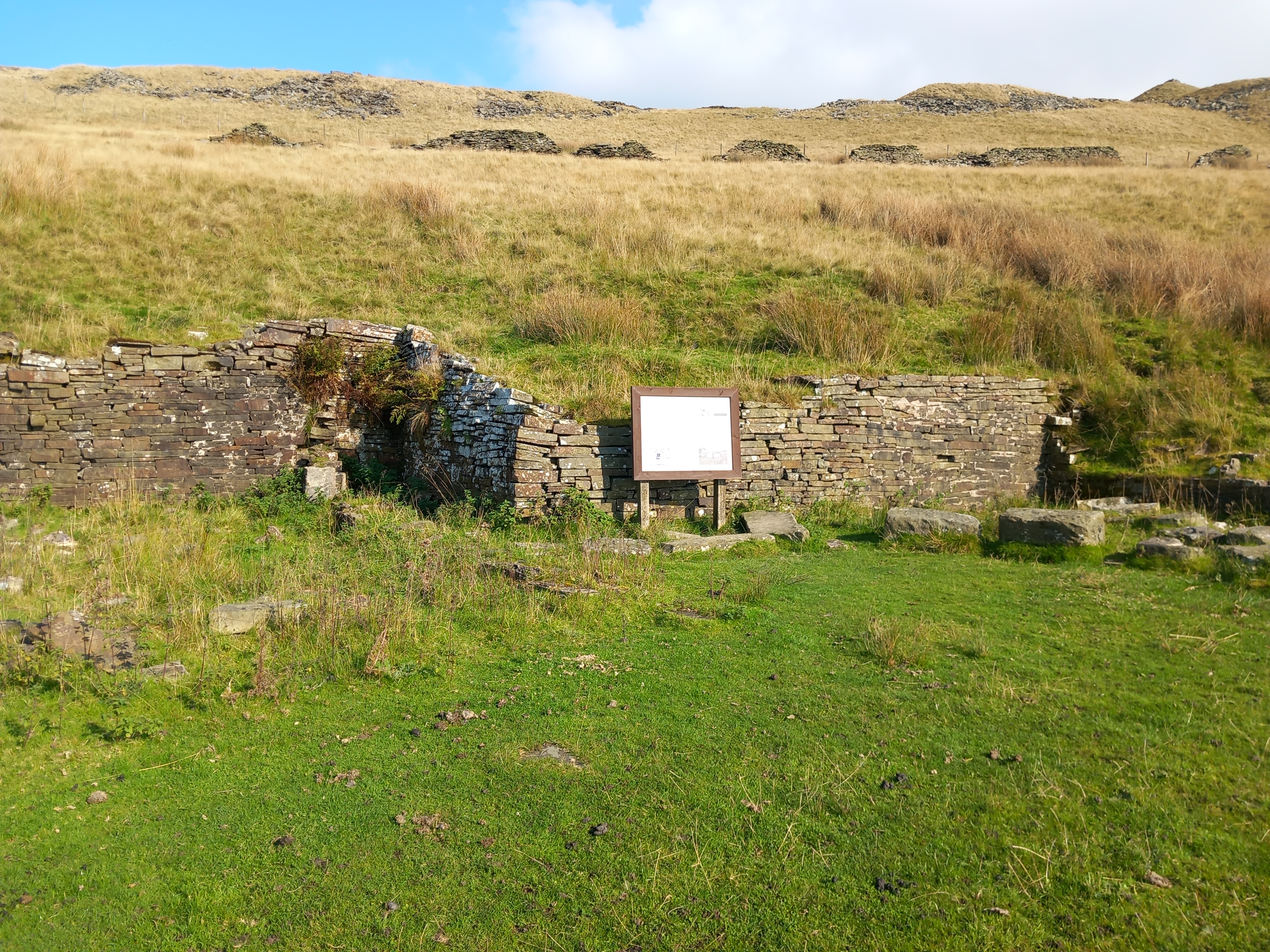
Local historian Stephen Oldfield in his book The Mystical Moors tells how as a young boy he pestered his dad to take him out to see Foe Edge Farm and Waugh’s Well. He had been told that years ago his great aunt had lived at the farm during the First World War, when her father was the water bailiff for the reservoir below. Stephen and his father struggled through thick snow to get to the site, and were welcomed in for a hot drink by the farmer’s wife. Three years later when he returned in 1979, he was inconsolable when he saw that Foe Edge Farm had been destroyed. North West Water Authority, the owners of the farm, had not been able to find a new tenant farmer for such a remote spot, and so had knocked it down. Walkers of the Lancashire region will be familiar with many demolished farms that litter the landscape, courtesy of North West Water and its predecessors. In 1985, the Rossendale Groundwork trust were funded by the water authority to clean up the site where the farm once stood. Now only the back walls of some of the farm buildings remain, dug into the bank.
A New Interpretation Board
On New Years Day in 2022, local business man Matthew Kendall saw that the interpretation board at Foe Edge Farm ruins was missing its lower half. He contacted both the Edwin Waugh Dialect Society and landowners United Utilities to see about getting a new board installed. In July the next year, Matthew, together with John Pye (the publicity officer for the society) and Graham Barnes, whose father had been the reservoir warden when he lived at Foe Edge Farm, did a reconnaissance trip to the site. A month later, the newly designed board was ready to be installed. Matthew kept the wording as close to the original as possible, but added an updated map and a QR code link to the Edwin Waugh Dialect Society website. He drove his vehicle as close as he could, presumably using the access road to Scout Moor turbines. Then he strapped the sign to his back and carried it along the winding moorland footpath. It is now installed by Foe Edge Farm ruins, and explains the importance of the farm and the well in the life of Edwin Waugh.
Visiting the Well Today
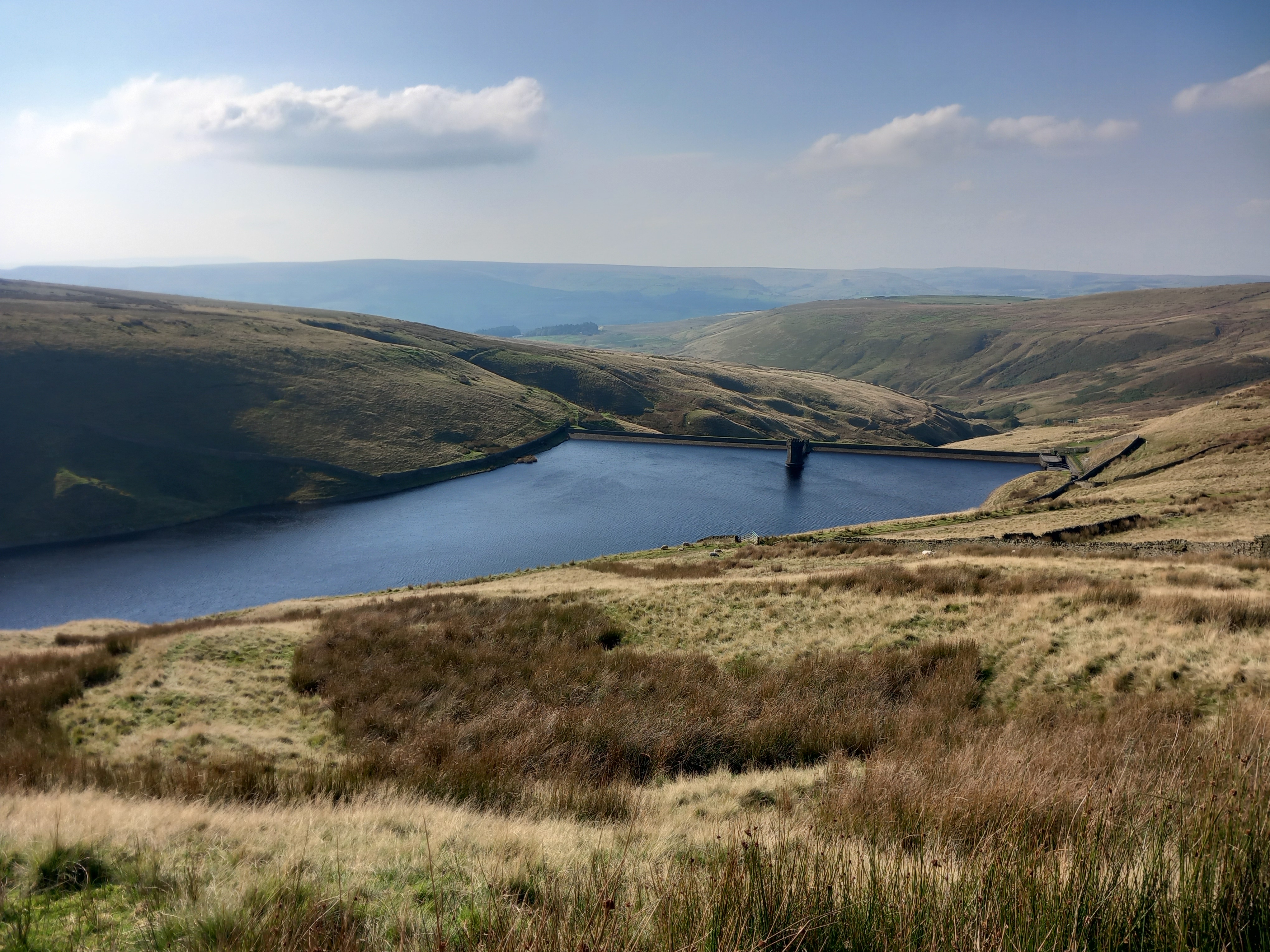
Today the site, though remote, is still a popular place for walkers to visit as it is on the Rossendale Way long distance path. Each July, the Edwin Waugh Dialect Society organises a walk to the well and Waugh’s poems are read out. Some parts of the moors would be little different since Waugh’s time, but other parts have seen huge changes. Scout Moor High Level Reservoir arguably adds to the scene below the well, with successive water bailiffs living at Foe Edge Farm and earning a living from its existence. Behind the well, spoil heaps from the nearby quarry still grace the ridge on the skyline. The owner Thomas Brooks, a local Justice of the Peace, paid to keep the well in good condition for years.
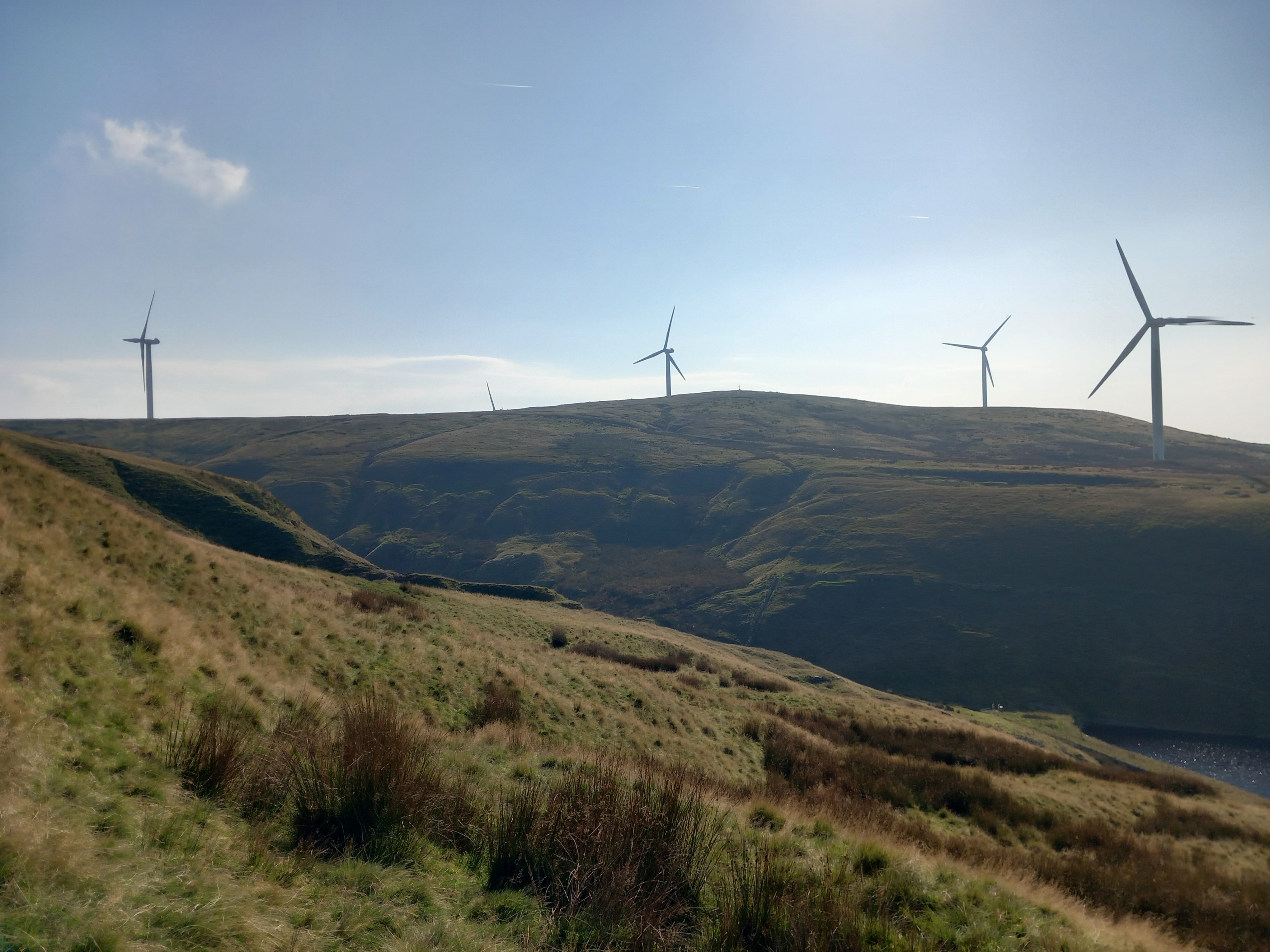
The biggest change since Waugh sat by the well is the addition of Scout Moor Windfarm, whose turbines are spread out before the well on Whittle Hill. The windfarm consists of 26 turbines, providing equivalent energy needs for 40,000 homes. There are currently proposals to add a further 21, which as they are larger and more efficient, would power 100,000 residences.
The moorlands themselves may see less grazing by sheep in the years ahead. While Britain was in the European Union, farmers were paid for the number of sheep they grazed. This lead to overgrazing of the moorland vegetation, and the peat beneath being eroded. This in turn caused the moors to release carbon dioxide into the atmosphere. The government is now looking at ways to restore peatland nationally, including re-wetting schemes where drainage ditches are blocked, a reduction in sheep grazing and tree planting.
Waugh’s Well is in good condition, the stonework has been well maintained and the spring still feeds the well. The new interpretation board at the Foe Edge Farm ruins is very welcome, and will hopefully keep the memory of Edwin Waugh alive for future generations.
The Edwin Waugh Dialect Society meets regularly in Rochdale every 2nd Tuesday, October to July. See their website here
Site visited by A. and R. Bowden 2024
Access
The well is at grid reference 829 196. The path is on rough moorland. To visit ensure that you have a map, a compass and are wearing appropriate footwear.
On-street parking is available on Lodge Mill Lane. Follow this road up to the A680 and turn right at the junction. Keep to the pavement and head up the A680 looking out for a public footpath sign that points to a footpath on your left on the opposite side of the road. This leads to Coal Road, a rough, wide track. This becomes the public footpath of the Rossendale Way (both it and Coal Road are marked on Google Maps). Carry on past the first turbine. The Rossendale Way reaches a crossroads with an access road for the turbines. Carry straight over the crossroads and keep following the Rossendale Way. Waugh’s Well lies on the public footpath, as do the ruins of Foe Edge Farm where the information board is installed.
Nearby
References
The Mystical Moors: A historical field guide to the Rossendale Valley, East Lancashire: Part Two: The Ogden, Lower Irwell and Spodden Valleys, Stephen Oldfield (2022) Carnegie Scotforth Book Productions. This highly recommended book is a superb addition to any local history lovers bookshelf
Moorlands, Memories and Reflections, Paul Salveson (2020) Lancashire Loominary. All Paul Salveson’s books are worthy of reading and collecting
The Lancashire Dictionary of Dialect, Tradition and Folklore, Alan Crosby (2000) Smith Settle
North-Country Folklore, Jessica Lofthouse (1976) Hale
minorvictorianwriters.org.uk/waugh/index.htm
edwinwaughdialectsociety.com
edwinwaughdialectsociety.com/brief-biography.html
en.wikipedia.org/wiki/Edwin_Waugh
lancashiretelegraph.co.uk/news/24507531.horror-state-edwin-waugh-memorial-prompts-action/
lancs.live/news/lancashire-news/rambler-disappointed-condition-remote-poet-29749241
bbc.co.uk/news/articles/c2e7jvv2l1ko
 Lancashire Past
Comments are closed.