Heron Mill is a rare surviving early Georgian corn mill, powered by water. The present building dates from 1740, but there has been a long tradition of milling on the site. The first record of a mill dates from 1220, when the Lord of the Manor gave the monks of St Marie’s of York the right to grind their grain here. Heron Mill is named after a heronry that existed a mile north of the present site. A second mill on the opposite bank of the River Bela was converted into a paper mill in 1788, and still operates as one today. The river at one time had 35 mills along its banks.
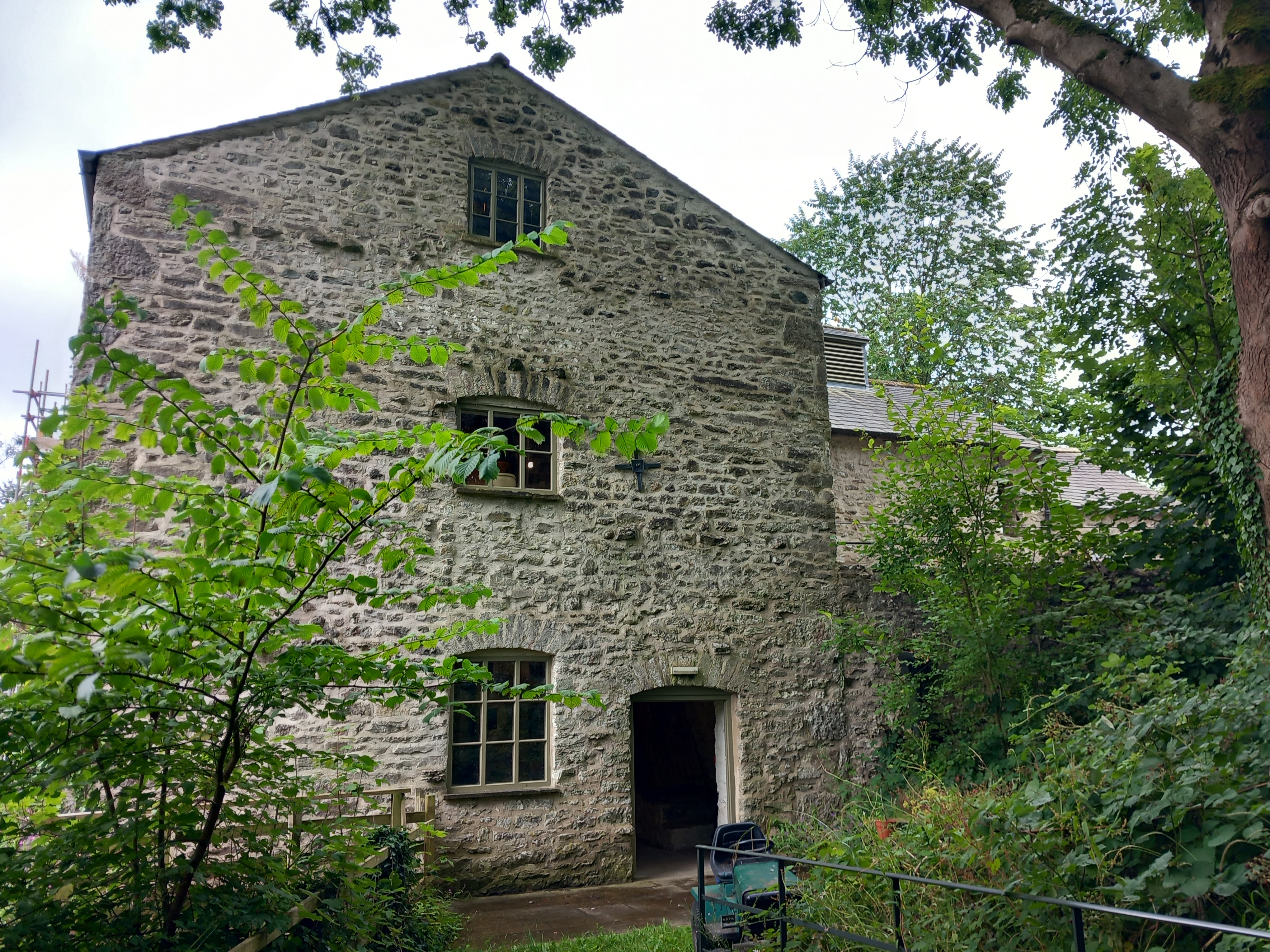
In 1849, the current iron waterwheel was installed. Fourteen feet in diameter, it is of the ‘breast watershot’ variety, meaning the water that turns it hits the wheel at mid-level. The water is brought from the river by the launder (a wooden chute) and can be controlled by means of a sluice gate on the river bank.
The months from September through to April were always the busiest, with the mill working both day and night to meet demand. By the end of the 1800s, records show that it had four pairs of millstones, capable of grinding 80-90 tons of flour each week, enough to make 12,000 loaves. A small external waterwheel connected to a generator was installed in the the early 1900s to supply electricity for the mill. In 1927, the owners W & J Pye of Lancaster took the decision to stop producing flour for human consumption, but Heron continued to make animal feed.
Bob Parkinson recalls when he joined W & J Pye the company owned 26 watermills in the region. He remembered Heron Mill working flat out, running all four sets of its grinding stones to produce oatmeal for cattle feed. Bob was employed to do maintenance work, and winter, a particularly busy time, could be difficult with “icicles on everything”. However, during Bob’s time with the firm, Heron’s days were numbered, as it was not seen as economical enough to keep going. The company’s main mill was at Lancaster and was powered by a gas engine, which was later replaced by an electric one. The vertical grinding stones were fast and efficient, and the Lancaster mill had plenty of spare capacity. In 1958, the decision was taken to close Heron Mill.
Closure and Renewal
Once it stopped milling, Heron Mill returned to the local Dallam Estate. They used the mill for agricultural storage, and at one point it became a hen house. Over time, the mill fell into disrepair. Fortunately, Henry Cooke Ltd, then owners of the paper mill opposite, bought Heron. They formed Beetham Trust, a charity tasked with restoring the mill and its traditional machinery. Two years later, Princess Alexandra was the guest of honour at the opening ceremony in 1975.
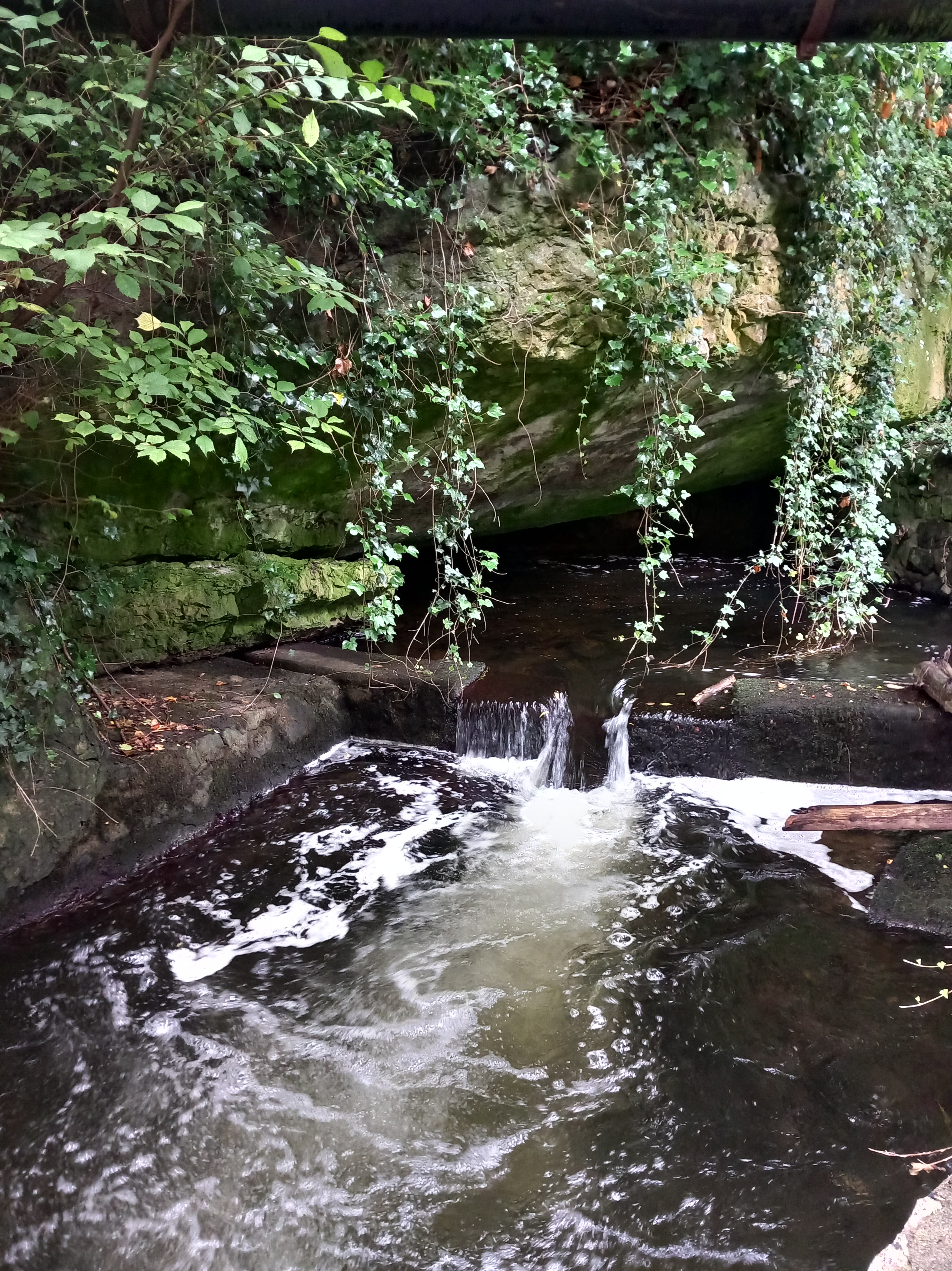
A fish pass was created in a natural limestone cave, which can be viewed between the barn and the mill. Prior to this, the fish had to leap up a 16-foot weir. Salmon and sea trout jump up the fish pass between September and December to go back to spawn at their place of birth.
In the early 2000s, Audrey Steeley became manager of Heron Mill, and has overseen its restoration and expanded the events the site can offer to the public. Traditional millwright Martin Watts was able to fully restore the internal working machinery in 2009, and the launder and sluice gate were renovated soon after. A lottery grant meant that the mill’s barn could be redeveloped into an office and project space for the public. The following year, a 100 KW Kaplan hydropower turbine was installed on the site. This uses the power of the river to generate electricity for the mill buildings. Any excess electricity is sold to Beetham Paper Mill across the river, an employer of some 140 people today.
In 2013, a £900,000 grant from the Heritage Lottery Fund meant that a further large-scale refurbishment could take place. This included repairs to the huge waterwheel, and to the Lowder Frame that holds the grinding stones. For the first time since closure, flour could now be produced using all of the mill machinery. The money also enabled skilled traditional builders to repair the roof and walls of the mill buildings.
In 2020, Heron received a £52,000 grant to educate the public about its history, stretching back to its Medieval past. One of the projects involved growing flax, whose blue flowers would once have been common in the area of Beetham and Milnthorpe. The flax was processed and used to make linen clothes under the supervision of artist Stella Adams-Schofield. Paper was also made using linen rags and flax fibre. As late as the 1880s there were still flax mills working on the Bela.
Stuart Hobbs is the current miller. He checks and operates the mill machinery regularly, producing the flour that can be purchased in the barn shop. He is also in charge of the Kaplan hydropower turbine, and takes visitors on tours of the mill.
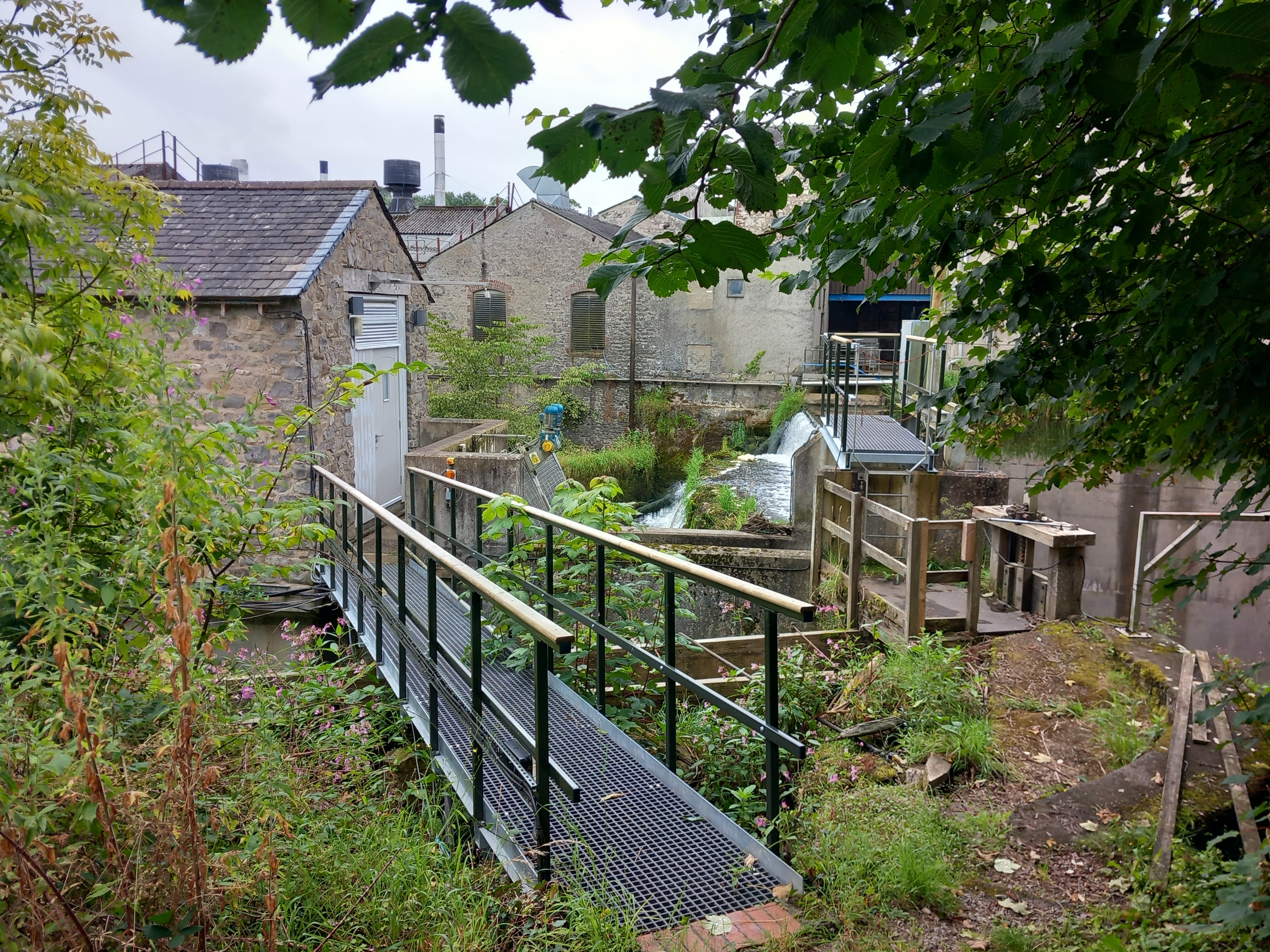
In 2024, Stuart began to train a millwright apprentice, in a programme lasting three years. The pair will not only work at Heron, but also repair other heritage mill machinery in the area. They have lent their expertise to Eskdale Mill at Boot, where the waterwheel could no longer turn as the axle had become worn out. At Beckside, they have replaced the ‘sole boards’, the wooden inner lining of the waterwheel.
How the Mill Works
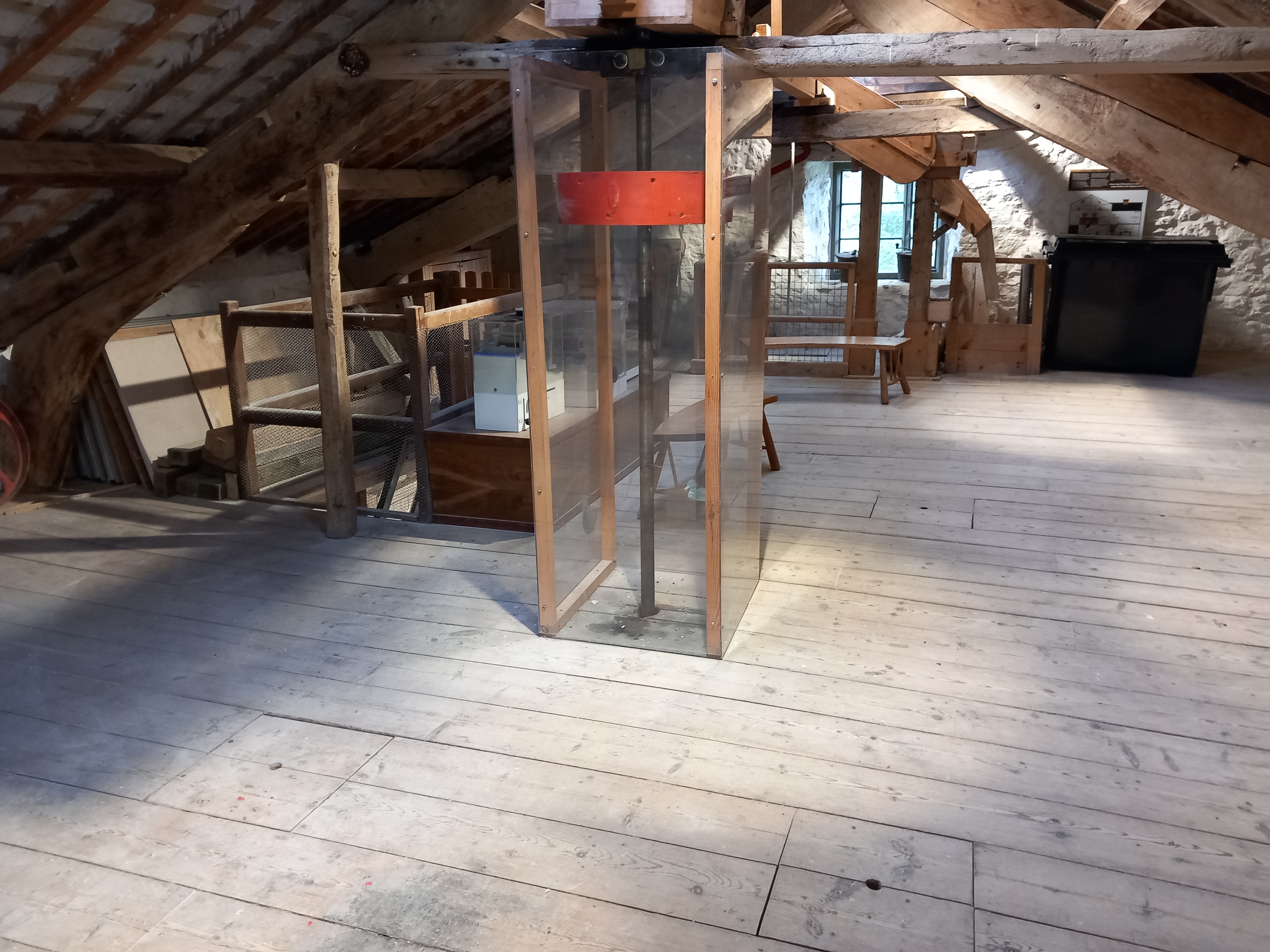
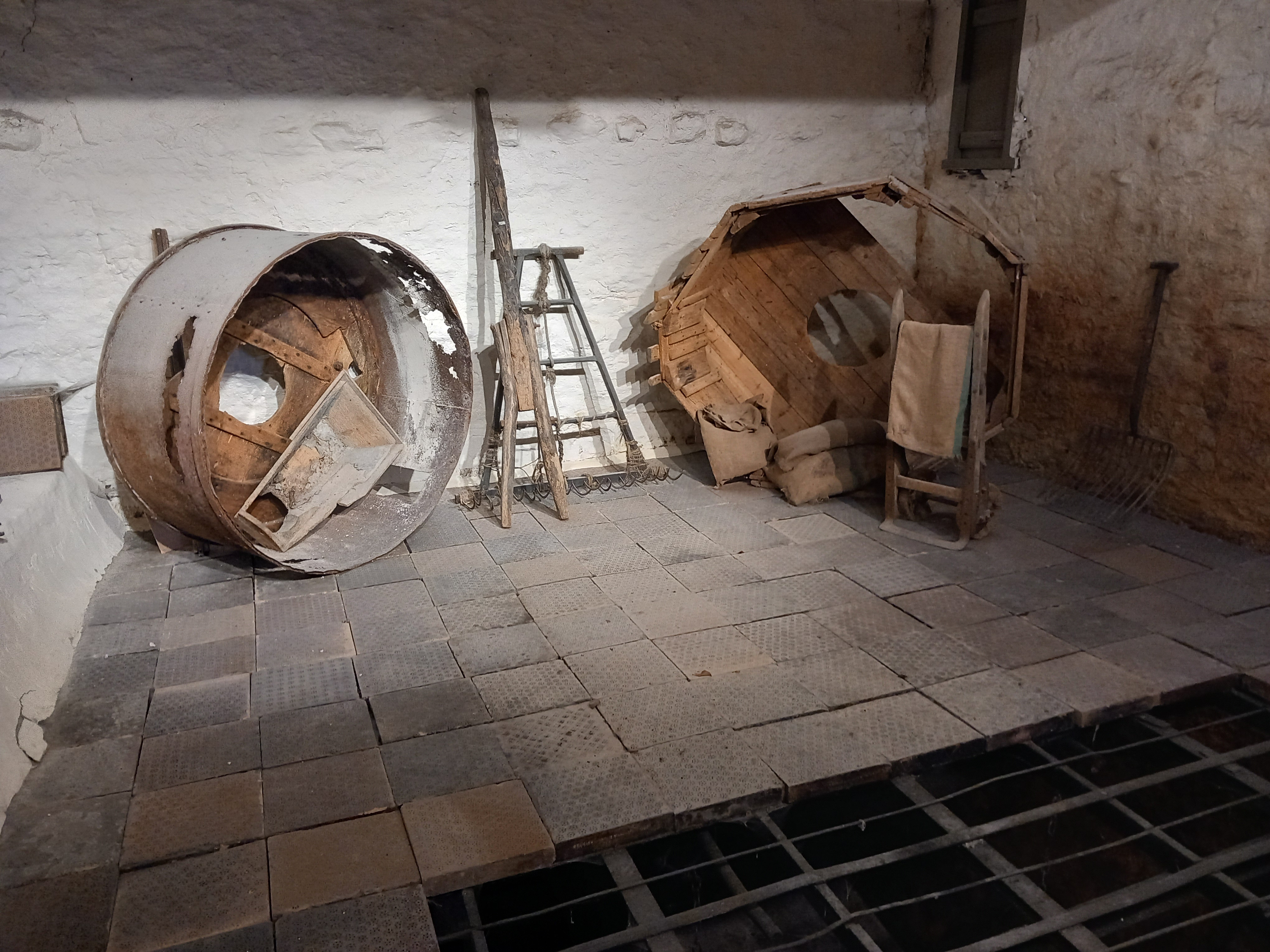
The mill today continues to grind flour, and all the working parts can be seen by visitors. The kiln is the only part that is non-operational, but it can still be entered into and its component parts viewed. Here the oats would have been spread out onto the perforated tiles in the kiln, up to 10 cm in depth. A fire would be lit underneath, and the grains turned occasionally so that they dried evenly. The dried oats were swept into a hopper (a funnel) and poured into sacks. The sacks were then hauled up to the top floor of the mill, where the grain could be stored.
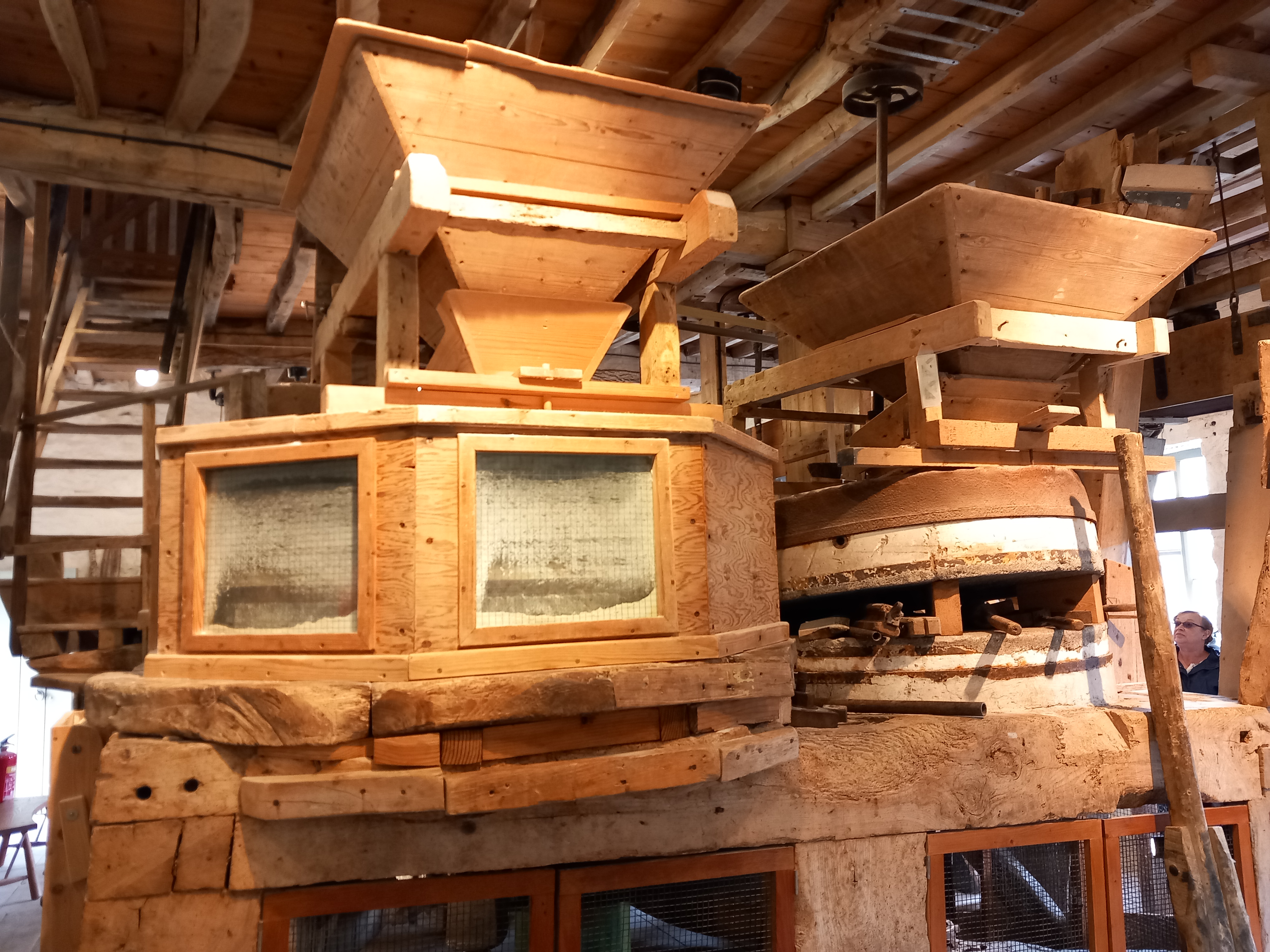
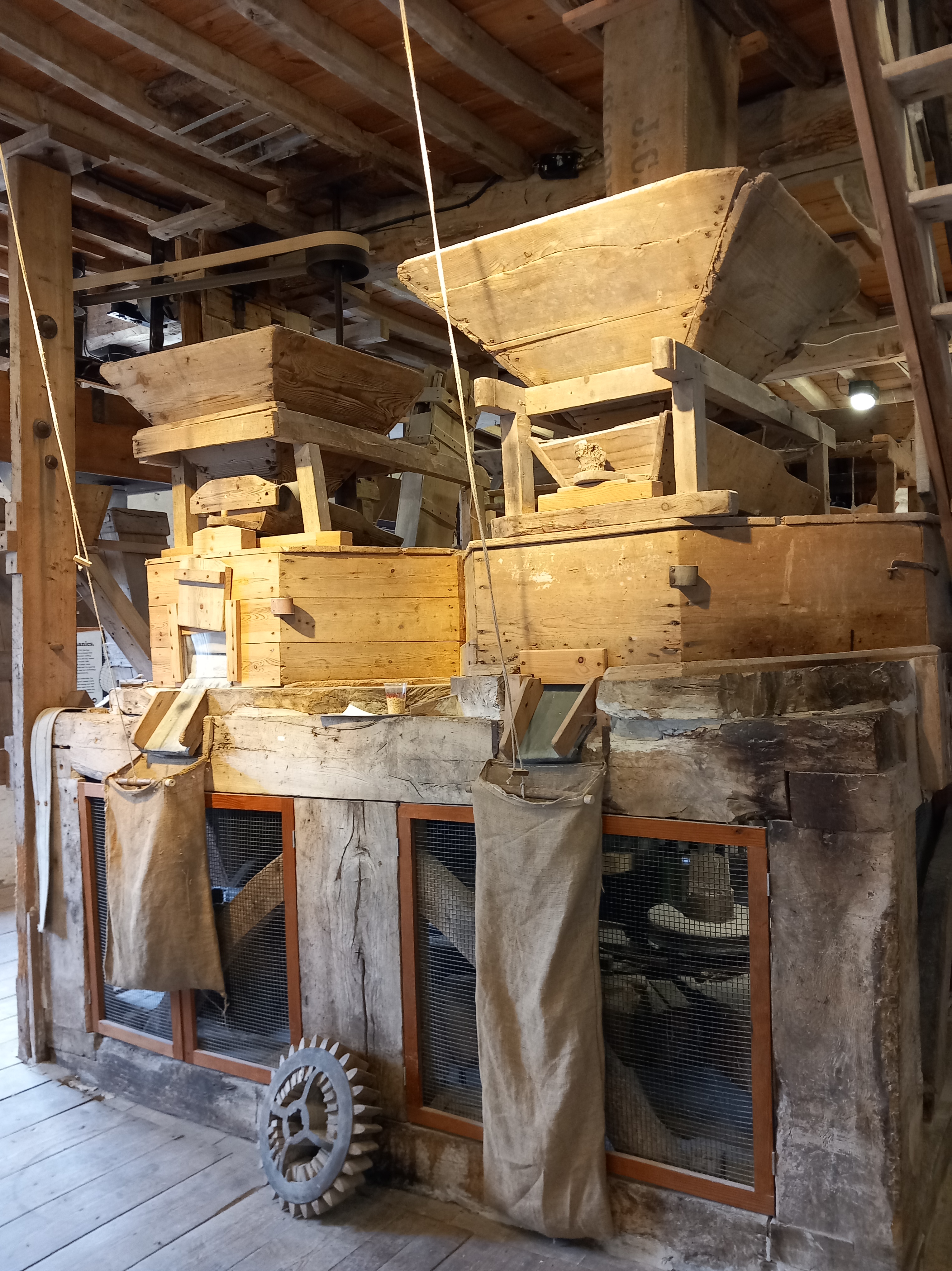
Today, when the oats are needed for grinding, the miller pours them through a wooden hopper on the top floor which takes them into one of the pairs of millstones below on the middle floor. The millstones are turned by a system of gears that are powered by the waterwheel. The wooden channel of the launder brings water from the river onto the waterwheel. The amount of water in the launder can be controlled by the sluice gate on the river bank.
The first set of stones remove the outer husk of the oat from the inner (edible) groat. Husk and groat then drop through to the ground floor, where a winnowing fan separates them. The cleaned groats are then lifted back up again to the top floor and put into sacks. When they are ready to be ground they are dropped through a hopper onto milling stones on the middle floor. Here they are ground to produce the flour, which is then bagged.
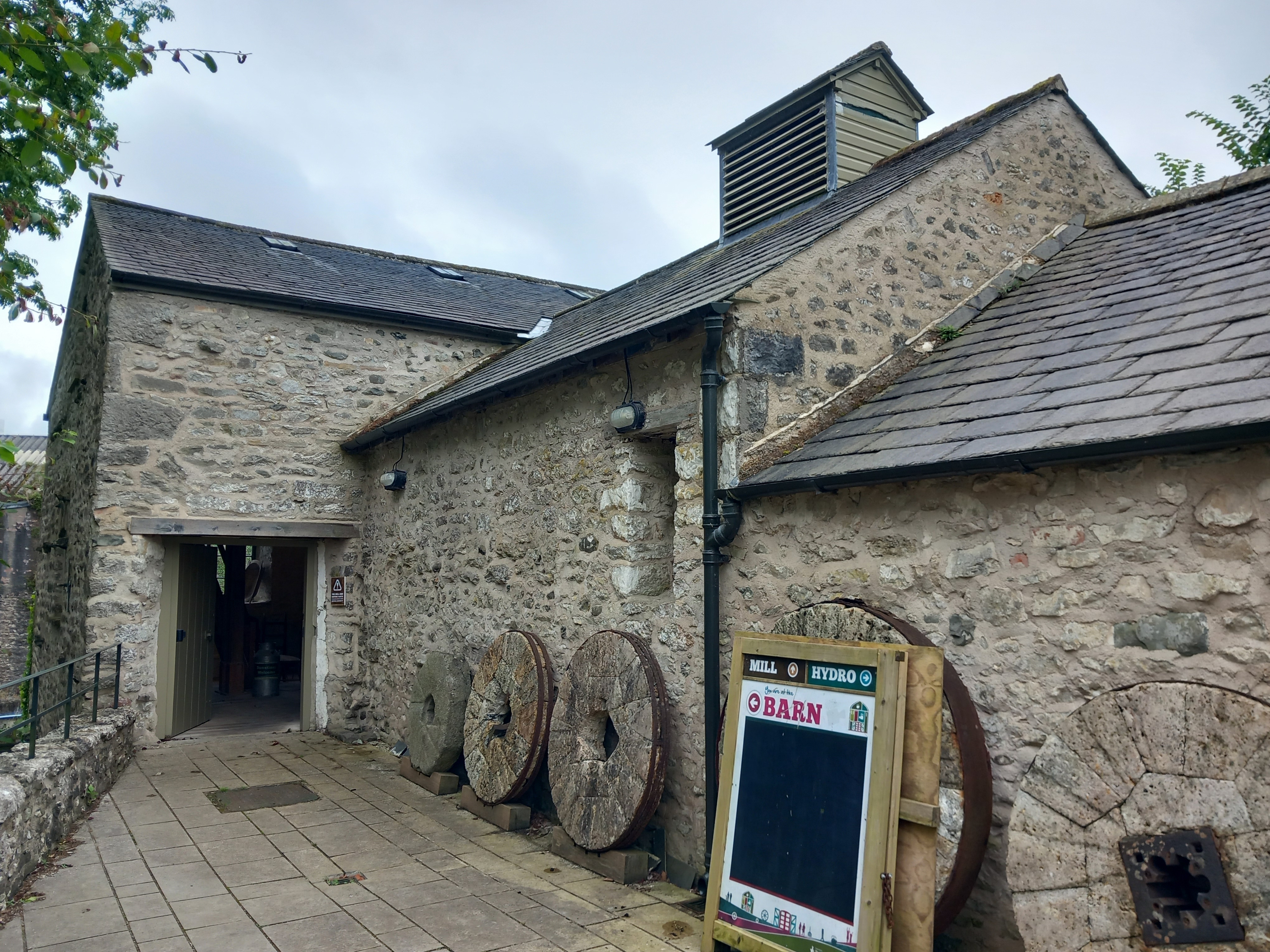
Derby Grit Stones are the grinding stones traditionally installed in most of the mills of the region, and were still being used into the 20th century. Also known as Peak Stones, they originate from the Stanage, Cubar and Bradfield areas. Heron Mill has two sets of these. It also has French Burrs Stones, made of crystallised flint. Unlike the Peak Stones, which are cut out of the ground as a single piece of rock, these are created by putting together pieces of stone, held together by iron hoops. Composite stones can also be created. For example, a worn French Burr could be given a new abrasive layer of carborundum and Heron has a set of these too, unique to the region. Records show that. in 1928, the young millwright Mr Kay (just 17 years old) refaced the French burrstones with carborundum.
Visitors today can see exactly how grain is milled, with access to all parts of Heron Mill, and buy the flour. This can be made from wheat, rye, spelt and blacksmith wheat. There are regular special events held at the mill’s barn, including lectures, craft workshops, circus skill sessions, and music sessions.
Site visited by A. and S. Bowden 2024
Geographical Note: Beetham lay within the historic county of Westmorland before the 1974 reorganisation. However, it is very close to the Lancashire border of that time and so is included on our website.
Access
Heron Mill is free to visit. There is a car parking charge. See the website here for opening times.
Nearby
References
Heron Corn Mill, Robert Clarke (undated booklet). Available from Heron Corn Mill
A River Runs Through, Nell Dale (2012), Heron Corn Mill and Different Sky. This beautiful book can be purchased at the mill
On site interpretation
The Heron Mill website: heronmill.org
 Lancashire Past
Comments are closed.