Rivington Pike stands high on the moors over Horwich, easily recognisable with its familiar short tower. At 1300 feet above sea level the hill must have always been a landmark, even to some of the earliest settlers of the area. Some local writers have speculated that there could have once been a Bronze Age burial mound on top, and this is quite possible. There are definite prehistoric burials from this era that have been excavated on nearby Winter Hill and Noon Hill. Clearly visible from those standing atop the Pike are Two Lads- long thought to be a Bronze Age burial place as well (for the full history of the Two Lads monument see our page here).
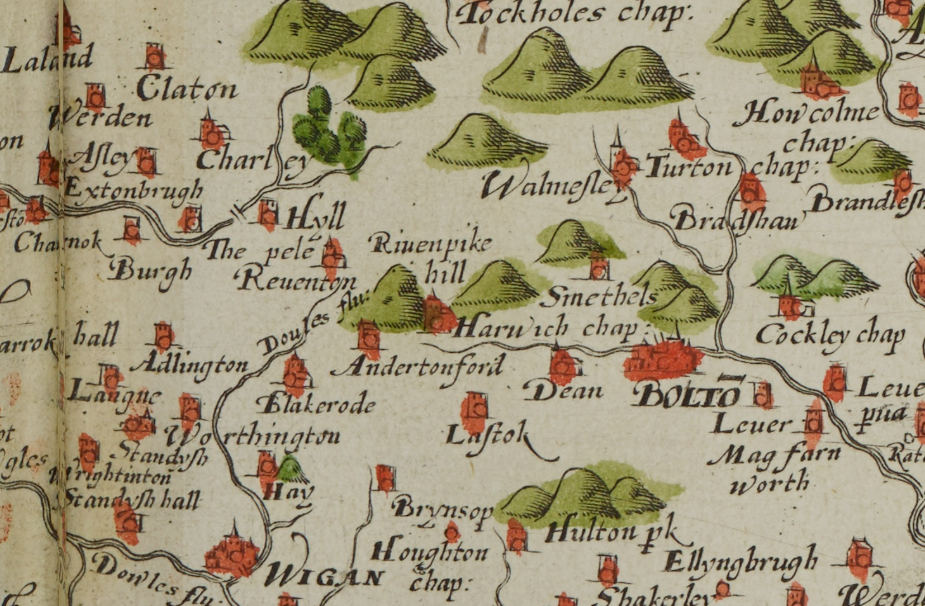
One of the earliest written records of Rivington Pike comes from 1325 when it is recorded as ‘Rovyng’. The name comes from Old English (i.e. the Saxon language) and is in two parts: ‘Rov’ stems directly from the Saxon word ‘hreof’ which means ‘rugged or rough’; and ‘yng’ means ‘one’- so ‘the rough one’, or ‘rough place’. By 1540 the Tudor historian John Leland gives it the much more recognisable name of ‘Rivenpike’. The ‘pike’ part of the word means ‘hill’ or ‘peak’. Just thirty seven years later it appeared on the Christopher Saxton’s Map of Lancashire as ‘Rivenpike Hill’.
Rivington Pike Fire Beacon
If there was once a burial mound on Rivington Pike, it is now long gone. This is quite probably because it has been used for centuries as a fire beacon. It is well documented as being a beacon when in 1588 the threat of Spanish invasion hung over the country, in the form of the Spanish Armada. The defence of Lancashire fell to the Stanley family, the leading landed gentry in the region. While the Earl of Derby, Henry Stanley, was on the continent negotiating for peace, his eldest son Ferdinando, Lord Strange, took charge of protecting Lancashire.
Rivington Pike fell within the administrative district of the Salford Hundred at that time, and records show that money was paid by the people of that area for it to be manned between 10th July to 30th September 1588. Funds collection from other areas were overseen by Ferdinando. This came from three ‘divisions’. The Manchester Division (which included Prestwich, Eccles and Flixton) donated three pounds, eight shillings and ten and three quarter pence. The other two contributing areas were the Middleton Division (which included Rochdale, Oldham and Ashton) and the Bolton Division (which included Bury and Radcliffe). Both of these paid two pounds, six shillings and ten and three quarter pence each. It does appear that the Rivington Pike fire beacon was lit on the 19th July, when the Spanish Armada first entered the English Channel.
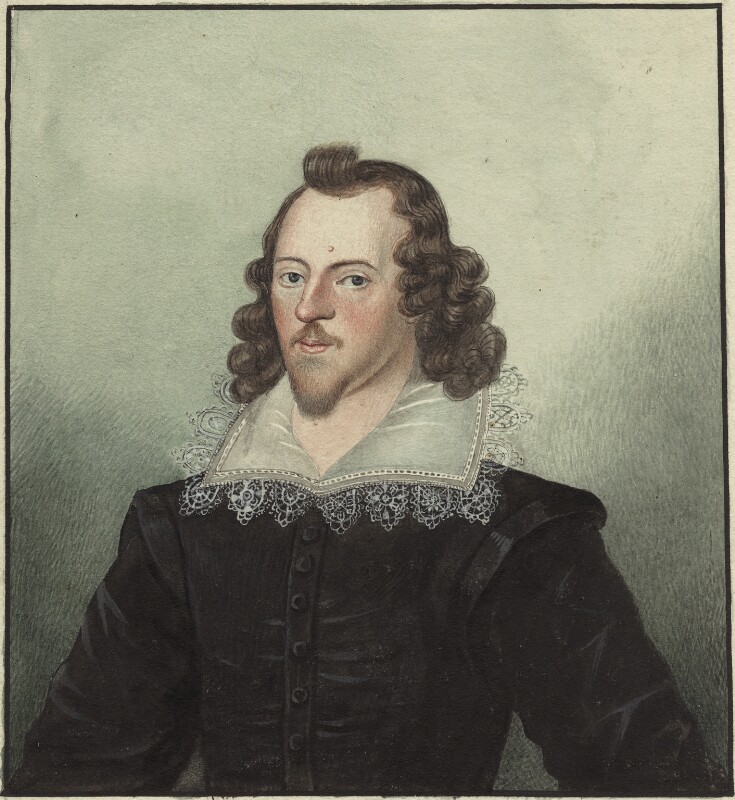
There was a great fear from Queen Elizabeth I’s government that Lancashire, having the most Catholics in the whole of the England, would side with Catholic Spain. The Stanleys, tasked with protecting the region were ironically not trusted by the government, as they too were Catholic. Worse still, Ferdinando had a legitimate claim to the throne if Queen Elizabeth was deposed or died. The Stanley were loyal to the crown though, but the suspicions perhaps played a part in Ferdinando’s dramatic death a few years later (For the full sorry story of his demise, see our post on Lord Strange’s Men here).
The Building of Rivington Pike Tower
John Andrews, a native of Little Lever, bought part of the Rivington Manor estate and Rivington Hall in 1729. Four years later he had built the landmark that we see today, Rivington Pike Tower. It was possibly erected to mark his legal ownership of that part of the moor, which was disputed. He only won his case four years after the tower was completed, as the boundaries to the land were deemed ill defined.
Andrews employed Henry Lathom as the stone mason, and in his construction of the tower he used gritstone boulders from the surrounding hillside, and from the River Douglas nearby. There are speculations by local author George Birtill that the rounded stones at the base of the structure come from the remnants of the fire beacon. The foundation stones can be seen today having been exposed by centuries of weather eroding the soil around them. They do appear rougher than the building stones above them, but it would require an architectural historian or archaeologist to shed definite light on the claim that they were from the beacon.
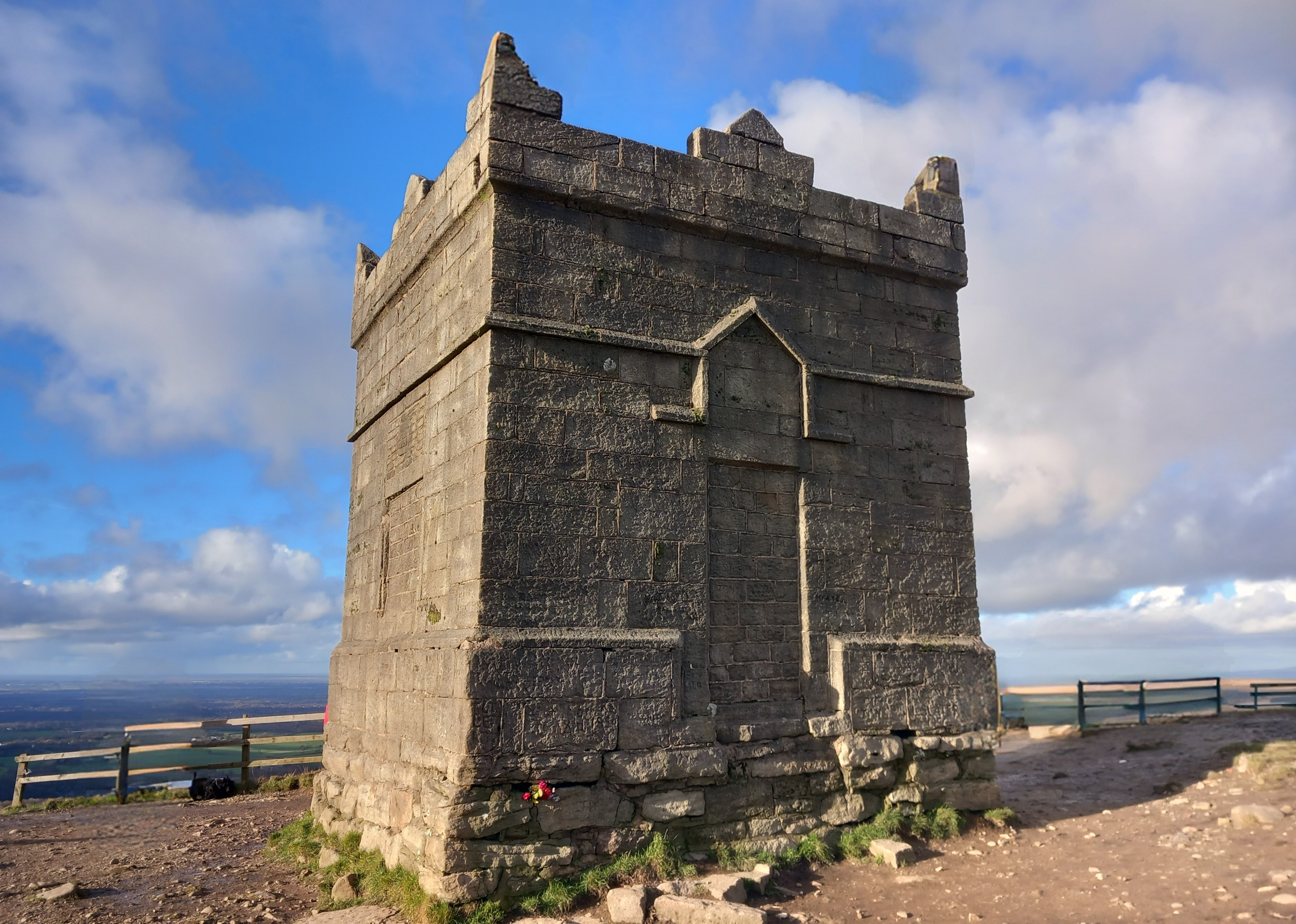
The tower was built 20 feet high, 17 feet wide, with a stout oak door in front of the only entrance way. Each of the three other sides had windows, and the structure was topped by a wooden roof. The door led into a square room. This had a stone flagged floor, with a cellar underneath. A fireplace and chimney were installed to provide heating for shooting parties using it to shelter, while out pursuing grouse on the moors.
The Democratic ‘Threat’ and Fears of Invasion
In the spring of 1801 a meeting was held by a group known as the United Englishmen at the Pike. This was an underground society, having been banned by the government five years earlier. The society’s initial aim was to bring in a ‘one person, one vote’ rule in annual parliamentary elections, making the country democratic for the first time. The movement was deemed treasonous, and a meeting of any kind that exceeded fifty people was also illegal at the time, such was the government’s paranoia. At the Rivington Pike gathering, it was not just democracy under discussion, but grievances about the ongoing war with France, a cost of living crisis, low wages, and state repression. There were arrests and imprisonments of the participants that day. Lord Alvanley, Chief Justice of the Court of Common Pleas, was unhappy that the men were not charged with riot.
In 1805 the fire beacon was rebuilt, as there was once again a very real threat of invasion. In France, Napoleon was plotting to attack Britain. His so called ‘Army of England’ numbered 200,000 men and were based at training camps at Boulogne, Bruges and Montreuil. However, the British sea victory at the Battle of Trafalgar, meant that the French Navy would not be able to convey the army across the Channel. Napoleon instead marched the army across the continent to attack Austria.
A Place of Recreation
Rivington Pike has long been a place that many have walked up to, when the precious time away from work and daily toils allowed them. However, some of the walkers have not always been the most well behaved. On the 26th of August 1834, an article appeared in the Bolton Chronicle, written by John Hopwood, the Constable of Chorley. It stated: “Whereas for some time past, particularly on Sundays, many persons of idle and disorderly habits, in a state of insobriety, have resorted to Rivington Pike, profaned the Sabbath, pulled down walls, and committed other trespasses, and by their noisy and offensive conduct have disturbed the peace and good order of society, notice is hereby given that all persons who shall resort tither on Sundays and in particular the owners of carts and other carriages employed for the purpose of conveying such persons will be prosecuted according to the law, and that officers are appointed at the approaches to the Pike, for the purpose of taking the names of all persons so offending”.
Visitors have long left their mark on the place. One of the earliest pieces of graffiti is recorded by George Birtill, who spotted an anchor with the date 1869 placed within it, on the east side of the building.

Decline and Restoration of Rivington Pike Tower
There is no shelter for the tower, as it stands at high altitude exposed to the elements. Wind, rain, snow and frost have taken took their toll. Thomas Hampson writing in 1893 in his History of Rivington asked: “Who put there the tower, and why, and wherefore are you boarded up at all your windows, and your door barred instead of standing open to let people get to the top of you and see at one sweep the horizon instead of now, creeping round your base- these questions you do not answer”
Shortly afterwards, William Hesketh (later given the title Lord Leverhulme) bought the Rivington Estate. He converted some of it into Lever Park for the public, and kept a portion for his own private use (the area now known as The Terraced Gardens- see our post on the park and gardens here). Keen on building roads, he had one constructed that ran almost up to the tower itself, and this still exists today. It would seem that Hesketh did not discourage the locals from visiting Rivington Pike Tower, even though it lay near his own private parts of his estate. At the coronation of King George V in 1910 a beacon was lit at the Pike, and once again at the end of the First World War. Seven years later Lord Leverhulme died, and the future of the tower was again in doubt. Just a year after his passing, it was noted that the oak door to the tower “swung loose on its hinges”.
Although Lever Park remained open to the public, the tower stood on land that had been compulsory purchased by Liverpool Corporation, as part of their estate for the collection of water in the reservoirs below. Water collecting authorities have had a mixed history over public access. Whilst in modern times, the public is encouraged to visit the reservoirs and roam over the moors by North West Water and its successor United Utilities, this has not always been the case. Previously, water authorities have been keen to limit public access, and would often see unoccupied buildings as a nuisance in that they may encourage squatters. One only has to roam over the moors of Lancashire today to see the many farmsteads that the water authorities have destroyed, once their tenant farmers had been put off the land.
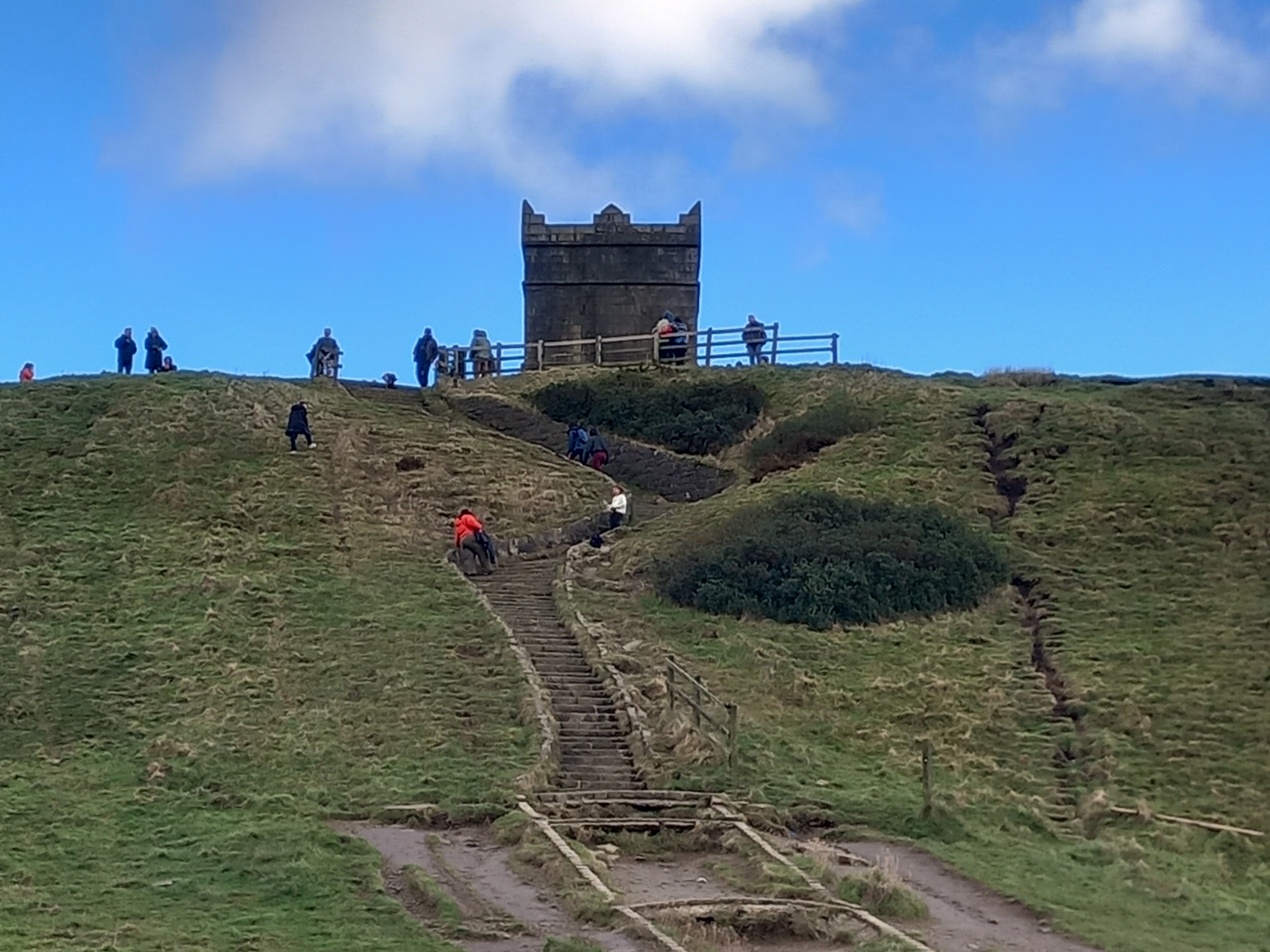
By 1967 exposure to decades of extreme weather, and vandalism by the less intelligent members of the public, had left Rivington Pike Tower in a sorry state. Writing at the time, George Birtill complained about words painted on it by vandals. The Liverpool Corporation water works department’s solution was simple: demolish it. There was an immediate public outcry at the plan to destroy the iconic monument, and a subsequent change of heart from the corporation. Instead, it was donated to Chorley Rural District Council, along with a small grant. They had the tower repaired in 1973, but this also meant that the door and windows were permanently sealed up, and have remained so to the present day. It no longer has a roof, but looks in good repair, both from a distance and close up. While visitors can no longer enter, they can hike up to examine the Grade II listed tower, and marvel at the views over the Lancashire Plain, and look towards Wales and the Cumbrian fells.
Traditions of the Pike: The Fair and the Race
During the 1800s a fair was held at the Whitsun weekend (Whitsun being the seventh Sunday after Easter). Local newspapers would report that the Pike was dotted with “nut stalls and drinking booths”. Alcohol seems to have been behind anti-social behaviour seen during these celebrations, but when the pub known as the Sportsman’s Arms closed in 1884, the Bolton Chronicle noted that the “Pike Fair has lost much of its rowdiness since the removal of the public house licence”. By 1900 the annual date of the fair had shifted to an earlier time and was being held on Good Friday. The numbers have swelled over the years, with crowds of 50,000 being recorded in the 1960s. In the following decade, for three year running starting in 1976, a free music festival was held, known as the North Country Fair. While the free festival is now history, the Pike Fair is still going strong, with people still flocking to the area every Easter.
The Rivington Pike Race was first held in 1892. It was organised by Lancashire and Yorkshire Railway as part of their annual sports day. The race started at the recreation ground of the Railway Mechanics Institute in Horwich. Surprisingly, there was no set route. This meant that many competitors took short cuts through the gardens of local residents. Dubious tactics were employed, such as removing the planks over streams once they had been crossed.
In the 1930s the race became more organised, and started at the entrance to Lever Park. T.P. Campbell of Salford Harriers won every year from 1929 to 1940, except 1933 when he did not compete. After the Second World War it took a while for the tradition to begin again, with the first race being held in 1956.
The race continues today, every Easter Saturday, with around 300 runners taking part. It is a 1.25 mile course, with 800 foot ascent, starting near the Crown Hotel on Lever Park Avenue in Horwich. The route involves running up to Rivington Pike and back again. As of 2025 the male course record is 15 minutes 53 seconds set by John Wild in 1981, and the female record is 19 minutes 11 seconds set by Sarah McCormack in 2022.
Site visited by A. Bowden and J. Board 2025
Access
There is lots of parking (free at the time of writing) at Rivington Country Park. However, the area does get very busy during weekends and holidays, so arrive early to avoid disappointment.
Nearby
Lever Park and Rivington Terraced Gardens
References
The Place-names of Lancashire, Eilert Ekwall (1922/2019) Alpha Editions
The Place Names of Lancashire, David Mills (1976) B.T. Batsford Ltd London
The History of the County Palatine and Duchy of Lancaster, Edward Baines (1888), J. Heywood Manchester, London
Heather in My Hat, George Birtill (1969/1985) Nelson Brothers
The Enchanted Hills, George Birtill (1966/1983) Nelson Brothers
Winter Hill Scrapbook, Dave Lane (2008) Lulu.com
A History of Rivington Pike Tower, undated leaflet, available from the Rivington Visitor Information Centre.
The United Englishmen and Radical Politics in the Industrial North-West of England, 1795-1803, Alan Booth (2008) Cambridge University Press. Available online as a free pdf document.
Letter from Ralph Fletcher, Bolton le Moors Ref: HO 42/62/165 discovery.nationalarchives.gov.uk/details/r/C15930596
en.wikipedia.org/wiki/Napoleon%27s_planned_invasion_of_the_United_Kingdom
horwichrmiharriers.co.uk/races/pikerace/
ukrockfestivals.com/rivington-pike-78.html
 Lancashire Past
Comments are closed.