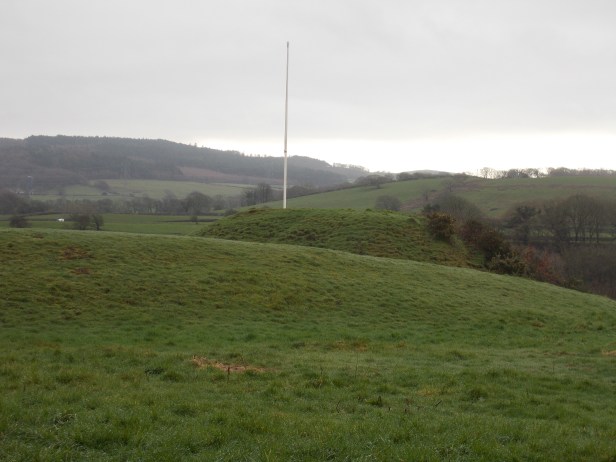
At Halton, above the River Lune on the end of a promontory, stands the motte of Halton’s Norman Castle. The motte (or mound) measures 100 feet in diameter and the top is some 35 feet across. On this would have stood a small wooden fortification. Below it was the bailey area, which would have had a wooden fence around its outskirts. Inside the bailey would be other buildings tasked with running the castle.
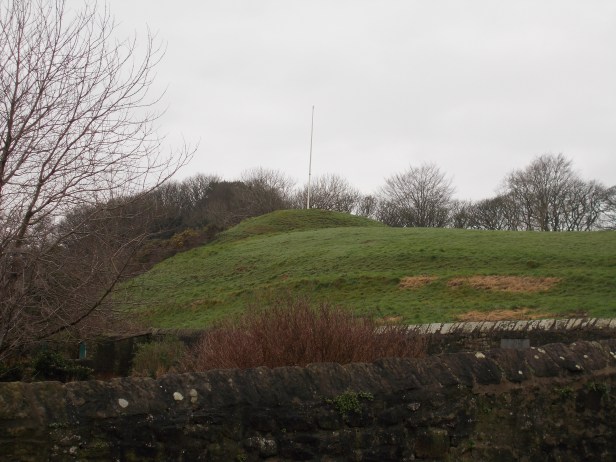
This was a highly defendable structure. The motte rose 12 feet above the bailey and was surrounded by a timber palisade, and a ditch (which is now mostly ploughed out) gave an extra line of defence between the two. Traces of a rampart can still be seen on the north and north-west side of the bailey and there are steep natural sides on the south and west. Cote Beck on the west side would have given additional defence.
It’s not clear if the castle was built as one of the first wave of fortifications after the Norman Conquest, or a little later during the days of King William (Rufus) II when he pushed into Cumbria and established a permanent frontier against the Scots at Carlisle. Most sources favour the latter, which means that it was probably built around 1092 by Roger de Poitou, who was given most of North Lancashire by the king in the expectation that he would defend it against the Scots.
A string of motte and bailey castles exists within the Lune valley and these were placed on strategic sites to give good views up and down the rivers, or to defend crossing points. The mottes would have been built by unskilled local labour, from layers of soil and stone rubble.
After King William II’s death, Roger of Poitou supported an ill-advised rebellion against the former king’s younger brother, Henry I. This resulted in Roger losing his Lancashire lands in 1102 and never regaining them.
Halton then seemed to have been the residence of Roger Gernet, chief forester of Lancaster. In 1193, one of his descendants, Benedict Gernet, joined Prince John in his rebellion against King Richard I. The rebellion failed but Benedict was able to retain his inherited lands by paying £20 to the king and a year later he was made deputy sheriff. When John finally became king, Benedict was given the job of forest sergeant for Lancashire.
A hundred years later, the last of the Gernet line, Joan, married William Dacre of Dacre in Cumberland, bringing Halton to them. It stayed with the Dacre family for the next three centuries. However, the end seems to have come for the castle in 1322 when Robert the Bruce attacked Lancashire. The manor house was burnt down and the castle badly damaged. It was never rebuilt.
Site visited by A. and R. Bowden 2019. Page updated 2025.
Access
The site is close to the M6 motorway junction 35. Park in the car park on Denby Beck Lane, just off the A683. Walk across the Halton Bridge over the River Lune (it’s not recommended to drive over as it is very narrow). Head up Station Road and you will see the motte rising before you.
Hornby’s motte and bailey sit within a small field within the heart of Halton village, above the church of St Wilfrid. There are good views of the earthworks from the perimeter stone fence, and recently there has been work to improve access into the field to view them.
Updated 2025: Although no public footpath existed into the field, a levelling up grant has been received from the previous government for £18,000. This will give the public access into the field. New gates, fences and paths were announced as part of the Rural England Prosperity Fund. More of this kind of work should be done in England to improve access to our heritage, and to promote a wider Right to Roam bill.
On the same site, a Home Guard look out post from the Second World War. See our page on Lancashire at War here
Nearby, just a few moments away The Sigurd Cross
Just a short drive away
Castle Stede motte and bailey, Hornby
Anglo-Saxon Cross fragments, Hornby
References
Norman Castles of Lunesdale: A History Trail, A.J. White (1998) Leaflet published by Lancaster City Museums
The Castles and Tower Houses of Lancashire and Cheshire, Mike Salter (2001), Folly Publications
Lancashire Castles and Towers, Leslie Irving Gibson (1977) Dalesman Books
The Mottes of North Lancashire, Lonsdale and Cumbria, Mary C. Higham (undated)available from:
archaeologydataservice.ac.uk/archiveDS/archiveDownload?t=arch-2055-1/dissemination/pdf/Article_Level_Pdf/tcwaas/002/1991/vol91/tcwaas_002_1991_vol91_0010.pdf
wikipedia.org/wiki/Roger_the_Poitevin
castlesfortsbattles.co.uk/north_west/halton_castle_motte.html
gatehouse-gazetteer.info/English%20sites/1710.html
On Right to Roam
gov.uk/right-of-way-open-access-land/use-your-right-to-roam
scotways.com/faq/law-on-statutory-access-rights
wikipedia.org/wiki/Freedom_to_roam
ramblers.org.uk/
 Lancashire Past
Comments are closed.