Although it was the daughters and sons of James and Alice Barlow who set up the Barlow Institute, its vision and ethos was very much a product of their parents’ ethics. To understand these ideals, it is best to briefly examine the lives of James and Alice Barlow.
James was a mill owner, eventually being in charge of five separate premises. A liberal councillor, his politics very much informed his extra-curricular activities. These were numerous – he was the first president of the Mechanics Institute, active in the formation of Bolton Workshops for the Blind and the driving force behind the setting up of the National Children’s Home at nearby Crowthorn. James’ and Alice’s religious convictions as Methodists meant they helped fund the building of the Methodist Church in Edgworth, supported the Band of Hope (a club for children in which they pledged never to drink alcohol) and supported the closing of public houses on Sundays. James was president of the Temperance League (a society that campaigned against alcohol) and he established the two temperance bars in the heart of Bolton. These were the Bolton Arms in Bradshawgate and the Barlow Arms in Bridge Street.
James and Alice had built a Victorian mansion at Greenthorne Farm for their family. Their eldest son, Thomas, became a doctor in London, rising to the rank of Attending Physician to Queen Victoria. He would also go on to be in the service of King Edward VII and King George V. Daughter Alice attended Girton College Cambridge, then returned to Greenthorne to care for her younger siblings, John Robert and Annie. In time, John Robert followed his father into the family textile business. The three would remain at Greenthorne throughout their lives. Only their older sister Mariah would leave, when she married a Bolton Industrialist.
The siblings were very involved with Edgworth Methodist Church and the Crowthorn National Children’s Home. They also became active in the Bolton Egypt and Exploration Fund and Society. Annie and John Robert visited archaeological digs in Egypt which would lead to the acquisition of Egyptian artefacts. These are still on show today in Bolton Museum and Art Gallery.
The brothers and sisters were aware of their father’s and mother’s long-held desire to set up a village institute, but lack of suitable land had hampered their parents. After the death of their father James in 1887, some land at Walleach Farm alongside Bolton Road, one of the main roads through Edgeworth Village, became available.
The Beginnings of the Institute
Ground clearance began in 1897, and William Kingsley was appointed manager the next year. He would remain in that position until his death thirty-seven years later. William was involved in both the design of the institute and its facilities. Records show that Annie Barlow was responsible for signing the cheques for money spent on all aspects of the construction. She also appears to be the chief person of the Barlow family to be involved with the day-to-day affairs of the institute.
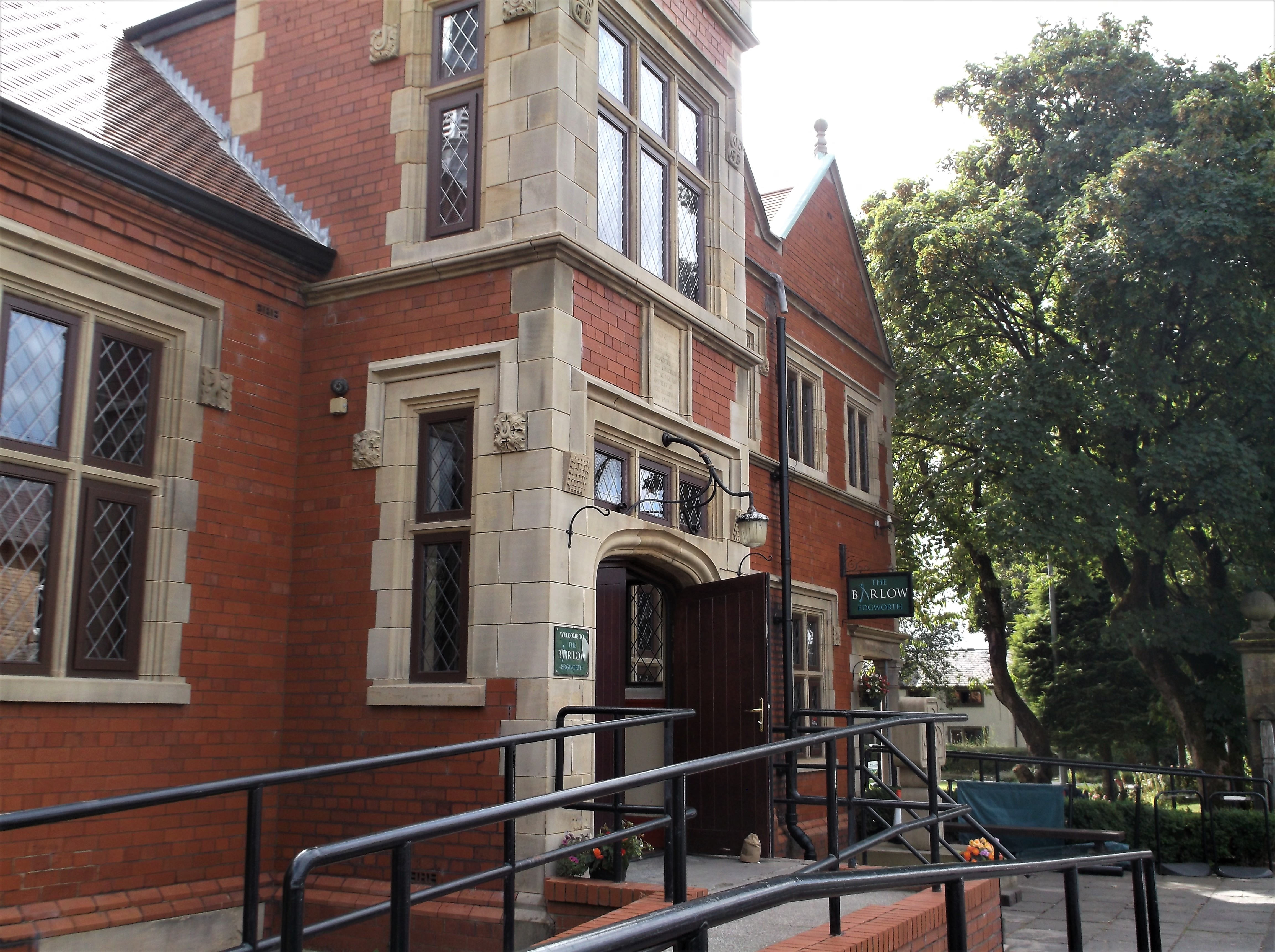
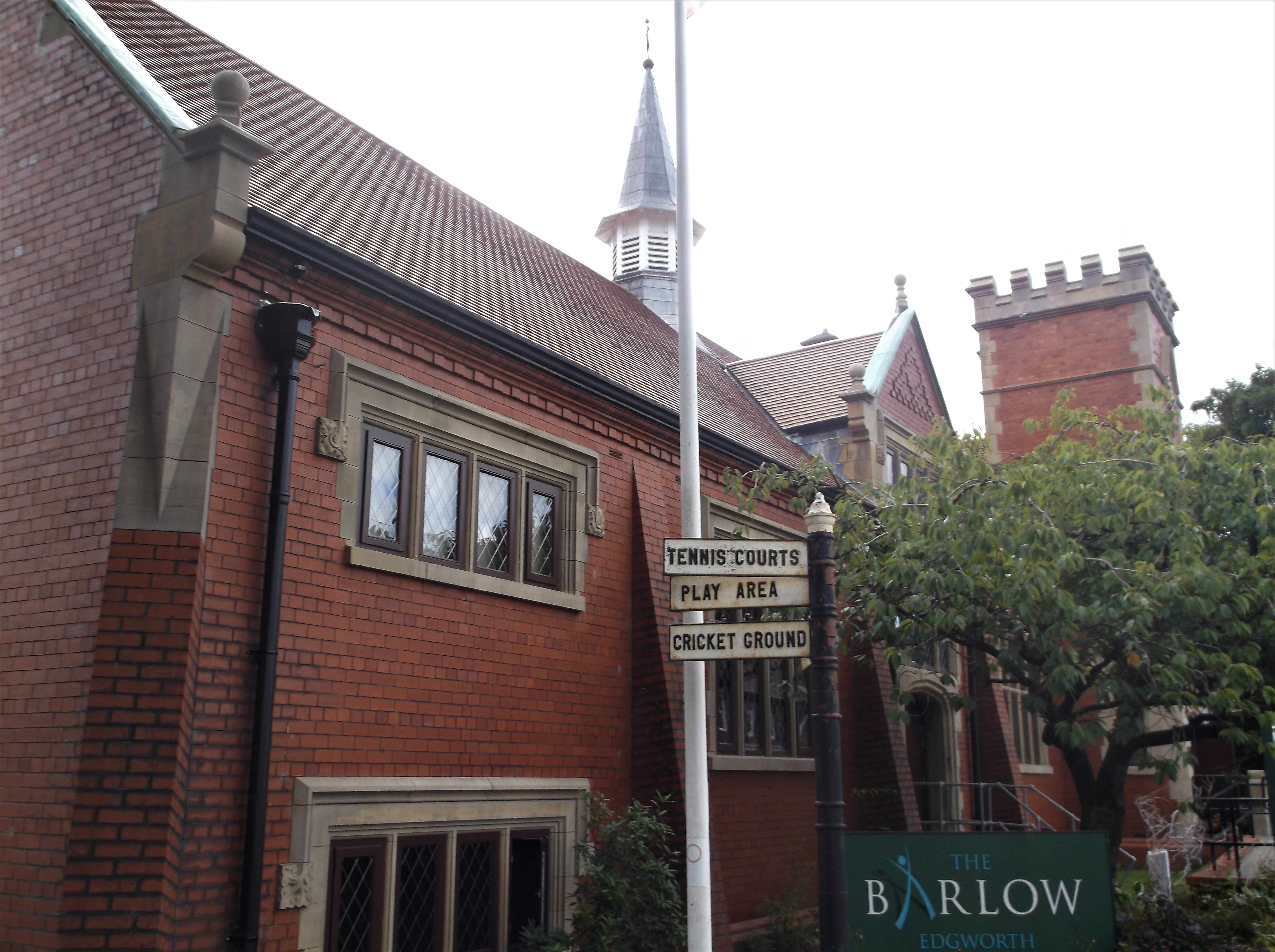
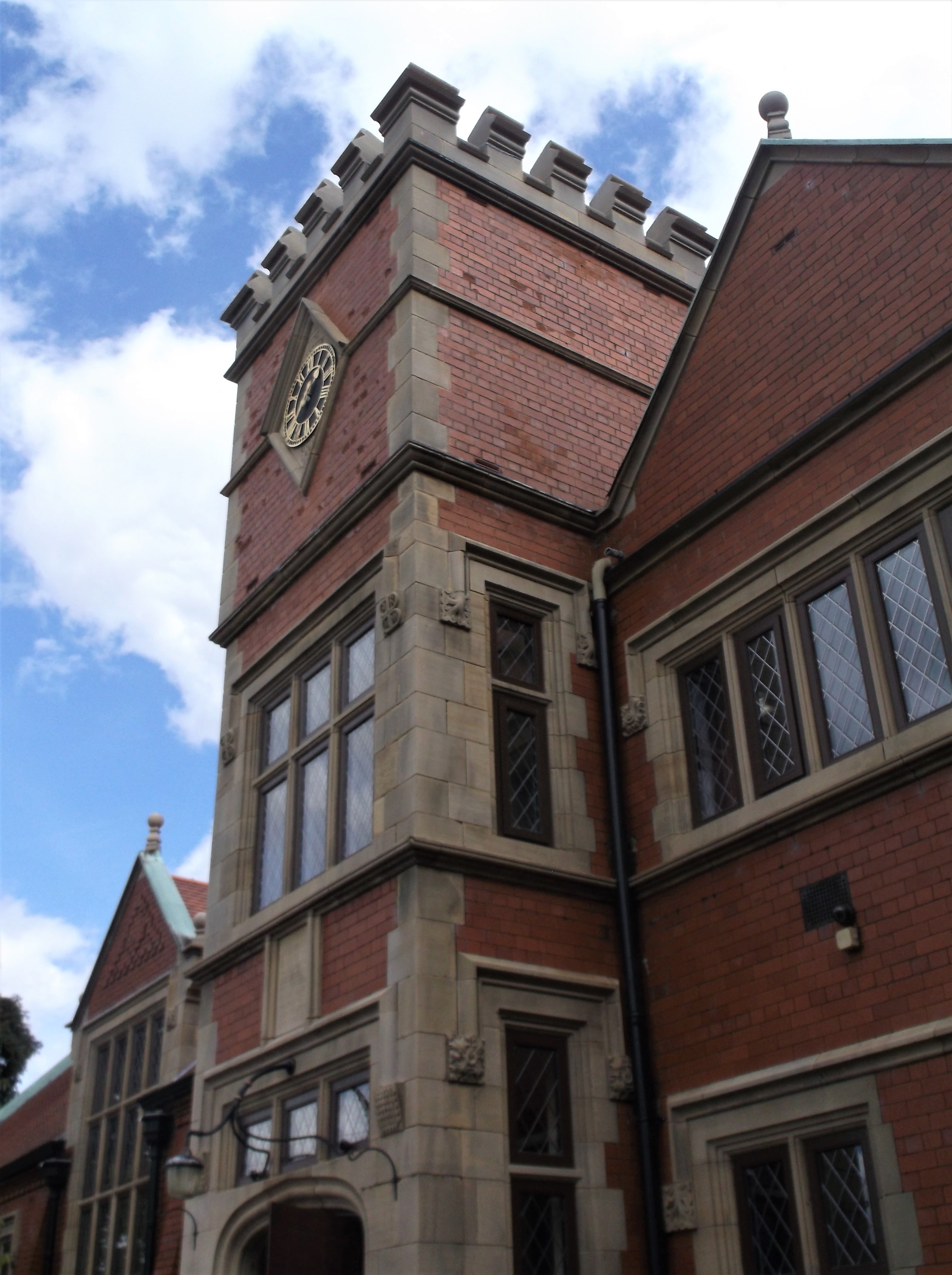
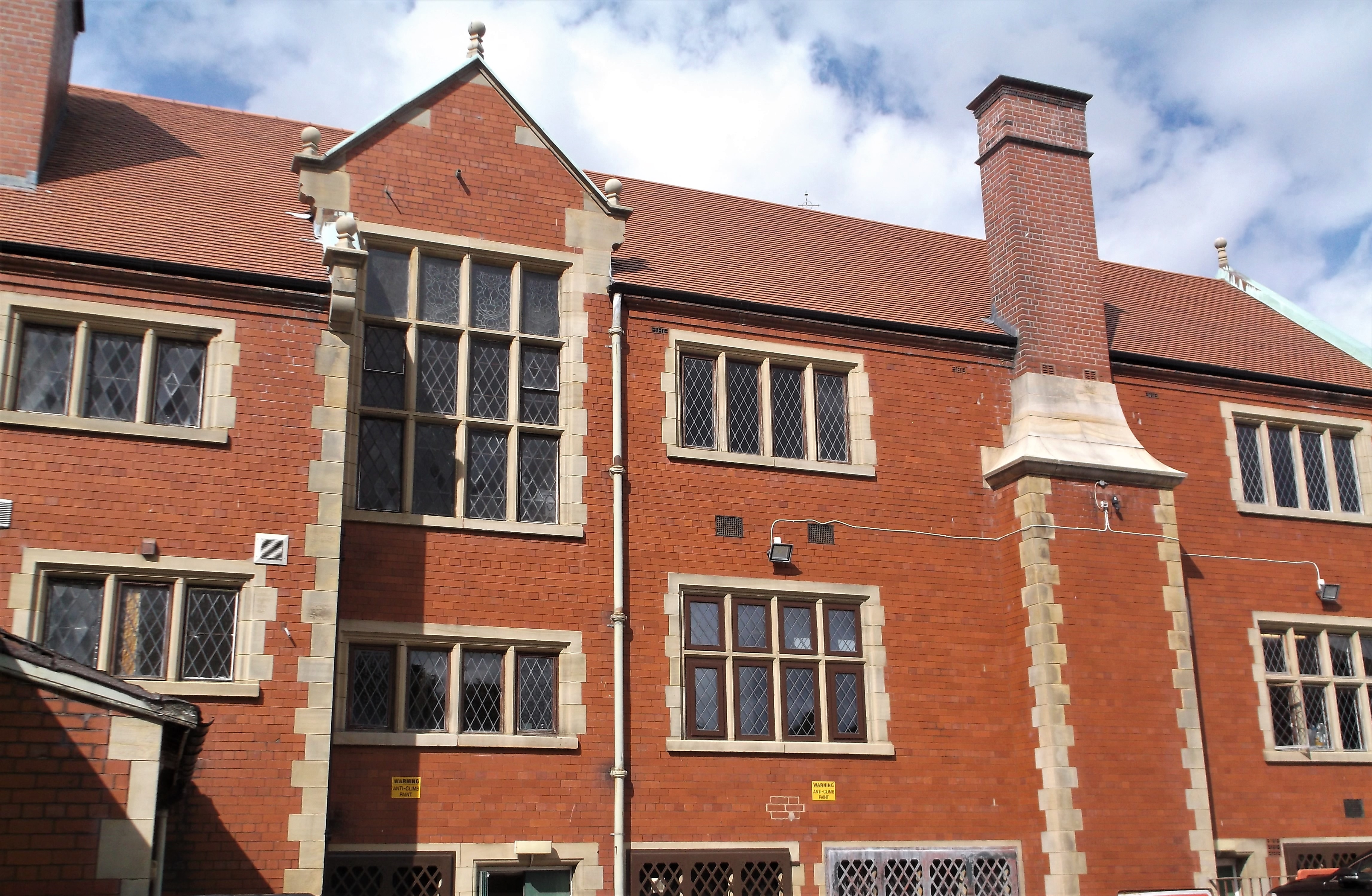
The cricket ground was the first of the facilities to be completed and was in use by 1898. Three years later, a pavilion had been set up and that same year the bowling club began. Subsequently, an open air swimming pool, maze and boating lake within a woodland park were added. The building itself was constructed in red brick in the Arts and Crafts style, and designed by architect George Faulkner Armitage. With a central tower entrance way topped by crenulations, and mullioned windows with leaded glass throughout, it was and still is an impressive structure.
John Robert gave the first speech on the building’s official opening day in 1909. He used it to describe what would be available within the institute – a large space that could be used as a lecture theatre and for concerts or as a gym, a library stocked with hundreds of books, a coffee room, committee room, teaching kitchen, District Nurses’ room, public wash room and public bath. John Robert then handed over to his brother, Sir Thomas. He officially opened the building, stating that it would be run for the benefit of the people of Edgworth, and managed by them too.
The First World War
With the outbreak of war in 1914, many of the annual sporting activities and competitions with other local villages became restricted. Although there was a curtailing of some sports, new activities were started. Children were encouraged to grow potatoes and other vegetables around the edge of the cricket ground. A cinematograph was installed, but it was found that some practice was needed in changing films and repairing breakages to the film. A feature film would be shown followed by a popular serial like Blake from The Yard.
The Lancashire Fusiliers camped across the road from the institute, using the area as training grounds. The building itself was used for recruitment of soldiers, with 172 men recorded as taking the oath over two nights. The institute’s windows were blacked out because of fear of German zeppelin attacks (a very real threat – see the page on our companion website Lancashire at War here). Men convalescing at Blair Hospital in Bromley Cross from injuries sustained during the war would be brought over to take advantage of the facilities. By the end of the conflict, 37 men had been lost from the village, and a further 27 from the Crowthorn Children’s Home. The recession that followed the conflict saw the setting up of a room at the institute to issue unemployment benefits. The Guild of Help raised money and distributed vouchers that could be exchanged for food in the local shops.
After the First World War
With peace returning to the continent, normal activities resumed, along with an expanded use of the institute by other groups. Rambling parties, the Bolton Boys Club and the Salvation Army all visited. Sometimes Annie Barlow would tell William Kingsley to provide teas while she would send down pie, pudding and salad from her home in Greenthorne for those groups lucky enough to be favoured.
In 1923, John Robert died and this seemed to be the precipitating event that led the siblings to make a change in governance. They decided that the control of the Institute should be completely transferred to Turton Urban District Council. Within three years this was done, but certain stipulations were kept in place that reflected their Methodist beliefs, including a prohibition on the serving of alcohol and a continuing ban on gambling on the premises.
By the late 1920s and early 1930s, there were regular meetings of the Brotherhood Club (motto ‘Brief Bright and Brotherly’), the Temperance League, Workers Education Association (WEA), Lancashire Education Association and the National Farmers Union. In this same era, large events taking place at the Institute included plays by the St Aldhelm’s Players, performances by the operatic society and an annual horticultural society show.
A snapshot of activity in 1927 reveals typical talks that local societies were enjoying. The Brotherhood Club attended lantern lectures on The Valley of the Wye, Switzerland and the Italian Lakes and A Naturalist in Dorset. The Temperance Society could listen to Sam Pilling expounding on Drink, Work and Wages. The National Farmers Union were enlightened about the Technology of Milk Production and the Abolition of Milk Prosecutions, with the poster stating ‘Ladies Invited’. Three years later, the Turton Urban District Council had a Demonstration of Washing with the BURCO Electric washing and Wringing Machine. That same year a heath film entitled Your Mouth was also shown.
In 1931, Annie Barlow hosted Mahatma Gandhi. He was visiting Lancashire to speak to representatives of the cotton manufacturers about the competition Britain was feeling from Indian cotton production. Although the meeting was supposed to be a secret, a group of villagers were waiting at the White Horse pub in Edgworth to greet Gandhi. Annie, the last of the siblings, passed away ten years later, and with manager William Kingsley, who had been at the Institute from its inception, dying five years beforehand, these events bookmarked the end of an era spanning the first forty years.
Later Changes
In 1971, a Deed of Modification of a Restrictive Covenant was passed. This rather grand-sounding piece of legislation meant that for the first time in the institute’s history beer and wine could be served, the Barlow’s Methodist wishes finally being reversed. Three years later, boundary changes in local government meant some council services were withdrawn. Most significant was the loss of finance from Bolton Council, which meant the Workers Education Association classes were no longer to be funded. Laudably, the group decided to continue and became the Turton Local History Society. This hugely successful local history group has since gone from strength to strength. Covering the areas of Edgworth, Quarlton, Turton, Entwistle, Longworth, Harwood and Bradshaw, they have been hugely prolific in terms of publications. Today, there are 38 titles available to buy (see here).
In 2000, the Institute renewed its registration for charity status. Still with the ethos of being run by local people, for local people, the structure of the committee consisted of eight appointed members. These include two elected members, four group members (from groups that use the facilities) and parish councillors.
The huge austerity cuts from central government meant that local councils’ budgets were massively reduced in the 2010s. For most authorities, this meant they had 50% less money than they had in the previous decade. In 2011, Blackburn with Darwen Council withdrew its staff resource support and, two years later, the council cut all of its funding. The outlook for the Barlow Institute seemed uncertain but, in 2017, the descendants of the Barlow family made a large donation, This helped pay for major renovations including a new roof, window and door repairs. Fundraising meant that further work was able to be carried out to restore the veranda and deck area used by the Reading Room Cafe. A new heating system was installed, and improvements to the kitchen and a new children’s playground followed in 2021.
Today, the institute is an entirely volunteer-led charitable organisation known as the Barlow Charitable Trust. The volunteers run every aspect of the day-to-day operations and their hard work has secured its future.
Visiting the Barlow Institute Today
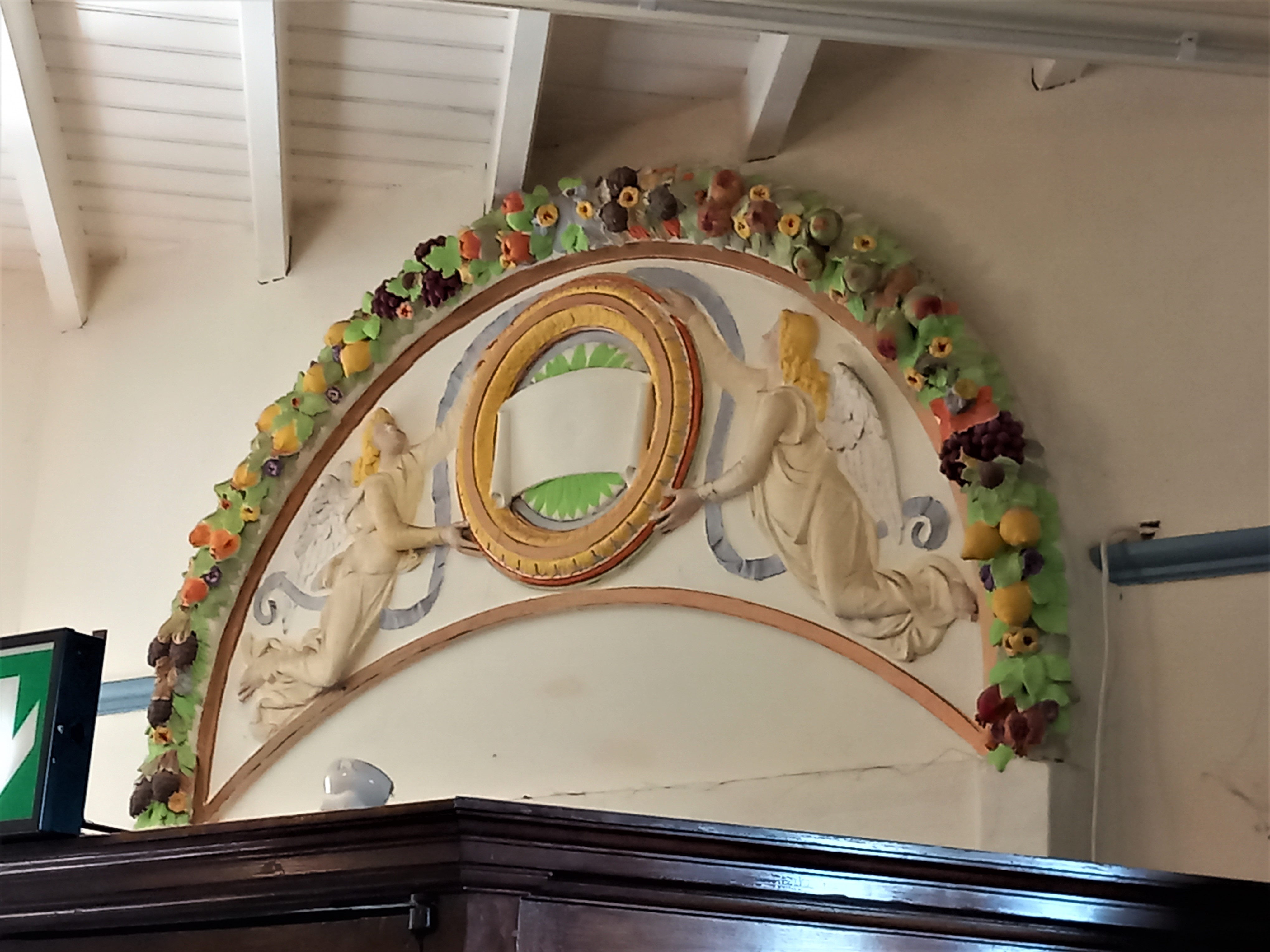
The Reading Room Café is very popular and is open to the public every day of the week. This has a number of interesting features. The fireplace carries the motto Fire Makes Fast Friends. Above this is a painting of St George and the Dragon and close examination reveals an inscription from the time of the Barlows: As St George in armed array did the fiery dragon slay, so mayest thou with might no less slay the demon drunkness. Above the entrance door is a painted moulded plasterwork featuring two angels, holding aloft a medallion. The scroll at the centre of this is blank, and it is not clear if there was once something painted on it. The Edgworth Art Triptych entitled Past and Present was created by the art group in 2018. It features local landmarks such as Edgworth Methodist Chapel, Turton Tower, the chimney at Quarlton Vale Works and the reservoir of Old Russia, along with the institute itself.
There are regular events held at the institute, some of which still use the large space of the lecture hall/ concert venue. Meetings include a Folk Group that regularly has visiting musicians, the Young Farmers, a Reading Group, the Horticultural Society, art classes and a Memory Group. As well as the new children’s playground, there is a woodland walk amongst mature trees that has paths that lead out into the wider countryside of Edgworth.
The Barlow Institute remains unique in Lancashire. Now known simply as ‘The Barlow’, it is a testament to the vision of the Barlow family from over a century ago. A wealthy family put their hands in their pockets to build a lasting legacy that would benefit the people of Edgeworth village and beyond. The volunteers today are to be applauded for the manner in which they have kept the institute alive, through all these years, for anyone to enjoy.
Access
There is a small free car park at the institute and additional parking on Bolton Road.
Nearby
Turton Bottoms Packhorse Bridge
The Mystery of the Timberbottom Skulls
References
The Barlow Institute 1909-2009, James J Francis (2009) Turton Local History Series. Available from the society here.
Interpretation boards at The Barlow
thebarlow.co.uk/history-of-the-barlow/
 Lancashire Past
Comments are closed.