Roger of Poitou set up Lancaster Priory, a small Benedictine monastery, by the side of Lancaster Castle. He was a Norman aristocrat at the court of King William II. In 1094, Roger was sent by the king to Normandy to fight against the forces of the King Philip of France and Duke Robert of Normandy. There he was tasked with holding the castle at Argentan, but after just one day Roger surrendered and he and his men were captured. Held to ransom, he purchased his freedom and probably in religious thanks for his liberty he set up the monastery at Lancaster that same year.
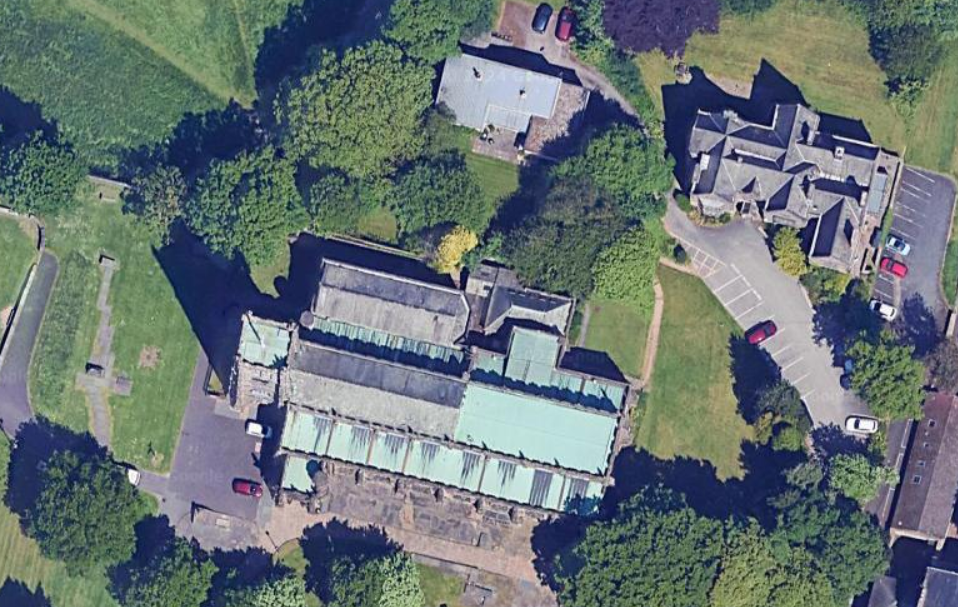
Photograph courtesy of Google Maps
The new priory was not independent, but was a subsidiary of the Benedictine Abbey of St Martin at Seez in Normandy, which Roger’s family had founded. The abbey sent over a small group of French clerics to set up and run the new English monastery. For much of its existence, Lancaster Priory was classed as an ‘alien’ priory, with the profits being sent back to the Seez. Records show that around 50 marks a year would go to the Normandy abbey’s coffers.
For income, de Poitou endowed the priory with grants of land in Preston and Poulton le Fylde. He also provided it with the tithes of nineteen local townships. As the major land owner of most of the land between the Ribble and the Mersey, two years before he had gained the land north of the Ribble up to Lancaster’s River Lune. Records show that the monks received a varied range of goods in tithe tax, including calves, lambs, goats, pigs, hens, corn, butter, cheese and pepper. In 1133, the Abbot of Seez received permission from the Pope to receive voluntary tithes from local people and in return the Lancaster monks would pray for them.
Disputes
In common with many monasteries, the priory was frequently in litigation with neighbouring establishments. These included disputes with the Leper Brothers of St Leonardsgate in the town, and the abbeys of Cockersand and Stanlaw. A conflict with Furness Abbey over fishing rights in the River Lune came to blows. Furness was required to give a third of its catch to Lancaster Priory. This was defined as a third throw of each net, clearly a rather unworkable arrangement. In 1314, a fight broke out between the priory servants and the abbey’s fishermen.
A much more serious incident occurred in late December 1330. Prior Ralph Courait, together with a group of the priory servants, was attacked and abducted by armed men in the service of Sir Adam Banastre. Banastre was a substantial land owner in Poulton and was aggrieved by the presence of the monastery’s men on his land. He complained that the priory men used the Wyre fords to drive their cattle across, often to the detriment of the crops on his farmland. On the day in question, the prior was visiting tenants in Poulton when he and his men were captured. They were taken to Thornton, and held there for almost two weeks. In captivity they were badly treated, some of the men suffering wounds that meant they were unable to work for a considerable time afterwards.
Good Times and Terrible Times
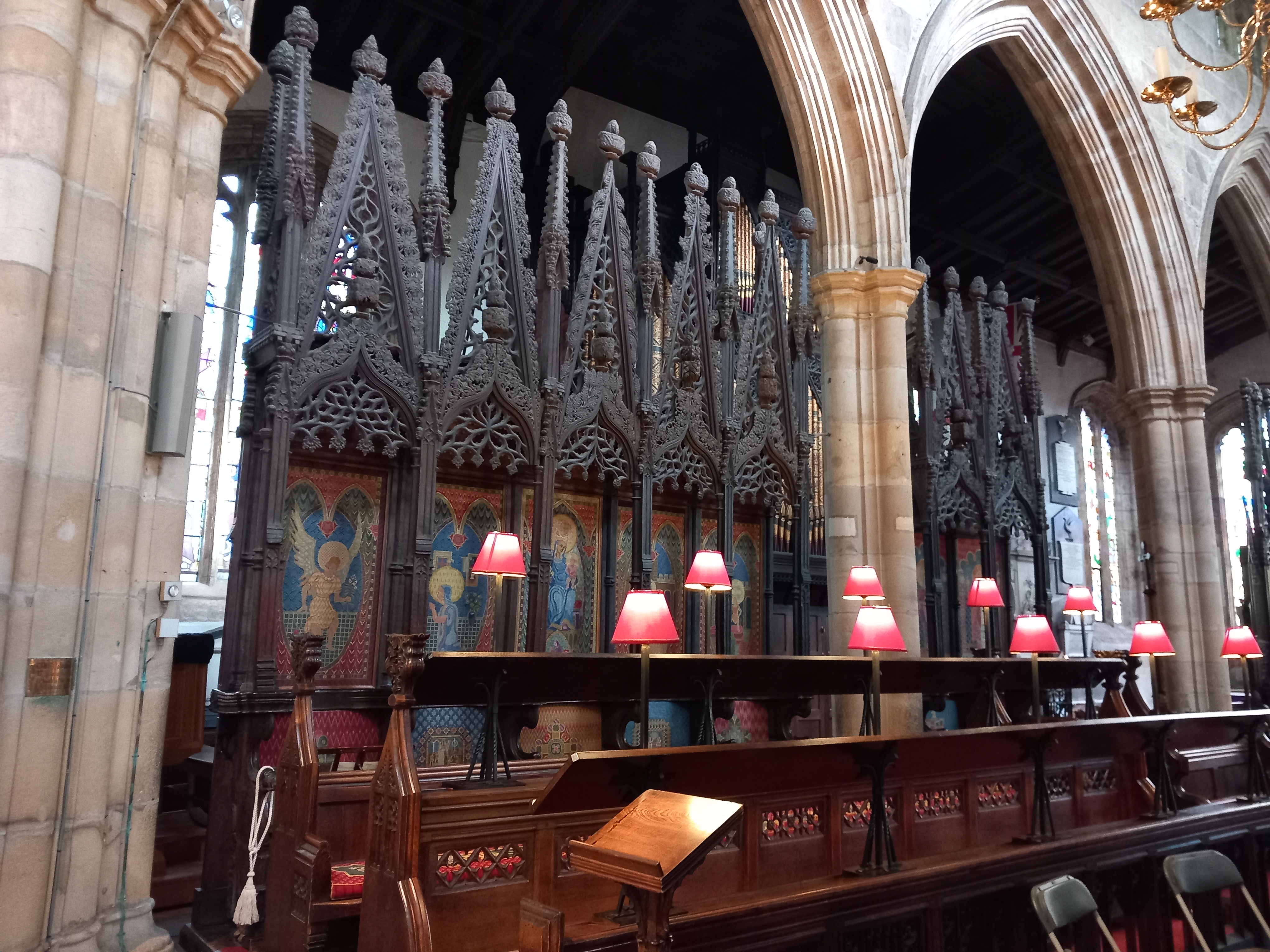
During the 1300s, the town of Lancaster had mixed fortunes. It had been granted the right to hold a market at the start of the century, which would have given a huge boost to the town’s trade and wealth. It was severely damaged during the Scottish raid of Robert the Bruce in 1322. The local chronicler Holinshed wrote how the Scots “came to Lancaster, which town they also burnt, save onlie the priorie of black monks, and a house of preaching friers”. However, the town was able to recover and to elect its first mayor in 1337, further boosting its status. It is around this time that the stunning choir stalls and misericords (monk’s seats with elaborate carvings beneath them) that can still be seen at the church today, were installed.
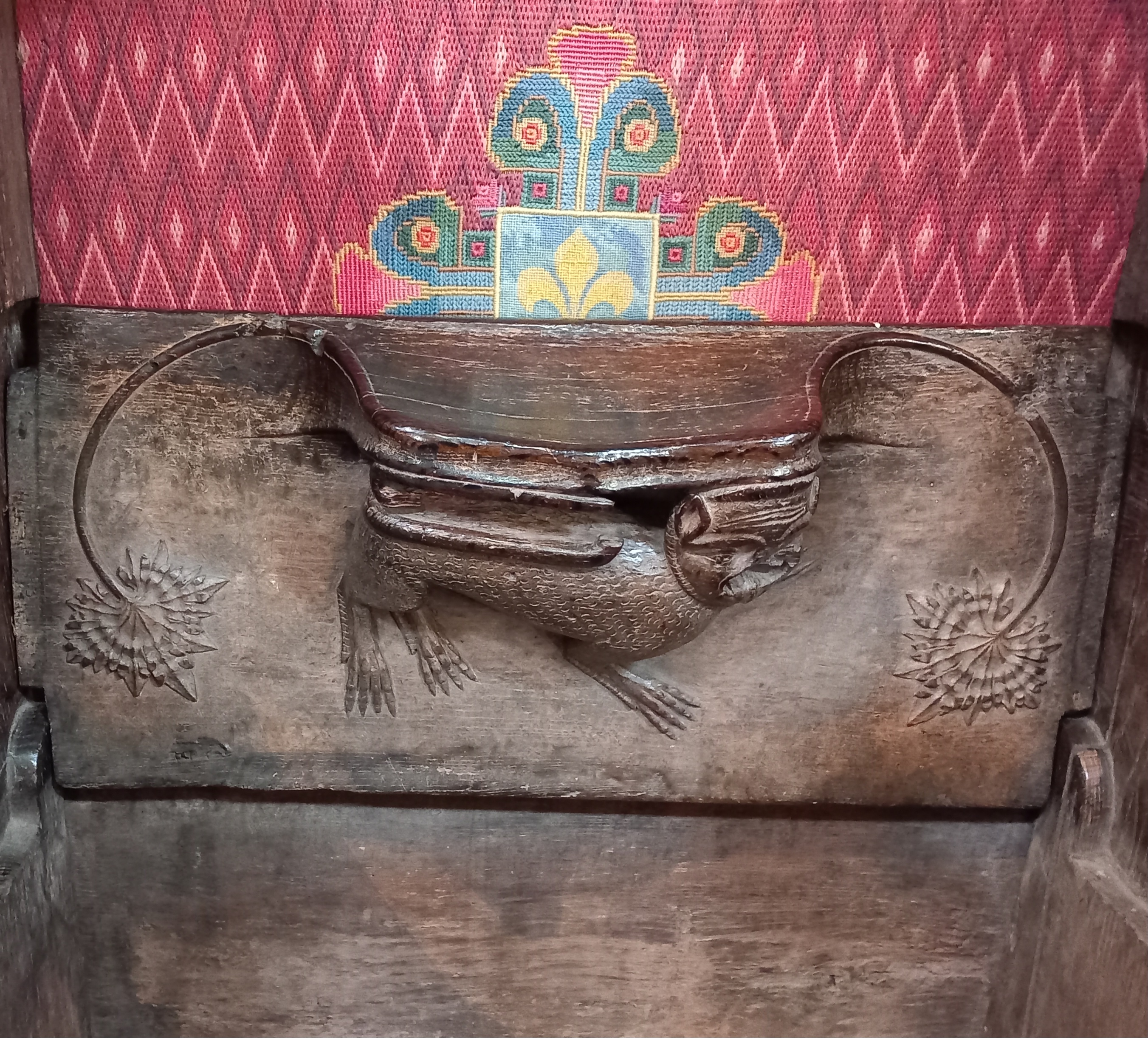
In Misericords of North West England, John Dickson puts forward the idea that the first mayor, John de Bolton, may have commissioned these to signal Lancaster’s rising status. Indeed, one carving shows a man with curly hair and large moustache, wearing rich clothes, that could well be him, or another wealthy benefactor. These carvings are the earliest of their type in the north west. The wood carvers have created intricate and delicate work above the choir seats, and on the misericords themselves are animals, monsters and people caught up in narratives.
Much of the meaning of these figures and scenes is lost to us now, but some can be interpreted, and were presumably put in place for the monks’ edification and education. Two scenes seem to show monastic life, one being figures attending a baptism, the other being a monastic school. Two other panels seem to show moral teachings of the time. The first is of a king, head slightly bowed, shoulders hunched, looking down, not a regal pose at all. Beside him is a monstrous creation known as a ‘groinhead’ a creature that is just a head on legs, not something that would normally be placed near a king. The second shows a noble woman in the act of recoiling from something (the details of which have been damaged), while nearby an angel squats in a suggestive pose. Both of these panels hint at impropriety, something the monks’ minds perhaps would stray to, or meditate on. Unfortunately, the full meaning of these scenes is hard to interpret, as they have been badly vandalised by Protestant reformists in later centuries. Most of the figures, humans and animals have been scarred across the face and in some places decapitated by pious believers during the time of religious intolerance amongst Christians sects.
What strikes some contemporary commentators as odd is that there are fourteen individual stalls for the monks, which seems too many as the priory was never that large. Indeed, some have argued that they were installed at a later date, with Cockersand Abbey being a leading contender for their origin. However, John Dickinson in his book makes a very strong case for them being created for Lancaster Priory in 1340, and the reader is directed to that excellent publication if they wish to see his evidence laid out before them.
Just nine years after their installation, the Black Death arrived at Lancaster, and it is estimated that of the 3000 people living within the town, a third would have died. How this impacted the monastery is not clear, but records show that by 1374 it was staffed by the prior, five monks, two chaplains and two clerks.
Syon Abbey Take Possession
With the advent of the Anglo-French wars, it was only a matter of time before the connection between Lancaster Priory and the Abbey of Seez was severed. In 1414, King Henry V abolished all alien monasteries, so that they could no longer send money to mother houses abroad. Over a hundred were closed throughout the country. He handed Lancaster Priory to the Bishop of Durham to decide its future. It was decided that the newly founded Syon Abbey in Middlesex would receive Lancaster’s revenue, which perhaps not coincidently had just been created by the king. This establishment had both nuns and monks in its service and was ruled over by an abbess. It was the only house dedicated to the Swedish St Bridget in the country, and would in time become the wealthiest of all monasteries.

Lancaster Priory continued as a monastery for a few more years, but with the death of its prior Giles Lovel, this status was taken away. By 1430, it had become the parish church for Lancaster, with the Abbess of Syon having the right to appoint the vicar. Her agents would now manage the church and its outlying dependent chapels. The vicar was aided by three chaplains at Lancaster, and one each for Gressingham, Caton and Stalmine. Under the ownership of Syon Abbey a major period of rebuilding then occurred, and the church that can be seen today in large part was constructed in that era. The abbey would continue to own the church and its chapels until King Henry VIII destroyed of all monasteries, with Syon being suppressed in 1539. Lancaster Priory has continued as Lancaster’s parish church up to the present day, and its later fascinating history will be the subject of a future post on Lancashire Past.
Visiting Today
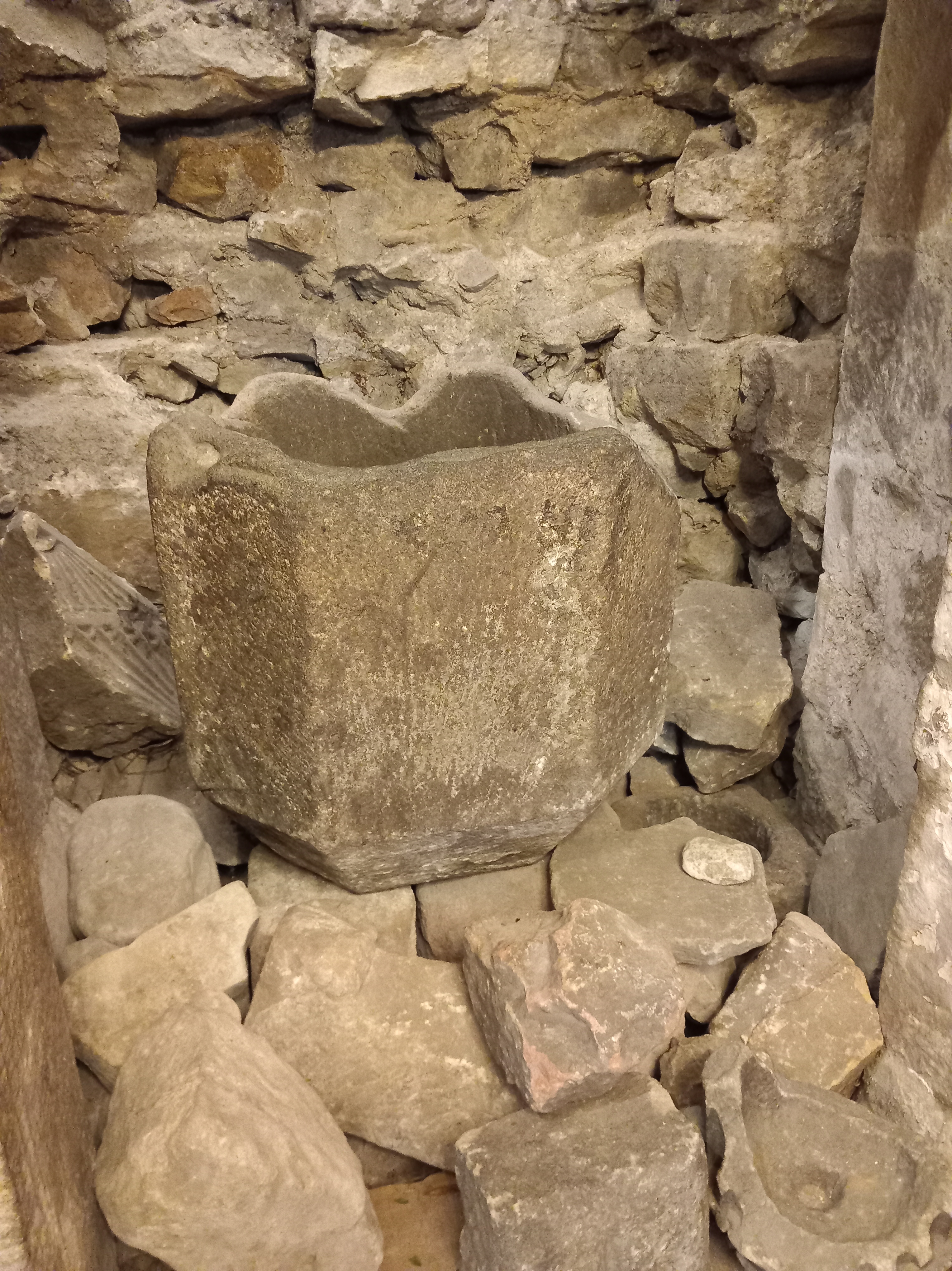
Little remains of the Benedictine church from the earliest days of the priory, but the wall next to the tower has an early doorway that could date from this time. A small octagonal font that was found in the vicarage garden stands amongst carving and blocks, again which could be from the earlier church. Another early feature is the ‘Crusaders Casket’ that was discovered on the site of the vestry and is now displayed on its west wall. Carved into it is a sword and a cross.
The most impressive internal feature of the church from its time as a monastery are its spectacular Medieval choir stalls and misericords, dating from around 1340. These really do repay dividends on careful inspection. The backs of the choir stalls are all different, but as John Dickinson explains in above mentioned book, they are very ‘flat’. That is, they do not have large overhanging canopies that are seen on later examples. This is because they are the earliest set of carvings of this type in the north-west, and the wood carvers were still developing their technique. Later craftsmen would use mortise and tenon joints to enable heavy wood carvings to extend out and overhang the monks’ seats.
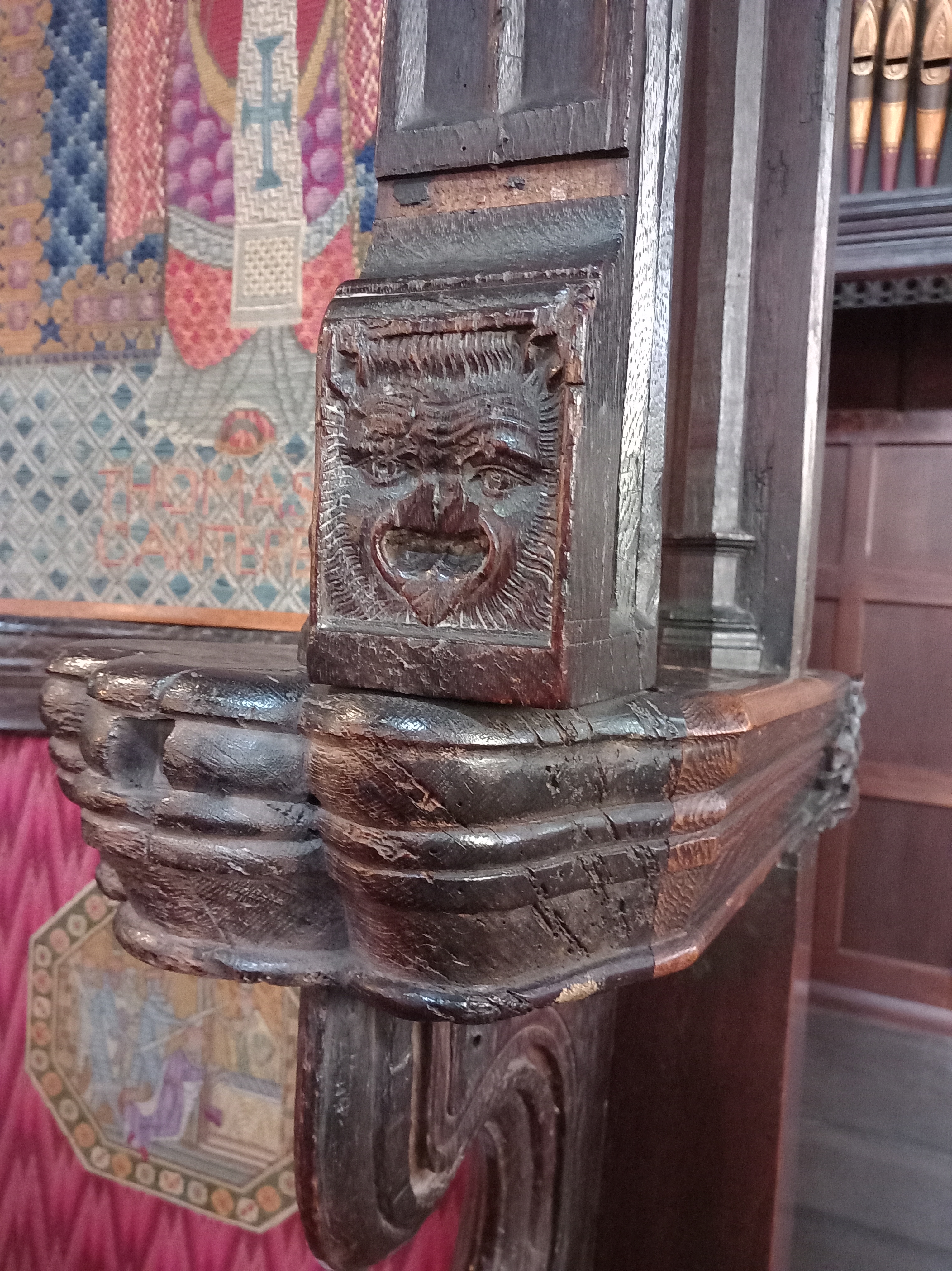
Likewise the carvings of the misericords, although skilled, show the difference between earlier and later techniques. At Lancaster, most of the wood has been removed so the the figures are appearing on a flat background. In later styles, the wood is retained and the figures are carved around a curved block that supports the seat. Later misericords are also designed to be viewed while looking down from above, but the Lancaster ones were made to be viewed face on, which would require a person to lie down on the floor to get to the right eye level. (John Dickinson’s book has been invaluable in supplying information for this page, and at the time of writing is available at a bargain price at Lancaster University’s website- see the Reference section below).
There is much more to be seen within the church from its later history. This will be discussed in a future post on this site.
Site visited by A. and S. Bowden 2024
Access
Open 10am- 4pm Monday through to Saturday
Paid parking is available in the many Lancaster City car parks
Nearby
Lancaster Castle: The Fortress
Lancaster Castle: The Prisons and Courts
Lancaster’s Custom House and Maritime Museum
A drive away
References
Lancashire’s Medieval Monasteries, Brian Marshall (2006) Landy Publishing
Misericords of North West England: Their significance and nature, John Dickinson (2008) Centre for North West Regional Studies, University of Lancaster. This book gives a guide to the choir stalls and misericords throughout the Lancashire region, and is an invaluable guide. New copies can still be bought from the Lancaster University website – see here.
Lancaster Priory, Marion E. McClintock (1980) Pitkin Pictorials
Poulton-le-Fylde Parish Church: A short guide and history, Peter Fox and Christine Storey (2004) Ashton Printers, Fleetwood
On site interpretation at Lancaster Priory
en.wikipedia.org/wiki/Roger_the_Poitevin
hslc.org.uk/wp-content/uploads/2017/05/117-14-Schofield.pdf
specialcollectionsarchive.exeter.ac.uk/exhibits/show/syon-abbey/
en.wikipedia.org/wiki/Syon_Abbey
 Lancashire Past
Comments are closed.